Tunica Albuginea: The Tough Layer of the Penis and Testicles
In short
- The tunica albuginea is a tough, white, fibrous layer.
- In the penis, it wraps the two erectile chambers and becomes tight during an erection, squeezing the draining veins so the penis stays firm.
- In the testicles, it's the strong capsule around each one.
- Scarring of this layer causes Peyronie's disease, and a tear in it during an erection is a penile fracture.
The tunica albuginea (TOO-nih-kuh al-byoo-JIN-ee-uh) is a tough, white, fibrous layer. Its name is Latin for "white coat". There are two of them in the male body: one around the erectile tissue of the penis, and one around each testicle.
In the penis, it's what makes an erection firm. It wraps the two spongy chambers that fill with blood and, when they swell, it tightens and squeezes the veins that would otherwise drain the blood away. When this layer scars, the penis can curve or dent, as in Peyronie's disease. When it tears during an erection, that's a penile fracture. This page explains the tunica albuginea, how it works and what can go wrong.
By the numbers: of the 6,026 men who shared their experiences with hard flaccid syndrome, 2,661 described their symptoms, and 411 of them described hourglassing or indents.
Key facts
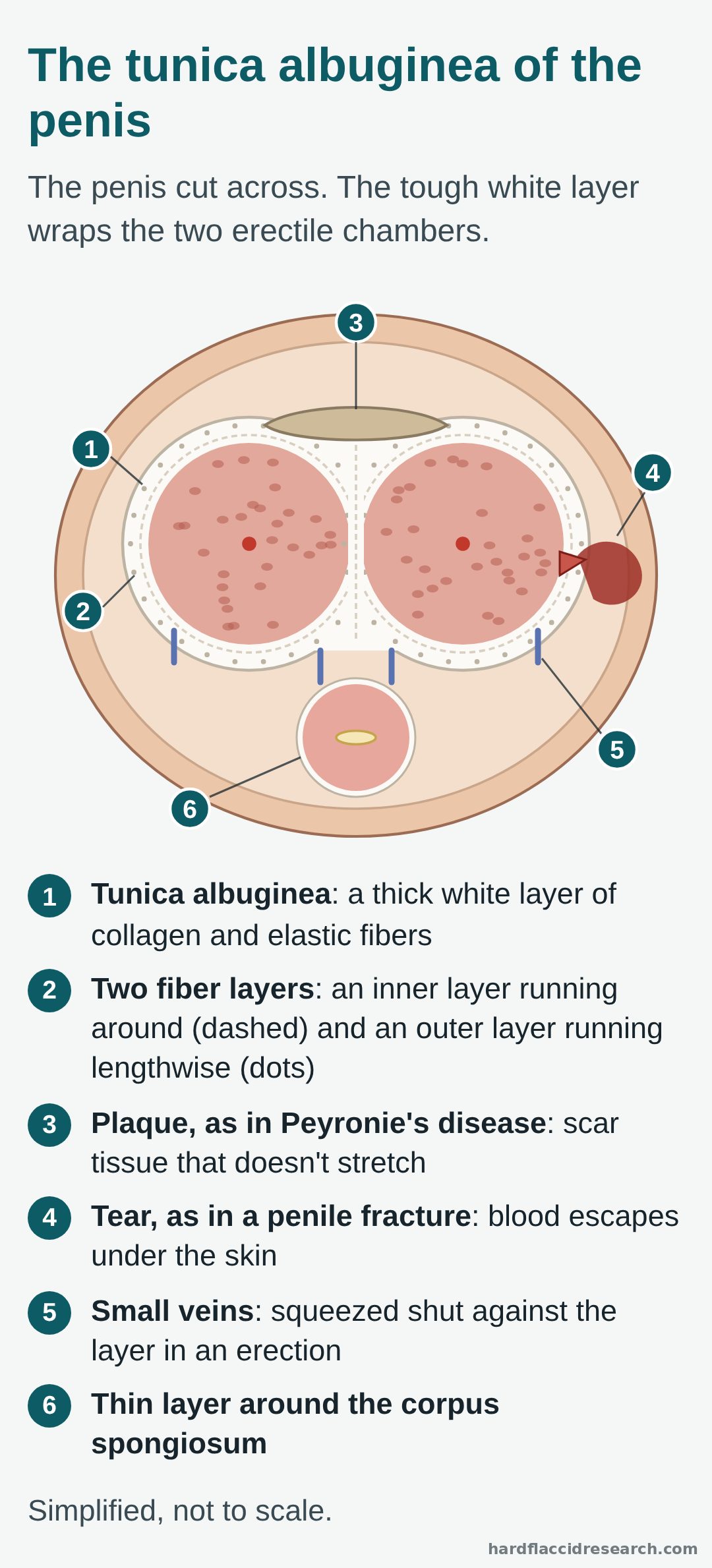
- The tunica albuginea of the penis wraps the two corpora cavernosa, the chambers that fill with blood in an erection.
- It's made mostly of collagen, with elastic fibers that let it stretch.
- It has two layers: an inner layer whose fibers run around the penis and an outer layer whose fibers run along it.
- In an erection, it stretches tight and presses the draining veins shut, trapping blood so the penis stays rigid.
- A scar in it, called a plaque, causes Peyronie's disease: a curve, dent, narrowing or shortening.
- A tear in it during an erection is a penile fracture, which is an emergency.
- Each testicle also has its own tunica albuginea, a strong capsule that protects it.
What is the tunica albuginea?
In the penis
The penis has three columns of erectile tissue: two corpora cavernosa along the top and the corpus spongiosum underneath, which carries the urethra. The tunica albuginea is a thick, strong sheath around the two corpora cavernosa, with a wall (the septum) between them. Around the corpus spongiosum it's much thinner, which keeps the urethra open during an erection and the glans softer than the shaft.
Its two layers work like a woven fabric. The inner, circular layer gives strength around the penis, and the outer, lengthwise layer gives strength along it. The outer layer is thinner on the underside, which is one reason fractures often happen on the underside or the side.
In the testicle
Each testicle is wrapped in its own tunica albuginea, a dense white capsule. It protects the delicate tubes inside, and it sends thin walls inward that divide the testicle into small sections called lobules.
Related: Hourglass Dent in Your Penis? The Hard Flaccid Link »
How does the tunica albuginea help an erection?
- Nerves release nitric oxide, and the smooth muscle in the corpora relaxes.
- Blood rushes in and the corpora swell.
- The swelling stretches the tunica albuginea and presses the small veins that pass through and under it flat against it.
- With the exits squeezed shut, blood is trapped and pressure rises, making the penis rigid.
- When the smooth muscle tightens again, blood flows in more slowly, the pressure falls, the veins reopen and the penis softens.
Because the tunica albuginea is strong but only slightly stretchy, it also sets the shape and length of the erect penis.
What can go wrong with the tunica albuginea?
Peyronie's disease
In Peyronie's disease, scar tissue (a plaque) forms in the tunica albuginea, often after small, repeated injuries during sex. The scar doesn't stretch, so the erect penis curves towards it or develops a dent, a narrowing (hourglassing) or shortening. It can cause pain in the early phase and make sex difficult. US urology guidelines describe it as fibrosis of the tunica albuginea, and treatments include injections into the plaque, traction devices and surgery for stable cases.
Penile fracture
If an erect penis is bent sharply, usually during sex, the pressure inside can tear the tunica albuginea. Men describe a cracking or popping sound, sudden pain, a quick loss of erection and rapid swelling and dark bruising. It's an emergency, and surgery to repair the tear protects erections and the urethra.
Venous leak
If the tunica albuginea or the tissue under it doesn't press the veins shut properly, blood drains away and erections fade quickly. Doctors call this veno-occlusive dysfunction. Weak or damaged tunica tissue is one possible cause.
Congenital curvature
Some men are born with one side of the tunica albuginea longer than the other, so the penis has always curved when erect. This isn't Peyronie's disease and is usually only treated if it makes sex difficult.
In the testicle
A hard injury can tear the tunica albuginea of a testicle, called a testicular rupture. It causes severe pain and swelling and needs urgent surgery.
Related: Jelqing: Does It Work? Side Effects & Risks »
How to protect the tunica albuginea
Most injuries to this layer happen during sex, when an erect penis bends suddenly. You can lower the risk:
- Take care with positions where the penis can slip out and hit a partner's body, and slow down if you lose your rhythm.
- Use plenty of lubricant.
- Don't bend an erect penis forcefully, for example to push it down.
- Avoid jelqing, clamping, pumps and other devices sold to enlarge the penis, which can injure the tunica and the tissue under it.
- Stop straight away and get urgent care if you hear a crack or feel sudden pain.
- Look after your blood vessels, with exercise, no smoking and good sleep, which keeps the tissue healthy.
The tunica albuginea and hard flaccid syndrome
Hard flaccid syndrome is a firm, shrunken penis at rest, often with numbness, weaker erections and pelvic pain. Many men with hard flaccid worry about dents or hourglassing, especially when the penis is soft.
Of the 2,661 men who described their symptoms, 35% described weaker or lost erections (926 men), 15% described hourglassing or indents (411 men) and 10% described a new curve (256 men). In a separate count, 64 men asked whether it's Peyronie's disease instead. An indent that's only visible when the penis is soft is different from a Peyronie's plaque, which is usually felt as a firm lump and shows during an erection. A urologist can tell them apart.
Our members' guide, Weak Erections With Hard Flaccid: The Gentle Way Back to Sex, covers rebuilding erection confidence step by step.
How do doctors check the tunica albuginea?
- An examination of the penis, feeling for a plaque or a gap.
- Photos of the erect penis taken at home, which help show a curve or dent.
- An ultrasound scan, often a penile Doppler scan after an injection that causes an erection, which shows plaques, calcium in them, tears and blood flow.
- An MRI scan, sometimes, if a fracture is suspected.
Our doctor visit kit helps you describe any curve, dent or pain clearly.
When should I see a doctor?
See a primary care provider or a urologist (a doctor for urinary and sexual health) if you notice a new curve, dent, lump, narrowing or shortening of the penis, pain during erections, or erections that fade quickly.
Get urgent care straight away (call 911 or go to the emergency room) if you have:
- A cracking or popping sound during sex or masturbation, followed by sudden pain, a quick loss of erection, or rapid swelling or dark bruising.
- An erection lasting more than 4 hours.
- Sudden, severe pain or swelling in a testicle, especially after an injury.
- Blood at the tip of the penis or trouble peeing after an injury.
Frequently asked questions
Can the tunica albuginea heal?
Small injuries usually heal on their own. A fracture needs surgery to heal properly. In Peyronie's disease, the scar usually stops changing within a year or so, and then treatment can straighten the penis if needed.
Can you stretch the tunica albuginea?
Traction devices, worn for many hours over months, may lengthen or straighten the penis a little in men with Peyronie's disease, under a urologist's guidance. Forceful stretching, jelqing or pumping can injure the tunica and the tissue under it, so avoid them.
Is a dent in a soft penis Peyronie's disease?
Not necessarily. A dent that only shows when soft and disappears in an erection is often just how the soft tissue sits. A dent or curve during an erection, especially with a lump, is more typical of Peyronie's disease.
Does the tunica albuginea get weaker with age?
It can lose some elasticity with age, which may contribute to weaker erections and makes small injuries more likely.
What color is the tunica albuginea?
It's white, which is where the name comes from. It's hidden under the skin and the other layers of the penis.
Takeaway
The tunica albuginea is the tough white layer around the erectile chambers of the penis and around each testicle. In the penis, it tightens during an erection and traps blood by squeezing the veins shut.
Scarring of this layer causes Peyronie's disease, and a tear during an erection is a penile fracture, which is an emergency. Take our free self-check if you also notice changes in your penis at rest.
This article is for general information and isn't a substitute for advice from your own doctor. Hard Flaccid Research doesn't diagnose or treat. If you have new or worsening symptoms, see a qualified clinician. In an emergency, call 911.
Free tools that can help
- Self-check: do I have hard flaccid?Compare your symptoms with what 6,026 men report.
- Doctor visit kitA one-page summary to take to your appointment.
- Habit trackerCount your days without porn or masturbation, and get through urges.
- Diaphragm breathing toolBreathe with a moving picture of your diaphragm and pelvic floor.
- Add your experienceTell us what you tried and how it went. No name needed.
- Hard Flaccid Syndrome CensusWhat men answered in 818 polls.
- Symptom trackerLog your symptoms and see what helps you.
- Ask us a questionThe questions men ask most become new articles.
The numbers behind this article
Every number in this article comes from what men with hard flaccid syndrome shared between December 2020 and October 2026, counted once per person, or from their polls. These are self-selected reports, not a clinical study. See hard flaccid syndrome statistics, the Hard Flaccid Syndrome Census and how we count.
15% of men who described their symptoms described hourglassing or indents
Share of the 2,661 men who described their symptoms. Each man is counted once.These are self-selected reports, not a clinical study. A description can't show whether the tunica albuginea is involved.
Source: Hard Flaccid Research, hardflaccidresearch.com
Every number in this article, with its source
| In this article | Source |
|---|---|
| 10% of the men who described their symptoms described a new curve (256 of 2,661) | 256 of 2,661 men, counted |
| 15% of the men who described their symptoms described hourglassing or indents (411 of 2,661) | 411 of 2,661 men, counted |
| 35% of the men who described their symptoms described weaker or lost erections (926 of 2,661) | 926 of 2,661 men, counted |
| 6,026 men shared their experiences, and 2,661 of them described their symptoms | 2,661 of 6,026 men, counted |
| 64 men asked whether it's Peyronie's disease instead | 64 men asked whether it's Peyronie's disease instead, counted from what men wrote, once per person |
Medical sources
What this article says about medical research, guidelines and urgent care comes from these sources.
- Anatomy, Abdomen and Pelvis, Penis. In: StatPearls. Treasure Island (FL): StatPearls Publishing. https://www.ncbi.nlm.nih.gov/books/NBK482236/
- Dean RC, Lue TF. Physiology of penile erection and pathophysiology of erectile dysfunction. Urol Clin North Am. 2005;32(4):379-395. https://doi.org/10.1016/j.ucl.2005.08.007
- Nehra A, Alterowitz R, Culkin DJ, et al. Peyronie's disease: AUA guideline. J Urol. 2015;194(3):745-753. https://doi.org/10.1016/j.juro.2015.05.098
- Penile Fracture. In: StatPearls. Treasure Island (FL): StatPearls Publishing. https://www.ncbi.nlm.nih.gov/books/NBK551618/
- Gratzke C, Angulo J, Chitaley K, et al. Anatomy, physiology, and pathophysiology of erectile dysfunction. J Sex Med. 2010;7(1 Pt 2):445-475. https://doi.org/10.1111/j.1743-6109.2009.01624.x
- Anatomy, Abdomen and Pelvis: Testes. In: StatPearls. Treasure Island (FL): StatPearls Publishing. https://www.ncbi.nlm.nih.gov/books/NBK470201/
How we made this article
We started from the question many men asked. Every number was checked against our data. Our editorial team edited it and Dr. Julian Reyes reviewed it medically. Read our editorial policy.
Read next
See more of us on Google
Add Hard Flaccid Research as a preferred source, and Google shows you our pages more often when you search.
Add as a preferred sourceDon't see your question? Ask us. We answer the most-asked ones in new articles.
Cite and share this article
You're welcome to quote this article. Please name Hard Flaccid Research and link to this page, so others can find the full answer and the data behind it. To cite this page, use its link.
Citation
Hard Flaccid Research. (2026). Tunica Albuginea: The Tough Layer of the Penis and Testicles. Written by the Editorial Team, medically reviewed by Dr. Julian Reyes. https://hardflaccidresearch.com/articles/tunica-albuginea
Credit link for your article
Source: <a href="https://hardflaccidresearch.com/articles/tunica-albuginea">Hard Flaccid Research</a>
Wikipedia reference
<ref>{{cite web |url=https://hardflaccidresearch.com/articles/tunica-albuginea |title=Tunica Albuginea: The Tough Layer of the Penis and Testicles |website=Hard Flaccid Research |date=2026 |access-date=22 November 2026}}</ref>
How the data was collected: our methodology. Journalists and researchers: key numbers, data and contact.