Vas Deferens: What It Is, What It Does and Common Problems
In short
- The vas deferens is a firm, muscular tube that carries sperm from the epididymis behind each testicle up into the pelvis.
- There it joins the seminal vesicle to form the ejaculatory duct, which opens into the urethra inside the prostate.
- It's the tube cut or blocked in a vasectomy.
- Problems include blockage, pain after a vasectomy and, rarely, being born without it.
The vas deferens is a firm, muscular tube that carries sperm away from the testicle. There are two, one on each side. Each starts at the epididymis, the coiled tube on the back of the testicle, runs up through the scrotum and groin into the pelvis, and ends behind the bladder, where it joins the seminal vesicle.
You can often feel it yourself: it's the firm, smooth cord, a bit like a thin piece of cooked spaghetti, that you can roll between your fingers above the back of each testicle. It's also the tube a surgeon cuts or blocks in a vasectomy. This page explains the path the vas deferens takes, what it does, what can go wrong and when to see a doctor.
By the numbers: of the 6,026 men who shared their experiences with hard flaccid syndrome, 2,661 described their symptoms, and 102 of them described testicle pain or a tight scrotum.

Key facts
- The vas deferens, also called the ductus deferens, carries sperm from the epididymis to the ejaculatory duct.
- Its wall is thick and muscular. During ejaculation it contracts in waves to push sperm forward.
- It runs inside the spermatic cord, together with blood vessels, nerves and the cremaster muscle.
- A vasectomy cuts or blocks the vas deferens on both sides, so semen no longer carries sperm.
- A vasectomy doesn't stop the testicles making testosterone, and semen looks much the same afterwards.
- Some men are born without the vas deferens. This is often linked to changes in the gene behind cystic fibrosis.
- Pain in the vas or the cord can come from infection, a recent vasectomy, a hernia or a strain.
Where is the vas deferens?
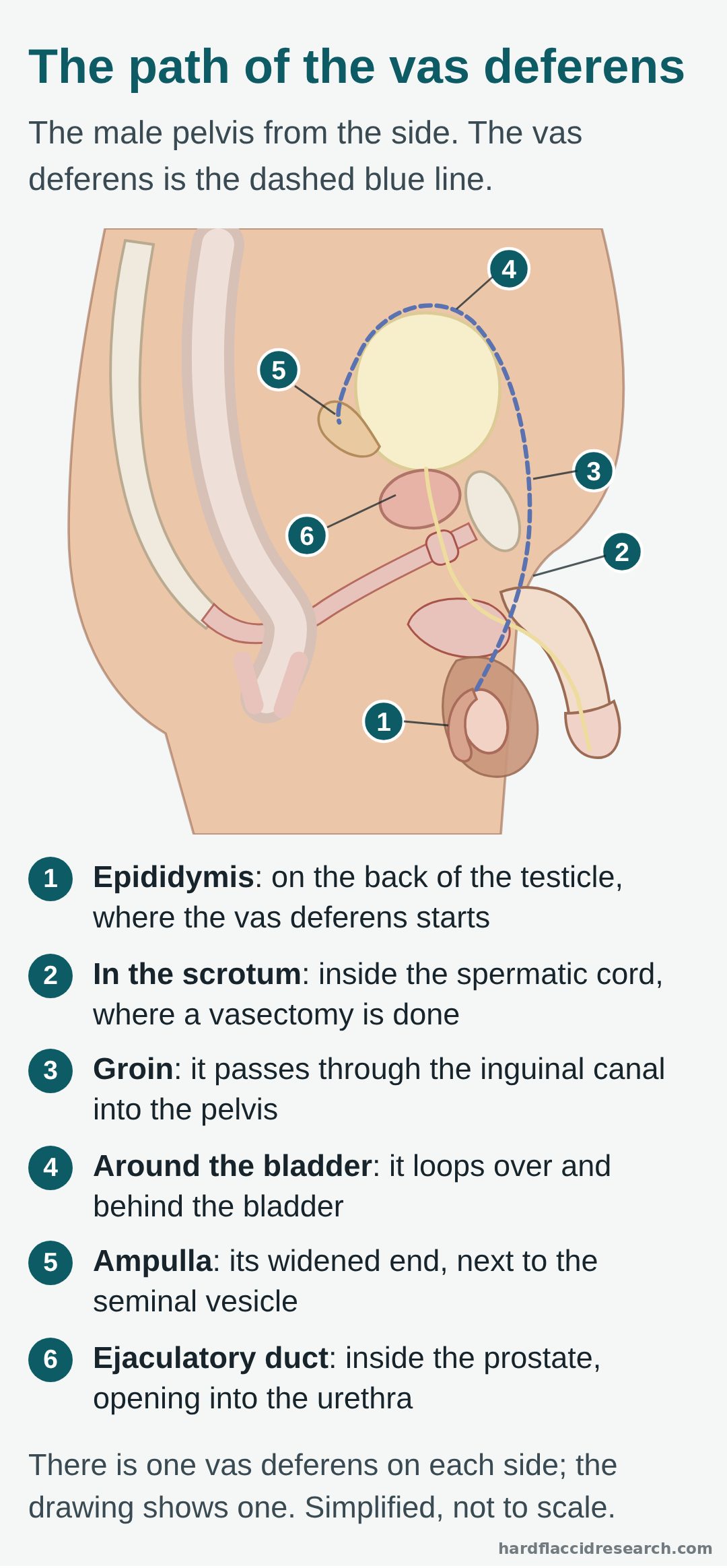
The vas deferens follows a long, looping path:
- It starts at the tail of the epididymis, at the bottom of the back of the testicle.
- It climbs up the back of the testicle inside the spermatic cord, where you can feel it through the skin of the scrotum.
- It passes through the inguinal canal, a short tunnel in the groin, into the pelvis.
- Inside the pelvis it loops over and behind the bladder.
- Near its end it widens into a part called the ampulla, which lies next to the seminal vesicle.
- It joins the duct of the seminal vesicle to form the ejaculatory duct, which runs through the prostate and opens into the urethra.
Related: Testicle Pain After Ejaculation: Causes and When to Worry »
What does the vas deferens do?
It stores and moves sperm
Sperm made in the testicles mature in the epididymis and are stored in its tail and in the first part of the vas deferens. When you ejaculate, the vas moves them up into the pelvis.
It contracts during ejaculation
The vas deferens has a thick, muscular wall. During the first step of ejaculation, called emission, nerves from the sympathetic nervous system make it contract in strong waves. These push sperm into the ejaculatory ducts, where they mix with fluid from the seminal vesicles and prostate.
It carries only a small part of semen
Sperm make up only a small part of semen. Most of the fluid comes from the seminal vesicles and prostate. That's why semen volume barely changes after a vasectomy.
What is a vasectomy?
A vasectomy is a small operation that cuts or blocks the vas deferens on both sides, usually through a tiny opening in the skin of the scrotum. US urology guidelines describe it as a permanent form of birth control.
- It doesn't work straight away. Sperm already past the cut can remain for a while, so you need a semen test, usually a couple of months later, to confirm there are no moving sperm.
- Testosterone still goes into the blood, because it leaves the testicle through the bloodstream, not the vas.
- Erections, orgasm and ejaculation usually feel the same, and semen looks much the same.
- Reversal is possible, but it doesn't always work, so the operation should be thought of as permanent.
- A small number of men have ongoing scrotal pain afterwards, called post-vasectomy pain syndrome.
Related: Alpha Blockers for Hard Flaccid: 45% of Men Said They Help »
What can go wrong with the vas deferens?
Being born without it
Congenital absence of the vas deferens means one or both tubes didn't develop. When both are missing, there are no sperm in the semen. It's often linked to changes in the CFTR gene, the gene behind cystic fibrosis, even in men without other signs of the disease. It's usually found during fertility tests, and men can still father children with fertility treatment.
Blockage
Infection, scarring or past surgery, such as hernia repair in the groin, can block the vas deferens. If both sides are blocked, semen contains no sperm.
Infection
Infections from the urethra or prostate can travel down the vas deferens to the epididymis, causing epididymitis, a painful swelling behind the testicle.
Pain after a vasectomy
Most men recover quickly. A few have long-lasting pain in the testicle or cord, sometimes worse with ejaculation. A urologist can discuss treatment, from medicines to further surgery.
Injury
The vas deferens can be injured during operations in the groin or scrotum, or by a direct blow, though it's well protected by the cord.
Vas deferens and hard flaccid syndrome
Hard flaccid syndrome is a firm, shrunken penis at rest, often with numbness, weaker erections and pelvic pain. There's no evidence that the vas deferens causes hard flaccid. But some men with hard flaccid notice aching in the testicles or cord, or changes in ejaculation, and it helps to know which structure is which.
Of the 2,661 men who described their symptoms, 8% described a weak or painful orgasm or ejaculation problems (202 men) and 4% described testicle pain or a tight scrotum (102 men).
Our members' guide, Hard Flaccid and Doctors: How to Get Taken Seriously, helps you describe symptoms like these clearly at an appointment.
How are problems with the vas deferens checked?
A primary care provider or a urologist (a doctor for urinary and sexual health) will examine the scrotum and can usually feel the vas deferens on each side. They may suggest:
- A urine test and tests for sexually transmitted infections.
- An ultrasound scan of the scrotum.
- A semen test, especially after a vasectomy or if you're trying for a baby.
- Genetic testing, if the vas deferens is missing.
Our doctor visit kit helps you list your symptoms and any past operations in the groin or scrotum.
How does the vas deferens differ from the urethra?
The two are easy to mix up:
- The vas deferens carries only sperm, from the epididymis to the ejaculatory duct. There's one on each side.
- The urethra is a single tube that carries both urine and semen out through the penis.
- The vas deferens ends inside the prostate, where the ejaculatory ducts open into the urethra.
When should I see a doctor?
See a primary care provider or a urologist if you have pain, swelling or a lump in the cord above the testicle, pain that keeps coming back after a vasectomy, or no sperm on a semen test, or if you're trying for a baby without success.
Get urgent care straight away (call 911 or go to the emergency room) if you have:
- Sudden, severe pain or swelling in a testicle, especially with nausea or vomiting. This can be testicular torsion.
- A fever or chills with a painful, swollen scrotum.
- A painful bulge in the groin that won't go back in, especially with vomiting.
- Sudden, severe pain in the penis, testicles or pelvis.
Frequently asked questions
Can I feel my vas deferens?
Usually, yes. Above the back of each testicle, you can feel a firm, smooth cord that rolls between your fingers. That's the vas deferens.
Does a vasectomy affect erections?
A vasectomy only blocks the path of sperm. Testosterone still reaches the blood, and erections, orgasm and ejaculation usually feel the same.
Can the vas deferens grow back after a vasectomy?
Rarely, the cut ends join up again. That's one reason a semen test is done after the operation.
Why does my vas deferens hurt?
Common causes include infection, a recent vasectomy, a strain or a hernia. Persistent pain is worth checking.
Does semen look different after a vasectomy?
Hardly. Sperm make up only a small part of semen, so the amount and look stay much the same.
Can you be born without a vas deferens?
Yes. It's uncommon and usually found during fertility tests. Genetic testing is often offered, because it's linked to the cystic fibrosis gene.
Can a hernia repair affect the vas deferens?
It can, though it's uncommon. The vas deferens runs through the groin, so surgery there can occasionally injure or scar it.
Takeaway
The vas deferens is the muscular tube that carries sperm from the epididymis to the ejaculatory duct. It contracts during ejaculation and is the tube that a vasectomy cuts or blocks.
Pain, swelling or a lump in the cord, or problems after a vasectomy, are worth checking with a doctor. Take our free self-check if you also notice changes in your penis at rest.
This article is for general information and isn't a substitute for advice from your own doctor. Hard Flaccid Research doesn't diagnose or treat. If you have new or worsening symptoms, see a qualified clinician. In an emergency, call 911.
Free tools that can help
- Self-check: do I have hard flaccid?Compare your symptoms with what 6,026 men report.
- Doctor visit kitA one-page summary to take to your appointment.
- Habit trackerCount your days without porn or masturbation, and get through urges.
- Diaphragm breathing toolBreathe with a moving picture of your diaphragm and pelvic floor.
- Add your experienceTell us what you tried and how it went. No name needed.
- Hard Flaccid Syndrome CensusWhat men answered in 818 polls.
- Symptom trackerLog your symptoms and see what helps you.
- Ask us a questionThe questions men ask most become new articles.
The numbers behind this article
Every number in this article comes from what men with hard flaccid syndrome shared between December 2020 and October 2026, counted once per person, or from their polls. These are self-selected reports, not a clinical study. See hard flaccid syndrome statistics, the Hard Flaccid Syndrome Census and how we count.
4% of men who described their symptoms described testicle pain or a tight scrotum
Share of the 2,661 men who described their symptoms. Each man is counted once.These are self-selected reports, not a clinical study.
Source: Hard Flaccid Research, hardflaccidresearch.com
Every number in this article, with its source
| In this article | Source |
|---|---|
| 4% of the men who described their symptoms described testicle pain or a tight scrotum (102 of 2,661) | 102 of 2,661 men, counted |
| 8% of the men who described their symptoms described a weak or painful orgasm or ejaculation problems (202 of 2,661) | 202 of 2,661 men, counted |
| 6,026 men shared their experiences, and 2,661 of them described their symptoms | 2,661 of 6,026 men, counted |
Medical sources
What this article says about medical research, guidelines and urgent care comes from these sources.
- Anatomy, Abdomen and Pelvis: Testes. In: StatPearls. Treasure Island (FL): StatPearls Publishing. https://www.ncbi.nlm.nih.gov/books/NBK470201/
- McKay AC, Odeluga N, Jiang J, Sharma S. Anatomy, Abdomen and Pelvis, Seminal Vesicle. In: StatPearls. Treasure Island (FL): StatPearls Publishing. https://www.ncbi.nlm.nih.gov/books/NBK499854/
- Sharlip ID, Belker AM, Honig S, et al. Vasectomy: AUA guideline. J Urol. 2012;188(6 Suppl):2482-2491. https://doi.org/10.1016/j.juro.2012.09.080
- MedlinePlus Genetics. Congenital bilateral absence of the vas deferens. US National Library of Medicine. https://medlineplus.gov/genetics/condition/congenital-bilateral-absence-of-the-vas-deferens
- Chronic Testicular Pain and Orchalgia. In: StatPearls. Treasure Island (FL): StatPearls Publishing. https://www.ncbi.nlm.nih.gov/books/NBK482481/
- Epididymitis. In: StatPearls. Treasure Island (FL): StatPearls Publishing. https://www.ncbi.nlm.nih.gov/books/NBK430814/
How we made this article
We started from the question many men asked. Every number was checked against our data. Our editorial team edited it and Dr. Julian Reyes reviewed it medically. Read our editorial policy.
Read next
See more of us on Google
Add Hard Flaccid Research as a preferred source, and Google shows you our pages more often when you search.
Add as a preferred sourceDon't see your question? Ask us. We answer the most-asked ones in new articles.
Cite and share this article
You're welcome to quote this article. Please name Hard Flaccid Research and link to this page, so others can find the full answer and the data behind it. To cite this page, use its link.
Citation
Hard Flaccid Research. (2026). Vas Deferens: What It Is, What It Does and Common Problems. Written by the Editorial Team, medically reviewed by Dr. Julian Reyes. https://hardflaccidresearch.com/articles/vas-deferens
Credit link for your article
Source: <a href="https://hardflaccidresearch.com/articles/vas-deferens">Hard Flaccid Research</a>
Wikipedia reference
<ref>{{cite web |url=https://hardflaccidresearch.com/articles/vas-deferens |title=Vas Deferens: What It Is, What It Does and Common Problems |website=Hard Flaccid Research |date=2026 |access-date=22 November 2026}}</ref>
How the data was collected: our methodology. Journalists and researchers: key numbers, data and contact.