What Causes Hard Flaccid? Every Trigger Men Named, Ranked
In short
- Nobody knows for sure what causes hard flaccid syndrome.
- Men named penis enlargement methods most often (155 men), then aggressive or excessive masturbation (125 men) and edging (72 men).
- Doctors think an injury at the base of the penis, a tight pelvic floor and stress may each play a part, and whatever started it, many men get better.
69 men with hard flaccid asked this question.
Hard flaccid syndrome is when the penis stays firm, rubbery or shrunken at rest, often with numbness and weaker erections. Nobody knows for sure what causes it. Many men link it to a strain on the penis, and doctors think a tight pelvic floor and stress may keep it going.
This page ranks the triggers men named, explains how each one may lead to hard flaccid, and covers what the cause means for getting better.
By the numbers: of the 6,026 men who shared their experiences between December 2020 and October 2026, 69 asked what causes it. What men named and what they answered in our polls are self-selected reports, not a clinical study.

Key facts
- No cause of hard flaccid syndrome is proven yet, and the research is small: case reports, case series and surveys.
- Men named penis enlargement methods most (155 men), then aggressive or excessive masturbation (125 men) and edging (72 men).
- Not every man recalls an injury. In a November 2022 poll, 26% said their symptoms began out of the blue (28 of 108 men).
- Doctors think an injury at the base of the penis, a tight pelvic floor and stress may each play a part.
- Whatever started it, many men improve. In a June 2023 poll, 42% said they were at least half better (56 of 132 men).
Hard Flaccid Explorerby Hard Flaccid Research
What causes hard flaccid?
A 7-minute animated explainer of this article. Press play, or skip between chapters. The first minute is free for everyone.
A picture to explain, not a diagnosis. Nobody knows for sure what causes hard flaccid, and the drawing shows the ideas doctors discuss, not proven steps.
What causes hard flaccid syndrome?
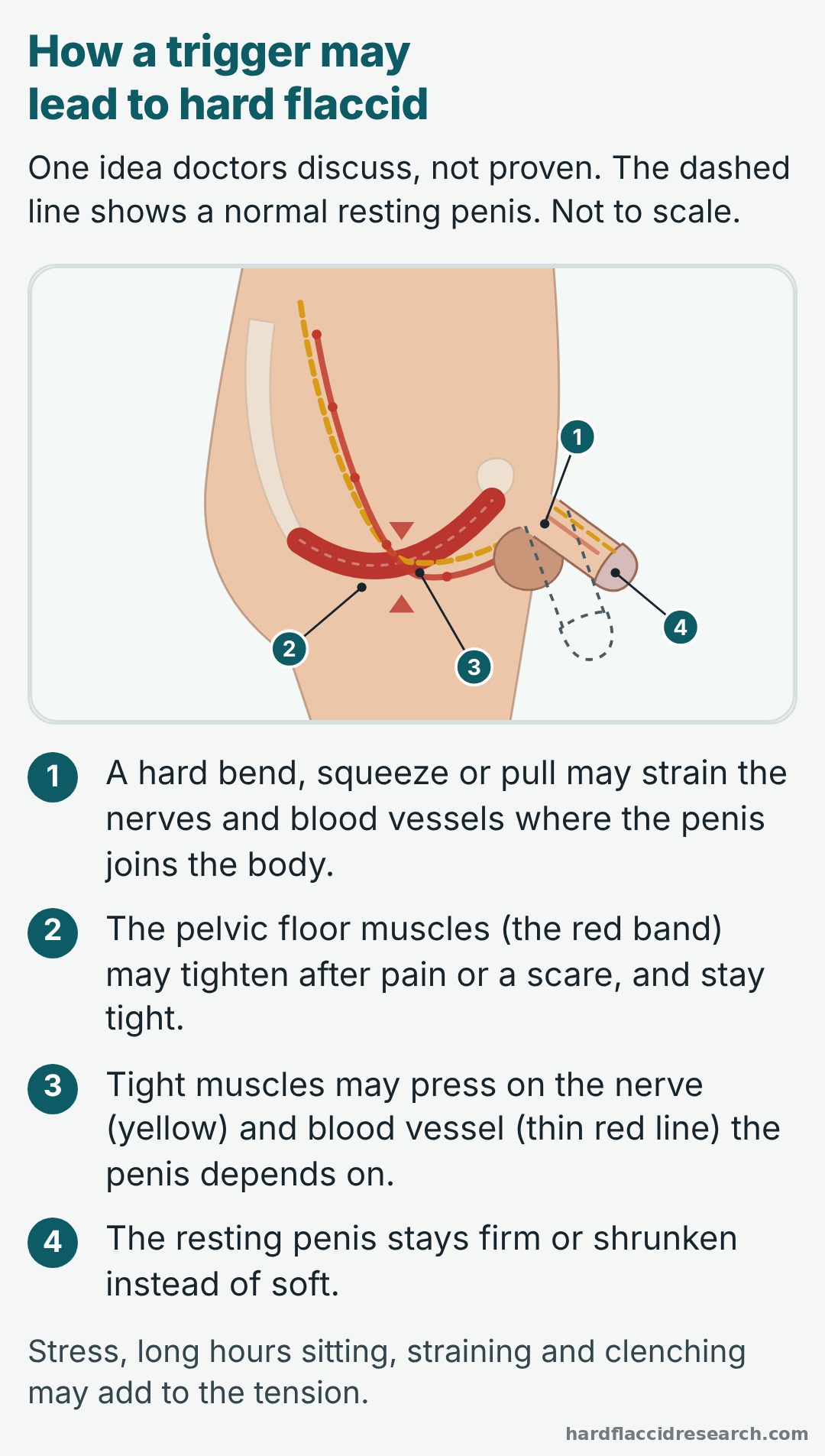
Specialists think hard flaccid syndrome often starts with an injury to the base of the penis, during sex or forceful masturbation. That injury may affect the nerves and blood vessels there, and a tight pelvic floor and the stress response may then keep symptoms going.
Doctors first described hard flaccid in a medical journal in 2020, in a small report of men whose symptoms began after an injury during sex or vigorous masturbation. A recent review of the published studies proposed that a first injury may set off changes in nerves, blood vessels and inflammation. Distress may then keep the cycle going, but most of those studies were case reports or very small case series, so this is still a theory.
In a published survey of men with hard flaccid, more than half linked their symptoms to a specific incident or injury. The rest didn't, so the authors suggested an injury may not be the only route in.
Related: Death Grip Syndrome: Is It Real? What 125 Men Say »
What are the triggers men named most?
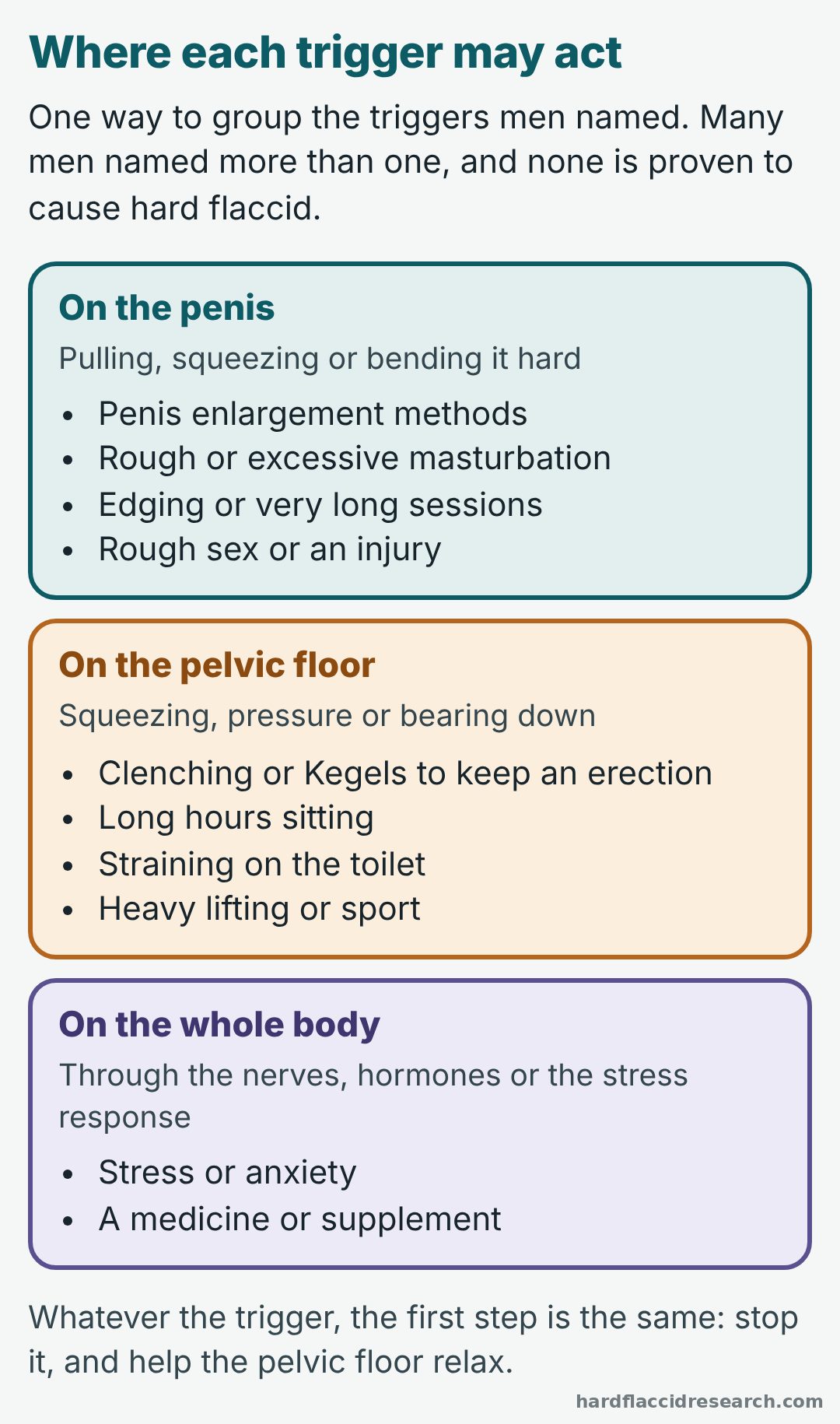
Men named penis enlargement methods most (155 men), then aggressive or excessive masturbation (125 men) and edging (72 men). We counted what men wrote about how their hard flaccid syndrome began, once per person. Here are all eleven triggers, from most to least named.
1. Penis enlargement methods: 155 men
Jelqing, pumps, extenders, hanging weights and clamping pull, squeeze or stretch the penis hard. Doctors think this may strain the tissue, nerves and small blood vessels at the base. Of the 155 men who named them, 70% described the firm flaccid state and 50% numbness.
Stop any enlargement method, and never use one to try to fix hard flaccid syndrome.
2. Aggressive or excessive masturbation: 125 men
This means a tight grip, rough or very long sessions, or masturbating many times a day. Of the 125 men who named it, 78% described the firm flaccid state and 62% numbness. Masturbation can also make symptoms flare: in a February 2023 poll, 78% said they were worse after masturbation or sex (92 of 118 men).
3. Edging or very long sessions: 72 men
Edging means stopping just before orgasm, again and again, to make a session last. One idea is that holding back over and over trains the pelvic floor to clench. Of the 72 men who named edging, 46% described pelvic floor tension.
4. A medicine or supplement: 38 men
Some men linked hard flaccid syndrome to a medicine or supplement. In a March 2023 poll, 4% named DHT blockers, such as the hair loss medicine finasteride or the supplement saw palmetto (6 of 164 men). Another 4% named recreational drugs (6 of 164 men).
Talk to a doctor first: never stop a prescribed medicine on your own, because stopping some medicines suddenly can be dangerous. Ask the doctor who prescribed it.
5. Stress or anxiety: 37 men
Some men felt their symptoms began during a very stressful time. Stress may tighten the pelvic floor, much as it tenses the jaw or shoulders. Of the 37 men who named stress, 41% described pelvic floor tension.
In an April 2023 poll, 76% said they had anxiety before hard flaccid syndrome (94 of 123 men), though that doesn't show anxiety caused it. Slow belly breathing may help your pelvic floor let go.
If hard flaccid is wearing you down, or you're thinking about suicide, call or text 988, or visit our Support page for more crisis lines. If you can't keep yourself safe, call 911.
6. Rough sex or a direct injury: 34 men
This includes the penis bending hard during sex, a fall, or a blow to the penis or the area between the legs. It fits the first medical reports, which described symptoms starting after an injury during sex. In a November 2022 poll, 11% named a blow or other injury (12 of 108 men).
7. Clenching or Kegels to keep an erection: 27 men
Some men squeezed their pelvic floor during sex to get or keep an erection, often as a habit over months or years. Doctors think too much squeezing may leave these muscles tight and unable to relax.
If your pelvic floor feels tight, ask a pelvic floor physical therapist before doing Kegels, and let go fully between squeezes.
8. Long hours sitting: 24 men
Desk jobs, gaming and long drives may put steady pressure on the pelvic floor and the pudendal nerve (pyoo-DEN-dul), the main nerve between the legs. Of the 24 men who named sitting, 58% described pelvic floor tension. Stand up and move every half hour or so.
9. Straining or constipation: 23 men
Pushing hard on the toilet bears down on the pelvic floor. Of the 23 men who named straining, 61% described bowel symptoms. Fiber, water and not rushing on the toilet may help you strain less.
10. The gym, heavy lifting or sport: 14 men
Heavy lifts, bracing and hard landings load the pelvic floor. Of the 14 men who named them, 57% described pelvic floor tension. Many physical therapists suggest breathing out as you lift, rather than holding your breath.
11. No clear cause or a sudden start: 8 men
A few men described symptoms that came on with nothing they could name. The polls below found this more often.
What did men say in our cause polls?
Three polls asked men what started their hard flaccid syndrome. Each offered different answers, so their numbers can't be added together. Masturbation came first in all three:
- November 2022: 42% named aggressive masturbation (45 of 108 men) and 26% a random start (28 of 108). Others named a blow or other injury, 11% (12 of 108), or penis extension methods, 9% (10 of 108). Fewer named jelqing, 7% (8 of 108), or aggressive sex, 5% (5 of 108).
- March 2023: 41% named masturbation, including excessive Kegels (68 of 164 men), and 29% didn't know or named something else (47 of 164). Others named enlargement methods, 16% (26 of 164), or a fall or body injury, 7% (11 of 164).
- October 2023: 50% named over-masturbation (68 of 137 men), 28% an enlargement injury or jelqing (38 of 137) and 23% another injury (31 of 137).
Our counts of what men wrote put enlargement methods first. The difference may come from how each was asked: polls offer fixed choices, while the counts come from men's own words.
Related: Hard Flaccid Out of Nowhere? 28 of 108 Men Never Knew Why »
How could a trigger lead to hard flaccid?
Specialists discuss a few main ideas, and they may work together:
- An injury at the base of the penis. A hard bend, squeeze or pull may strain the nerves and blood vessels where the penis joins the body.
- Overactive nerve signals. Specialists think the nerves that control blood flow in the penis may become overactive after an injury, upsetting the balance between soft and firm.
- A guarded pelvic floor. After pain or a scare, the pelvic floor muscles may tighten and stay tight, pressing on the nerves and blood vessels the penis depends on.
- A reflex loop. In a 2023 article for urologists that wasn't peer reviewed, specialists proposed that an overactive nerve reflex in the pelvis may keep the penis semi-firm.
Posture changes things for many men. In a March 2023 poll, 86% said it was harder when standing than lying down (54 of 63 men). That fits the idea that pelvic floor tension plays a part.
Who is more likely to get hard flaccid?
Hard flaccid syndrome is mostly reported by young men. In a July 2023 poll, 68% first noticed it between the ages of 19 and 30 (80 of 118 men). Another 21% noticed it between 10 and 18 (25 of 118), 11% between 31 and 45 (13 of 118), and none after 45.
Men who named a trigger described these habits before their symptoms began:
- Enlargement methods, rough or very frequent masturbation, and edging.
- Squeezing the pelvic floor during sex, or doing a lot of Kegels.
- Long hours sitting, straining on the toilet and heavy lifting.
- Stress or anxiety.
Does the cause change how you get better?
Mostly, no. Whatever started it, the first step is the same: stop anything that may keep irritating it, such as enlargement methods, rough masturbation, edging or clenching. Then help the pelvic floor relax with gentle stretching, slow belly breathing and reverse Kegels, a gentle letting go, never a push.
Many men improve. In a June 2023 poll, 42% said they were at least half better (56 of 132 men), including 11% who were about 90% better or fully healed (14 of 132). Men who recover may stop answering polls, so these numbers may undercount recovery.
Men who shared stories of getting better most often credited stretching, which came up in 40 of the 126 recovery stories. A break from masturbation and porn came up in 28 of the 126, and reverse Kegels or pelvic floor relaxation in 20 of the 126. In a June 2023 poll, 51% of men who had tried a break said it helped at least some (39 of 77 men).
A pelvic floor physical therapist can check whether your pelvic floor is tight and teach you to relax it. US guidelines on pelvic pain in men say doctors may offer this hands-on therapy. In a November 2022 poll of men who had seen one, 36% said it helped quite a bit or cured them (17 of 47 men).
Our members' guide, New to Hard Flaccid? What 6,026 Men Wish They'd Known, sets out first steps week by week.
When should I see a doctor?
See a primary care provider or a urologist if symptoms started after an injury, or haven't settled within a few weeks of stopping the trigger. Other conditions can look similar, such as Peyronie's disease, venous leak, pudendal nerve problems and prostatitis. Some of them respond best to early care.
Some men find it hard to be taken seriously, so it helps to prepare. Our doctor visit kit helps you explain your symptoms.
Get urgent care straight away (call 911 or go to the emergency room) if you have:
- A popping or cracking sound during sex or masturbation, followed by sudden pain, a quick loss of erection, or rapid swelling or dark bruising.
- A penis that turns dark, blue or black, or swells badly after a pump or clamp.
- An erection lasting more than 4 hours.
- Blood in your urine that you can see.
- Sudden, severe pain in the penis, testicles or pelvis.
- New numbness around your back passage, genitals or inner thighs, or new weakness in your legs.
- New trouble starting or controlling your pee, not being able to pee, or not feeling when your bladder is full.
- Loss of control of your bladder or bowel.
- A fever or chills with pelvic pain or pain when peeing.
Frequently asked questions
Can masturbation cause hard flaccid?
It may play a part. Aggressive or excessive masturbation was the second trigger men named (125 men), and masturbation came first in all three cause polls. Doctors think rough or very long sessions may strain the penis or tire the pelvic floor, but gentle masturbation isn't known to cause hard flaccid syndrome.
Can Kegels cause hard flaccid?
Possibly, if they're overdone. Clenching or Kegeling to keep an erection was named by 27 men, and one poll counted excessive Kegels with masturbation. Too much squeezing may leave the pelvic floor tight.
Can hard flaccid start without an injury?
Yes: in a November 2022 poll, 26% said their symptoms began out of the blue (28 of 108 men), and in a separate count, 8 men described no clear cause. Others linked it to everyday strains, such as long hours sitting, straining or stress.
Is hard flaccid psychological?
Not only: its main features are physical. In a January 2023 poll, 84% said its cause isn't psychological (88 of 105 men). Stress may make symptoms worse, and US guidelines on pelvic pain in men say doctors shouldn't dismiss symptoms as psychological before a proper medical check.
Takeaway
Many men link hard flaccid syndrome to a strain on the penis or the pelvic floor, sometimes with stress or long sitting adding up.
Whatever started it, stop the trigger, help your pelvic floor relax and get checked. Many men get better. Start with our free self-check, and add your experience to help the next man.
This article is for general information and isn't a substitute for advice from your own doctor. Hard Flaccid Research doesn't diagnose or treat. If you have new or worsening symptoms, see a qualified clinician. In an emergency, call 911.
Free tools that can help
- Self-check: do I have hard flaccid?Compare your symptoms with what 6,026 men report.
- Doctor visit kitA one-page summary to take to your appointment.
- Habit trackerCount your days without porn or masturbation, and get through urges.
- Diaphragm breathing toolBreathe with a moving picture of your diaphragm and pelvic floor.
- Add your experienceTell us what you tried and how it went. No name needed.
- Hard Flaccid Syndrome CensusWhat men answered in 818 polls.
- Symptom trackerLog your symptoms and see what helps you.
- Ask us a questionThe questions men ask most become new articles.
The numbers behind this article
Every number in this article comes from what men with hard flaccid syndrome shared between December 2020 and October 2026, counted once per person, or from their polls. These are self-selected reports, not a clinical study. See hard flaccid syndrome statistics, the Hard Flaccid Syndrome Census and how we count.
Penis enlargement methods were the trigger men named most
Number of men who named each trigger for their hard flaccid syndrome, counted once per person.Naming a trigger isn't proof that it caused hard flaccid syndrome. These are self-selected reports, not a clinical study.
Source: Hard Flaccid Research, hardflaccidresearch.com
In a November 2022 poll, 42% named aggressive masturbation
How 108 men answered: how did you develop hard flaccid syndrome?These figures come from voluntary polls. They describe the men who answered, not everyone with hard flaccid syndrome, and aren't clinical findings.
Source: Hard Flaccid Research, hardflaccidresearch.com
In a March 2023 poll, 41% named masturbation, including excessive Kegels
How 164 men answered: how did you get hard flaccid syndrome?Source: Hard Flaccid Research, hardflaccidresearch.com
In an October 2023 poll, 50% named over-masturbation
How 137 men answered: what caused your hard flaccid syndrome?Source: Hard Flaccid Research, hardflaccidresearch.com
Pelvic floor tension was more common among men who named sitting, the gym or straining
Share who described pelvic floor tightness, spasm or twitching: first all men who described their symptoms, then all the men who named each trigger.Small groups, and men who named a cause tended to describe more symptoms of every kind. A link like this isn't proof of a cause.
Source: Hard Flaccid Research, hardflaccidresearch.com
What men answered in other polls
Each bar is from its own poll, with its own date and number of men.Having anxiety before hard flaccid syndrome shows a link, not a cause. Polls are self-selected.
Source: Hard Flaccid Research, hardflaccidresearch.com
Many men get better: 42% said they were at least half better
The first two bars are from a June 2023 poll. The rest are the share of the 126 stories of getting better that credited each.Men who recover may stop answering polls, so these numbers may undercount recovery. A story mentioning something is what the man credited, not proof it worked.
Source: Hard Flaccid Research, hardflaccidresearch.com
Every number in this article, with its source
| In this article | Source |
|---|---|
| 6,026 men | 6,026 men, counted from what men wrote, once per person |
| 69 men asked what causes hard flaccid | Question group, 69 men, research data |
| 155 men named penis enlargement methods | 155 men, counted from what men wrote, once per person |
| 125 men named aggressive or excessive masturbation | 125 men, counted from what men wrote, once per person |
| 72 men named edging or long sessions | 72 men, counted from what men wrote, once per person |
| 38 men named a medication or supplement | 38 men, counted from what men wrote, once per person |
| 37 men named stress or anxiety | 37 men, counted from what men wrote, once per person |
| 34 men named rough sex or a direct injury | 34 men, counted from what men wrote, once per person |
| 27 men named Kegeling or clenching to keep an erection | 27 men, counted from what men wrote, once per person |
| 24 men named long hours sitting | 24 men, counted from what men wrote, once per person |
| 23 men named straining or constipation | 23 men, counted from what men wrote, once per person |
| 14 men named the gym, heavy lifting or sport | 14 men, counted from what men wrote, once per person |
| 8 men described no clear cause or a sudden start | 8 men, counted from what men wrote, once per person |
| Of the men who named penis enlargement methods: 70% firm flaccid state, 50% numbness, 33% pelvic floor tension | 155 men who named penis enlargement methods, counted from what men wrote, once per person |
| Of the men who named aggressive or excessive masturbation: 78% firm flaccid state, 62% numbness, 37% pelvic floor tension | 125 men who named aggressive or excessive masturbation, counted from what men wrote, once per person |
| Of the men who named edging: 46% pelvic floor tension | 72 men who named edging or long sessions, counted from what men wrote, once per person |
| Of the men who named stress or anxiety: 41% pelvic floor tension | 37 men who named stress or anxiety, counted from what men wrote, once per person |
| Of the men who named rough sex or a direct injury: 38% pelvic floor tension | 34 men who named rough sex or a direct injury, counted from what men wrote, once per person |
| Of the men who named Kegeling or clenching to keep an erection: 48% pelvic floor tension | 27 men who named Kegeling or clenching to keep an erection, counted from what men wrote, once per person |
| Of the men who named long hours sitting: 58% pelvic floor tension | 24 men who named long hours sitting, counted from what men wrote, once per person |
| Of the men who named straining or constipation: 61% bowel symptoms, 52% pelvic floor tension | 23 men who named straining or constipation, counted from what men wrote, once per person |
| Of the men who named the gym, heavy lifting or sport: 57% pelvic floor tension | 14 men who named the gym, heavy lifting or sport, counted from what men wrote, once per person |
| 23% of men who described their symptoms described pelvic floor tightness, spasm or twitching (601 of 2,661) | 601 of 2,661 men, counted from what men wrote, once per person |
| 42% named aggressive masturbation (45 of 108 men) | 45 of 108 men, poll, Nov 2022 |
| 26% said symptoms began out of the blue (28 of 108 men) | 28 of 108 men, poll, Nov 2022 |
| 11% named a blow or other injury (12 of 108 men) | 12 of 108 men, poll, Nov 2022 |
| 9% named penis extension methods (10 of 108 men) | 10 of 108 men, poll, Nov 2022 |
| 7% named jelqing (8 of 108 men) | 8 of 108 men, poll, Nov 2022 |
| 5% named aggressive sex (5 of 108 men) | 5 of 108 men, poll, Nov 2022 |
| 41% named masturbation, including excessive Kegels (68 of 164 men) | 68 of 164 men, poll, Mar 2023 |
| 29% didn't know or named something else (47 of 164 men) | 47 of 164 men, poll, Mar 2023 |
| 16% named enlargement methods (26 of 164 men) | 26 of 164 men, poll, Mar 2023 |
| 7% named a fall or body injury (11 of 164 men) | 11 of 164 men, poll, Mar 2023 |
| 4% named DHT blockers such as finasteride (6 of 164 men) | 6 of 164 men, poll, Mar 2023 |
| 4% named recreational drugs (6 of 164 men) | 6 of 164 men, poll, Mar 2023 |
| 50% named over-masturbation (68 of 137 men) | 68 of 137 men, poll, Oct 2023 |
| 28% named an enlargement injury or jelqing (38 of 137 men) | 38 of 137 men, poll, Oct 2023 |
| 23% named another injury (31 of 137 men) | 31 of 137 men, poll, Oct 2023 |
| 78% said symptoms were worse after masturbation or sex (92 of 118 men) | 92 of 118 men, poll, Feb 2023 |
| 86% said it was harder when standing than lying down (54 of 63 men) | 54 of 63 men, poll, Mar 2023 |
| 68% first noticed it between the ages of 19 and 30 (80 of 118 men) | 80 of 118 men, poll, Jul 2023 |
| 21% first noticed it between 10 and 18 (25 of 118 men) | 25 of 118 men, poll, Jul 2023 |
| 11% first noticed it between 31 and 45 (13 of 118 men) | 13 of 118 men, poll, Jul 2023 |
| 76% had anxiety before hard flaccid syndrome (94 of 123 men) | 94 of 123 men, poll, Apr 2023 |
| 84% said the cause is not psychological (88 of 105 men) | 88 of 105 men, poll, Jan 2023 |
| 51% of men who had tried a break said it helped at least some (39 of 77 men) | 39 of 77 men, poll, Jun 2023 |
| Of men who had seen a pelvic floor physical therapist, 36% said it helped quite a bit or cured them (17 of 47 men) | 17 of 47 men, poll, Nov 2022 |
| 42% said they were at least half better (56 of 132 men) | 56 of 132 men, poll, Jun 2023 |
| 11% said they were about 90% better or fully healed (14 of 132 men) | 14 of 132 men, poll, Jun 2023 |
| 126 recovery stories | 126 men, counted from what men wrote, once per person |
| Stretching came up in 40 of 126 recovery stories | 40 of 126 recovery stories |
| A break from masturbation and porn came up in 28 of 126 recovery stories | 28 of 126 recovery stories |
| Reverse Kegels or pelvic floor relaxation came up in 20 of 126 recovery stories | 20 of 126 recovery stories |
| Counting since December 2020 | Research data, December 2020 to October 2026 |
Medical sources
What this article says about medical research, guidelines and urgent care comes from these sources.
- Gul M, Towe M, Yafi FA, Serefoglu EC. Hard flaccid syndrome: initial report of four cases. Int J Impot Res. 2020;32:176-179. https://doi.org/10.1038/s41443-019-0133-z
- Abdessater M, Kanbar A, Akakpo W, Beley S. Hard flaccid syndrome: state of current knowledge. Basic Clin Androl. 2020;30:7. https://doi.org/10.1186/s12610-020-00105-5
- Pang KH, Feng J, Zhang Y. Hard-flaccid syndrome: a systematic review of aetiopathophysiology, clinical presentation and management. Int J Impot Res. 2026;38:393-403. https://doi.org/10.1038/s41443-025-01118-2
- Niedenfuehr J, Stevens DM. Hard flaccid syndrome symptoms, comorbidities, and self-reported efficacy and satisfaction of treatments: a cross-sectional survey. Int J Impot Res. 2025;37:458-464. https://doi.org/10.1038/s41443-024-00853-2
- Goldstein I, Komisaruk BR. Hard flaccid syndrome proposed to be secondary to pathological activation of a pelvic/pudendal-hypogastric reflex. AUA News, May 2023 (not peer reviewed). https://auanews.net/issues/articles/2023/may-2023/hard-flaccid-syndrome-proposed-to-be-secondary-to-pathological-activation-of-a-pelvic/pudendal-hypogastric-reflex
- Barham DW, Alzweri L, Yafi FA. Hard-flaccid syndrome: definition, diagnosis and management. AUA News, April 1, 2022. https://auanews.net/issues/articles/2022/april-2022/hard-flaccid-syndrome-definition-diagnosis-and-management
- Baxter R. What is hard flaccid syndrome? International Society for Sexual Medicine, September 13, 2021. https://www.issm.info/sexual-health-qa/what-is-hard-flaccid-syndrome/
- Hetrick DC, Ciol MA, Rothman I, Turner JA, Frest M, Berger RE. Musculoskeletal dysfunction in men with chronic pelvic pain syndrome type III: a case-control study. J Urol. 2003;170:828-831. https://doi.org/10.1097/01.ju.0000080513.13968.56
- Labat JJ, Riant T, Robert R, Amarenco G, Lefaucheur JP, Rigaud J. Diagnostic criteria for pudendal neuralgia by pudendal nerve entrapment (Nantes criteria). Neurourol Urodyn. 2008;27:306-310. https://pubmed.ncbi.nlm.nih.gov/17828787/
- Lai HH, Pontari MA, Argoff CE, et al. Male chronic pelvic pain: AUA guideline. J Urol. 2025. https://www.auanet.org/guidelines-and-quality/guidelines/male-chronic-pelvic-pain
- Bivalacqua TJ, Allen BK, Brock G, et al. Acute ischemic priapism: an AUA/SMSNA guideline. J Urol. 2021;206(5):1114-1121. https://doi.org/10.1097/JU.0000000000002236
- Substance Abuse and Mental Health Services Administration. 988 Suicide and Crisis Lifeline. https://988lifeline.org/
How we made this article
We started from the question 69 men asked. Every number was checked against our data. Our editorial team edited it and Dr. Julian Reyes reviewed it medically. Read our editorial policy.
Read next
See more of us on Google
Add Hard Flaccid Research as a preferred source, and Google shows you our pages more often when you search.
Add as a preferred sourceDon't see your question? Ask us. We answer the most-asked ones in new articles.
Cite and share this article
You're welcome to quote this article. Please name Hard Flaccid Research and link to this page, so others can find the full answer and the data behind it. To cite this page, use its link.
Citation
Hard Flaccid Research. (2026). What Causes Hard Flaccid? Every Trigger Men Named, Ranked. Written by the Editorial Team, medically reviewed by Dr. Julian Reyes. https://hardflaccidresearch.com/articles/what-causes-hard-flaccid
Credit link for your article
Source: <a href="https://hardflaccidresearch.com/articles/what-causes-hard-flaccid">Hard Flaccid Research</a>
Wikipedia reference
<ref>{{cite web |url=https://hardflaccidresearch.com/articles/what-causes-hard-flaccid |title=What Causes Hard Flaccid? Every Trigger Men Named, Ranked |website=Hard Flaccid Research |date=2026 |access-date=28 October 2026}}</ref>
How the data was collected: our methodology. Journalists and researchers: key numbers, data and contact.