Dribbling After Urination: Why It Happens and How to Stop It
In short
- Dribbling after urination, called post-micturition dribble, is a few drops of urine leaking after you've finished and zipped up.
- It happens when urine stays in the part of the urethra behind the scrotum and isn't squeezed out by the pelvic floor muscles.
- It's common and usually harmless, and pressing behind the scrotum after peeing and pelvic floor exercises help most men.
Dribbling after urination is when a few drops of urine leak out after you've finished peeing, often just as you zip up or walk away. Doctors call it post-micturition dribble, or after-dribble. It can leave a small wet patch on underwear or trousers, which can be embarrassing, but it's very common and usually harmless.
It happens because a little urine stays trapped in the part of the urethra behind the scrotum, and the muscle that normally squeezes it out doesn't fully do its job. Most men can stop it with a simple technique after peeing and with pelvic floor exercises. This page explains why it happens, how to stop it, and when dribbling might be a sign of something else.
By the numbers: of the 6,026 men who shared their experiences with hard flaccid syndrome, 2,661 described their symptoms, and 337 of them described urinary problems.
Key facts
- After-dribble is a small leak of urine just after you've finished peeing.
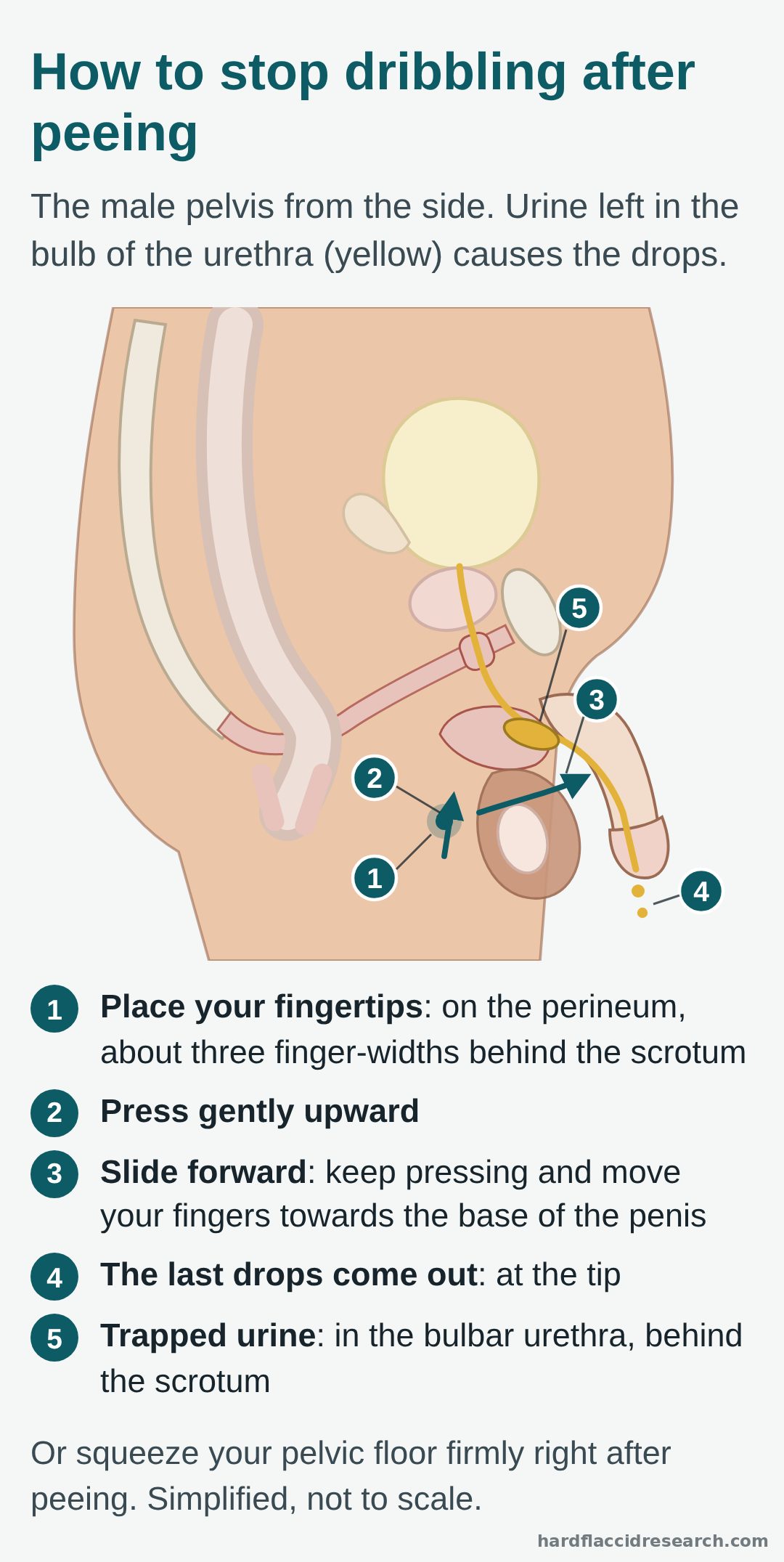
- It's caused by urine pooling in the bulbar urethra, the part of the tube in the perineum, behind the scrotum.
- Normally, the bulbospongiosus muscle squeezes this urine out. If it's weak or doesn't fire well, drops are left behind.
- Pressing behind the scrotum and sliding forward after peeing, called urethral milking, clears the drops.
- Pelvic floor exercises, including a strong squeeze after peeing, helped men in small trials.
- Dribbling that comes with a weak stream, straining or peeing often may be a sign of an enlarged prostate or a narrowing, and needs a check.
Why does dribbling after peeing happen?
The male urethra is long and curves down through the perineum before turning up into the penis. The lowest part of this curve, the bulbar urethra, sits behind the scrotum. When you finish peeing, a small amount of urine can stay pooled here.
In most men, the bulbospongiosus muscle, which wraps the bulb of the penis, contracts at the end of peeing and squeezes this urine out. If that squeeze is weak or doesn't happen, the trapped drops leak out later, often when you move or stand up.
Things that make it more likely:
- A weak pelvic floor, more common with age or inactivity.
- Prostate surgery.
- An enlarged prostate, which changes how the bladder empties.
- Erectile problems, which often go with weaker pelvic floor muscles.
- Tight underwear or trousers that press on the urethra.
- Rushing, and not waiting a moment after the stream stops.
- A tight pelvic floor that doesn't relax and contract smoothly.
Related: Kegel Exercises for Men: How to Do Them, Benefits & When to Stop »
How do I stop dribbling after peeing?
Urethral milking
This simple technique clears the trapped urine:
- Pee as usual, and wait a few seconds after the stream stops.
- Place the fingertips of one hand on the perineum, about three finger-widths behind the scrotum.
- Press gently upward.
- Keep pressing and slide your fingers forward towards the base of the penis, under the scrotum.
- Give the penis a gentle shake or squeeze along its length.
It takes only a few seconds and can be done discreetly through clothing in a stall.
The squeeze-out
Instead of milking, you can do a strong pelvic floor squeeze right after peeing, as if lifting the base of the penis. This mimics the muscle's natural squeeze and pushes the last drops out.
Pelvic floor exercises
Regular pelvic floor exercises strengthen the bulbospongiosus. In a small trial, men who did pelvic floor exercises improved more than men who only got advice, and in another trial of men with erection problems, pelvic floor exercises with biofeedback stopped after-dribble in many of them.
- Squeeze as if stopping your stream and lifting the base of the penis, hold for a few seconds, then relax fully.
- Repeat several times, a few times a day.
- A pelvic floor physical therapist can check that you're using the right muscles.
Other tips
- Take your time and don't rush away.
- Sit down to pee if it helps you relax and empty fully.
- Lower your underwear and trousers fully, so the waistband doesn't press on the urethra.
- Carry a spare pair of underwear or use a small pad on bad days while you build up.
When is dribbling a sign of something else?
After-dribble on its own is usually harmless. But see a doctor if you also have:
- A weak or slow stream, trouble starting, or straining to pee.
- Peeing often, urgency or waking at night to pee.
- A feeling that your bladder isn't empty.
- Dribbling or leaking at other times, not just after peeing.
- Pain, burning or blood in your urine.
These can be signs of an enlarged prostate, a narrowing of the urethra, an infection, an overactive bladder or a bladder that doesn't empty well. US urology guidelines describe a range of checks and treatments for these symptoms.
Related: Bulbospongiosus Muscle: Erections, Ejaculation and Dribbling »
Dribbling vs other kinds of leaking
Doctors separate after-dribble from other kinds of leaking, because the causes and treatments differ:
- After-dribble: a few drops just after you've finished and zipped up.
- Urge leaking: a sudden, strong need to pee and leaking before you reach the toilet, often from an overactive bladder.
- Stress leaking: leaking when you cough, sneeze or lift, more common after prostate surgery.
- Overflow leaking: constant dribbling from a bladder that doesn't empty properly, often with a weak stream. This needs a prompt check.
Telling your doctor exactly when leaking happens helps them find the cause.
Dribbling after urination and hard flaccid syndrome
Hard flaccid syndrome is a firm, shrunken penis at rest, often with numbness, weaker erections and pelvic pain. Many men with hard flaccid notice urinary changes, including dribbling, a slower stream or feeling that they haven't fully emptied.
Of the 2,661 men who described their symptoms, 23% described pelvic floor tightness, spasm or twitching (601 men) and 13% described urinary problems (337 men). In a separate count, 107 men asked why there are urinary problems.
In men with a tight pelvic floor, strengthening exercises may not be the right start. Gentle milking after peeing is fine either way, while a pelvic floor physical therapist can tell whether you need to relax or strengthen. Our members' guide, Bladder and Bowel Problems With Hard Flaccid: What Helps, covers toilet habits that help without straining.
When should I see a doctor?
See a primary care provider or a urologist (a doctor for urinary and sexual health) if dribbling bothers you, gets worse, or comes with any of the symptoms above. Our doctor visit kit helps you describe your stream and what happens.
Get urgent care straight away (call 911 or go to the emergency room) if you have:
- Not being able to pee at all, or a painful, swollen bladder.
- New trouble starting or controlling your pee, or not feeling when your bladder is full.
- New numbness around your back passage, genitals or inner thighs, or new weakness in your legs.
- Loss of control of your bladder or bowel.
- A fever or chills with pelvic pain or pain when peeing.
Frequently asked questions
Is dribbling after peeing normal?
It's very common, especially with age, and usually harmless. It's still worth fixing, because it's easy to improve.
Does shaking the penis stop dribbling?
Shaking helps clear drops at the tip, but not the urine trapped behind the scrotum. Milking from behind the scrotum works better.
Can young men get after-dribble?
Yes. It's more common with age, but young men can have it, especially with a weak or tight pelvic floor.
Is after-dribble a sign of prostate problems?
On its own, usually not. Together with a weak stream, straining or peeing often, it can be, so get checked.
How long do pelvic floor exercises take to work?
Many men notice a difference within a few weeks to a few months of regular practice.
Can tight underwear cause dribbling?
Tight underwear or a waistband pulled up under the scrotum can press on the urethra and trap urine. Lowering clothes fully when you pee helps.
Does sitting to pee help?
Some men find sitting helps them relax and empty more fully. You can still press behind the scrotum afterwards.
Can Kegels make dribbling worse?
In men with a tight pelvic floor, lots of strong squeezing can make the muscles tighter. A therapist can check whether you need to relax first.
Will a pad help?
A small absorbent pad or guard can protect clothes while you work on exercises and the milking technique, and many men only need one for a short time.
Takeaway
Dribbling after urination happens when urine stays in the urethra behind the scrotum. It's common and usually harmless.
Pressing behind the scrotum and sliding forward after peeing, or a strong pelvic floor squeeze, clears it, and pelvic floor exercises help over time. See a doctor if it comes with other urinary symptoms. Take our free self-check if you also notice changes in your penis at rest.
This article is for general information and isn't a substitute for advice from your own doctor. Hard Flaccid Research doesn't diagnose or treat. If you have new or worsening symptoms, see a qualified clinician. In an emergency, call 911.
Free tools that can help
- Self-check: do I have hard flaccid?Compare your symptoms with what 6,026 men report.
- Doctor visit kitA one-page summary to take to your appointment.
- Habit trackerCount your days without porn or masturbation, and get through urges.
- Diaphragm breathing toolBreathe with a moving picture of your diaphragm and pelvic floor.
- Add your experienceTell us what you tried and how it went. No name needed.
- Hard Flaccid Syndrome CensusWhat men answered in 818 polls.
- Symptom trackerLog your symptoms and see what helps you.
- Ask us a questionThe questions men ask most become new articles.
The numbers behind this article
Every number in this article comes from what men with hard flaccid syndrome shared between December 2020 and October 2026, counted once per person, or from their polls. These are self-selected reports, not a clinical study. See hard flaccid syndrome statistics, the Hard Flaccid Syndrome Census and how we count.
13% of men who described their symptoms described urinary problems
Share of the 2,661 men who described their symptoms. Each man is counted once.These are self-selected reports, not a clinical study.
Source: Hard Flaccid Research, hardflaccidresearch.com
Every number in this article, with its source
| In this article | Source |
|---|---|
| 13% of the men who described their symptoms described urinary problems (337 of 2,661) | 337 of 2,661 men, counted |
| 23% of the men who described their symptoms described pelvic floor tightness, spasm or twitching (601 of 2,661) | 601 of 2,661 men, counted |
| 6,026 men shared their experiences, and 2,661 of them described their symptoms | 2,661 of 6,026 men, counted |
| 107 men asked why there are urinary problems | 107 men asked why there are urinary problems, counted from what men wrote, once per person |
Medical sources
What this article says about medical research, guidelines and urgent care comes from these sources.
- Paterson J, Pinnock CB, Marshall VR. Pelvic floor exercises as a treatment for post-micturition dribble. Br J Urol. 1997;79(6):892-897. https://pubmed.ncbi.nlm.nih.gov/9202555/
- Dorey G, Speakman M, Feneley R, Swinkels A, Dunn C, Ewings P. Pelvic floor exercises for treating post-micturition dribble in men with erectile dysfunction: a randomized controlled trial. Urol Nurs. 2004;24(6):490-497. https://pubmed.ncbi.nlm.nih.gov/15658735/
- Dorey G. Prevalence, aetiology and treatment of post-micturition dribble in men: literature review. Physiotherapy. 2002;88(4):225-234. https://search.pedro.org.au/search-results/record-detail/4493
- Sandhu JS, Bixler BR, Dahm P, et al. Management of lower urinary tract symptoms attributed to benign prostatic hyperplasia (BPH): AUA guideline amendment 2023. J Urol. 2024;211(1):11-19. https://doi.org/10.1097/JU.0000000000003698
- Anatomy, Abdomen and Pelvis, Penis. In: StatPearls. Treasure Island (FL): StatPearls Publishing. https://www.ncbi.nlm.nih.gov/books/NBK482236/
How we made this article
We started from the question many men asked. Every number was checked against our data. Our editorial team edited it and Dr. Julian Reyes reviewed it medically. Read our editorial policy.
Read next
See more of us on Google
Add Hard Flaccid Research as a preferred source, and Google shows you our pages more often when you search.
Add as a preferred sourceDon't see your question? Ask us. We answer the most-asked ones in new articles.
Cite and share this article
You're welcome to quote this article. Please name Hard Flaccid Research and link to this page, so others can find the full answer and the data behind it. To cite this page, use its link.
Citation
Hard Flaccid Research. (2026). Dribbling After Urination: Why It Happens and How to Stop It. Written by the Editorial Team, medically reviewed by Dr. Julian Reyes. https://hardflaccidresearch.com/articles/dribbling-after-urination
Credit link for your article
Source: <a href="https://hardflaccidresearch.com/articles/dribbling-after-urination">Hard Flaccid Research</a>
Wikipedia reference
<ref>{{cite web |url=https://hardflaccidresearch.com/articles/dribbling-after-urination |title=Dribbling After Urination: Why It Happens and How to Stop It |website=Hard Flaccid Research |date=2026 |access-date=22 November 2026}}</ref>
How the data was collected: our methodology. Journalists and researchers: key numbers, data and contact.