Blood in Semen (Hematospermia): Causes and When to Worry
In short
- Blood in semen, called hematospermia, makes semen look pink, red or brown.
- It's alarming but usually harmless, often clearing up on its own within a few weeks.
- In younger men, it's most often caused by inflammation or infection of the prostate or seminal vesicles, or by a small burst blood vessel.
- Men over forty, and anyone with repeated episodes or other symptoms, should see a doctor.
Blood in semen, called hematospermia (hee-mat-oh-SPUR-mee-uh), is when semen looks pink, red, rusty or brown. It can be a frightening thing to see, but it's usually harmless. Most often, it clears up on its own within a few weeks, and in many men no cause is ever found.
In younger men, the most common causes are inflammation or infection of the prostate or seminal vesicles, a small burst blood vessel, or a recent procedure. In men over forty, or when it keeps coming back, a doctor will check more carefully for less common causes, including prostate problems. This page explains what blood in semen means, its causes, the tests a doctor may do and when to get checked.
By the numbers: of the 6,026 men who shared their experiences with hard flaccid syndrome, 2,661 described their symptoms, and 202 of them described a weak or painful orgasm or ejaculation problems.

Key facts
- Hematospermia means blood in the semen. It can look bright red, pink or brown, or show up as dark streaks or clots.
- It's usually benign and often goes away without treatment.
- Common causes include inflammation or infection of the prostate, seminal vesicles or urethra, a burst small blood vessel, and recent prostate procedures.
- Brown or rusty semen usually means old blood from a bleed that has already stopped.
- See a doctor if it lasts more than a few weeks, keeps coming back, comes with other symptoms, or if you're over forty.
- A doctor usually starts with an examination, a urine test, infection checks and sometimes a blood test for the prostate.
What does blood in semen look like?
- Pink or red streaks in the semen, or semen that's red throughout.
- Brown, rusty or dark semen, which often means older blood.
- Small clots or jelly-like dark lumps.
- Sometimes blood in the urine too, or a red stain on a condom or sheet.
It may happen once, or for several ejaculations in a row as old blood clears. It doesn't usually cause pain, but some men also notice pain when ejaculating or peeing.
Related: Prostate Anatomy: Where It Is, Its Zones and What It Does »
What causes blood in semen?
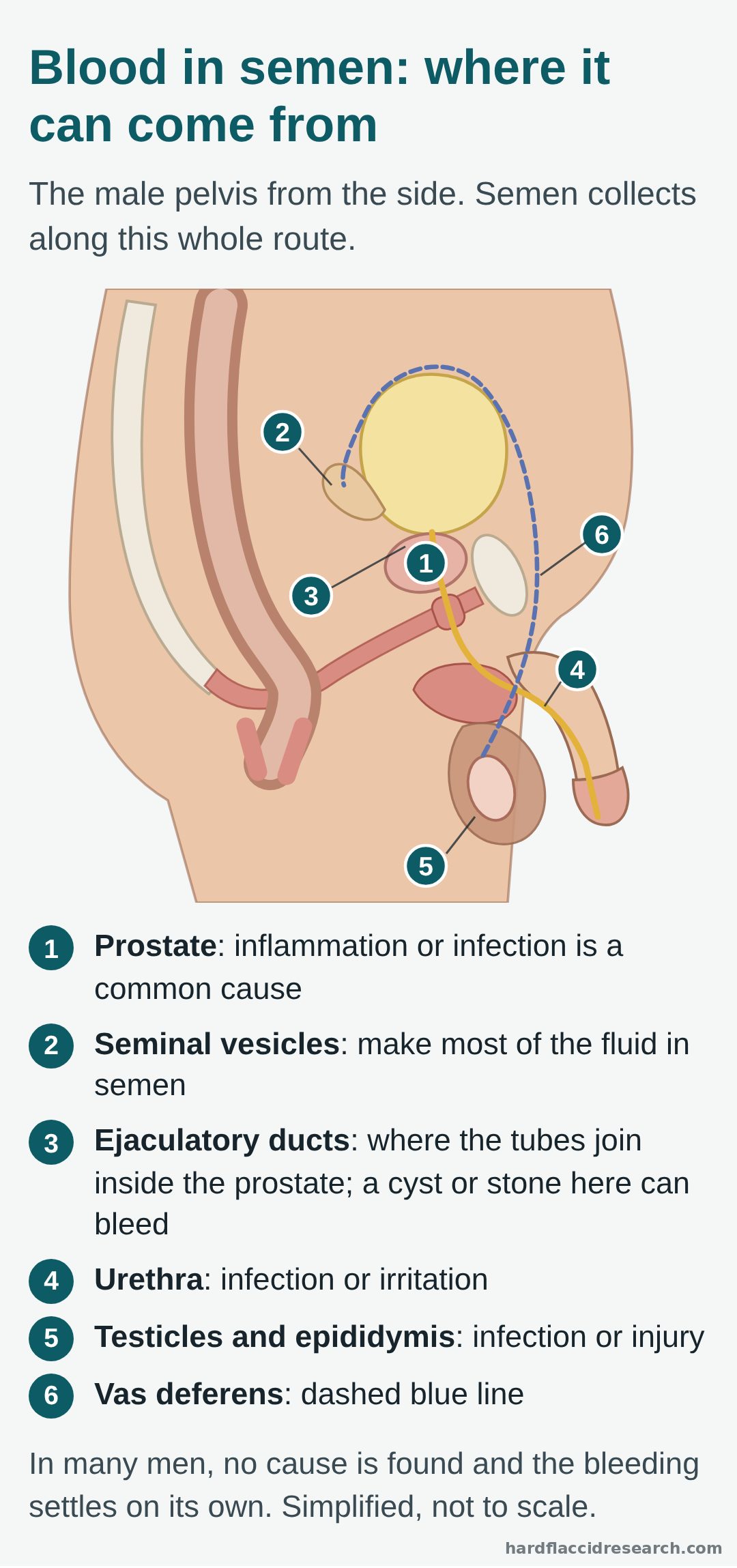
Semen is made along a long route. Sperm come from the testicles, mature in the epididymis and travel up the vas deferens. Most of the fluid comes from the seminal vesicles and the prostate, and it all passes through the ejaculatory ducts into the urethra. A bleed anywhere along this route can tint the semen.
Inflammation and infection
Infection or inflammation of the prostate (prostatitis), the seminal vesicles, the epididymis or the urethra is a common cause, especially in men under forty. Sexually transmitted infections such as chlamydia and gonorrhea are possible causes, as are urinary infections. These often come with other symptoms, such as pain when peeing, a discharge or pelvic pain.
A burst blood vessel
Vigorous or very frequent sex or masturbation, or a long gap without ejaculating, can sometimes burst a small blood vessel. This usually clears on its own.
Procedures
A prostate biopsy is a very common cause and can cause blood in semen for several weeks afterwards. Other procedures, such as a cystoscopy, a vasectomy or prostate treatment, can too.
Other causes
- Stones or cysts in the prostate, seminal vesicles or ejaculatory ducts.
- Blockage of the ejaculatory ducts.
- An enlarged prostate, which has fragile blood vessels.
- High blood pressure, bleeding disorders, or medicines that thin the blood.
- Rarely, cancer of the prostate, bladder or testicle, which is why men over forty and men with repeated episodes should be checked.
In many men, no clear cause is found, and it simply settles.
Blood in semen and hard flaccid syndrome
Hard flaccid syndrome is a firm, shrunken penis at rest, often with numbness, weaker erections and pelvic pain. Blood in semen isn't a symptom of hard flaccid, but some men with hard flaccid also have prostate or pelvic floor problems.
Of the 2,661 men who described their symptoms, 13% described urinary problems (337 men), 10% described pelvic, perineal or tailbone pain (267 men) and 8% described a weak or painful orgasm or ejaculation problems (202 men). If you notice blood in your semen, get it checked like anyone else, rather than assuming it's part of hard flaccid.
If you've felt brushed off by doctors before, our members' guide, Hard Flaccid and Doctors: How to Get Taken Seriously, has tips for getting your symptoms heard.
Related: Prostatitis or Hard Flaccid? Symptoms, Types and Treatment »
How is blood in semen diagnosed?
A primary care provider or a urologist (a doctor for urinary and sexual health) will ask how often it has happened, what it looked like, your age, your sexual health, your medicines and any recent procedures. Our doctor visit kit helps you note these before you go.
Tests your doctor may suggest:
- An examination of the testicles and penis, and a gentle check of the prostate through the back passage with a gloved finger. You can ask for a chaperone or stop at any time.
- A urine test for infection and blood.
- Tests for sexually transmitted infections.
- Blood pressure.
- A blood test for the prostate (PSA), usually for men over forty.
- A semen test, sometimes.
- An ultrasound scan of the prostate from inside the back passage, an MRI scan or a camera test of the bladder, if bleeding keeps coming back or other tests suggest a problem.
How is blood in semen treated?
Treatment depends on the cause:
- If no cause is found and you're under forty, it usually clears on its own and needs no treatment.
- Infections are treated with antibiotics. If an infection is sexually transmitted, your partner needs testing and treatment too.
- If a medicine that thins the blood is involved, don't stop it on your own: talk to the doctor who prescribed it.
- High blood pressure is treated in the usual way.
- Cysts, stones or blocked ducts can sometimes be treated with a procedure, if they keep causing bleeding.
- Any serious cause found is treated by a specialist.
Until it clears, you can still ejaculate. Regular ejaculation helps clear old blood. Use condoms if an infection is possible.
Can you prevent blood in semen?
You can't prevent every episode, but some steps lower the chances:
- Use condoms with new partners and get tested for sexually transmitted infections, since infections are a common cause.
- Treat urinary and prostate infections promptly and finish the full course of antibiotics.
- Avoid very rough or prolonged sex or masturbation if you've had a bleed recently.
- Keep your blood pressure in a healthy range.
- After a prostate biopsy or procedure, expect some blood in your semen for a few weeks, and ask your doctor what's normal.
- Avoid straining on the toilet, and treat constipation.
When should I see a doctor?
See a primary care provider or a urologist if blood in your semen lasts more than a few weeks, keeps coming back, or comes with pain, fever, blood in your urine or trouble peeing. See a doctor about any episode if you're over forty, or have a family history of prostate cancer.
Get urgent care straight away (call 911 or go to the emergency room) if you have:
- Large amounts of blood or clots in your urine, or you can't pee.
- A fever or chills with pelvic pain or pain when peeing.
- Sudden, severe pain in the penis, testicles or pelvis.
- Heavy bleeding that won't stop, or blood in your semen with easy bruising or bleeding elsewhere.
Frequently asked questions
Is blood in semen serious?
Usually not. In most men, especially those under forty, it's harmless and goes away on its own. It's still worth a check, especially if it keeps happening.
How long does blood in semen last?
A single bleed often clears within a few ejaculations or a few weeks. After a prostate biopsy, it can last several weeks.
Can masturbation cause blood in semen?
Vigorous or frequent sex or masturbation can sometimes burst a tiny blood vessel, and so can a long gap without ejaculating. It usually settles quickly.
Can I still have sex with blood in my semen?
Yes, unless a doctor has told you otherwise. It isn't harmful to a partner, but use condoms until an infection has been ruled out.
Why is my semen brown?
Brown or rusty semen usually means old blood from a bleed that has already stopped.
Is blood in semen a sign of cancer?
Rarely. It's more often linked to infection or inflammation. Men over forty, and men whose bleeding keeps coming back, should be checked so a doctor can rule out prostate problems.
Takeaway
Blood in semen is alarming but usually harmless, and it often clears on its own. In younger men, it's most often linked to inflammation, infection or a small burst blood vessel.
See a doctor if it lasts, keeps coming back, comes with other symptoms or if you're over forty, so the few causes that need treatment aren't missed. Take our free self-check if you also notice changes in your penis at rest.
This article is for general information and isn't a substitute for advice from your own doctor. Hard Flaccid Research doesn't diagnose or treat. If you have new or worsening symptoms, see a qualified clinician. In an emergency, call 911.
Free tools that can help
- Self-check: do I have hard flaccid?Compare your symptoms with what 6,026 men report.
- Doctor visit kitA one-page summary to take to your appointment.
- Habit trackerCount your days without porn or masturbation, and get through urges.
- Diaphragm breathing toolBreathe with a moving picture of your diaphragm and pelvic floor.
- Add your experienceTell us what you tried and how it went. No name needed.
- Hard Flaccid Syndrome CensusWhat men answered in 818 polls.
- Symptom trackerLog your symptoms and see what helps you.
- Ask us a questionThe questions men ask most become new articles.
The numbers behind this article
Every number in this article comes from what men with hard flaccid syndrome shared between December 2020 and October 2026, counted once per person, or from their polls. These are self-selected reports, not a clinical study. See hard flaccid syndrome statistics, the Hard Flaccid Syndrome Census and how we count.
8% of men who described their symptoms described orgasm or ejaculation problems
Share of the 2,661 men who described their symptoms. Each man is counted once.These are self-selected reports, not a clinical study.
Source: Hard Flaccid Research, hardflaccidresearch.com
Every number in this article, with its source
| In this article | Source |
|---|---|
| 8% of the men who described their symptoms described a weak or painful orgasm or ejaculation problems (202 of 2,661) | 202 of 2,661 men, counted |
| 10% of the men who described their symptoms described pelvic, perineal or tailbone pain (267 of 2,661) | 267 of 2,661 men, counted |
| 13% of the men who described their symptoms described urinary problems (337 of 2,661) | 337 of 2,661 men, counted |
| 6,026 men shared their experiences, and 2,661 of them described their symptoms | 2,661 of 6,026 men, counted |
Medical sources
What this article says about medical research, guidelines and urgent care comes from these sources.
- Kumar P, Kapoor S, Nargund V. Haematospermia: a systematic review. Ann R Coll Surg Engl. 2006;88(4):339-342. https://pmc.ncbi.nlm.nih.gov/articles/PMC1964630/
- Parnham A, Serefoglu EC. Retrograde ejaculation, painful ejaculation and hematospermia. Transl Androl Urol. 2016;5(4):592-601. https://doi.org/10.21037/tau.2016.06.05
- Leocadio DE, Stein BS. Hematospermia: etiological and management considerations. Int Urol Nephrol. 2009;41(1):77-83. https://doi.org/10.1007/s11255-008-9409-9
- Mayo Clinic. Blood in semen. https://www.mayoclinic.org/symptoms/blood-in-semen/basics/causes/sym-20050603
- Shindel AW, Althof SE, Carrier S, et al. Disorders of ejaculation: an AUA/SMSNA guideline. J Urol. 2022;207(3):504-512. https://doi.org/10.1097/JU.0000000000002392
How we made this article
We started from the question many men asked. Every number was checked against our data. Our editorial team edited it and Dr. Julian Reyes reviewed it medically. Read our editorial policy.
Read next
See more of us on Google
Add Hard Flaccid Research as a preferred source, and Google shows you our pages more often when you search.
Add as a preferred sourceDon't see your question? Ask us. We answer the most-asked ones in new articles.
Cite and share this article
You're welcome to quote this article. Please name Hard Flaccid Research and link to this page, so others can find the full answer and the data behind it. To cite this page, use its link.
Citation
Hard Flaccid Research. (2026). Blood in Semen (Hematospermia): Causes and When to Worry. Written by the Editorial Team, medically reviewed by Dr. Julian Reyes. https://hardflaccidresearch.com/articles/hematospermia
Credit link for your article
Source: <a href="https://hardflaccidresearch.com/articles/hematospermia">Hard Flaccid Research</a>
Wikipedia reference
<ref>{{cite web |url=https://hardflaccidresearch.com/articles/hematospermia |title=Blood in Semen (Hematospermia): Causes and When to Worry |website=Hard Flaccid Research |date=2026 |access-date=22 November 2026}}</ref>
How the data was collected: our methodology. Journalists and researchers: key numbers, data and contact.