Retrograde Ejaculation: Causes, Signs and Treatment
In short
- Retrograde ejaculation is when semen goes backward into the bladder instead of out through the penis, so little or no semen comes out at orgasm.
- It happens when the muscle at the neck of the bladder doesn't close properly, most often because of medicines such as alpha blockers, diabetes or prostate surgery.
- It isn't harmful, but it can affect fertility, and it often improves when the cause is treated.
Retrograde ejaculation is when semen goes backward into the bladder instead of out through the tip of the penis. You still have an orgasm and it usually feels the same, but little or no semen comes out. Some men call it a dry orgasm.
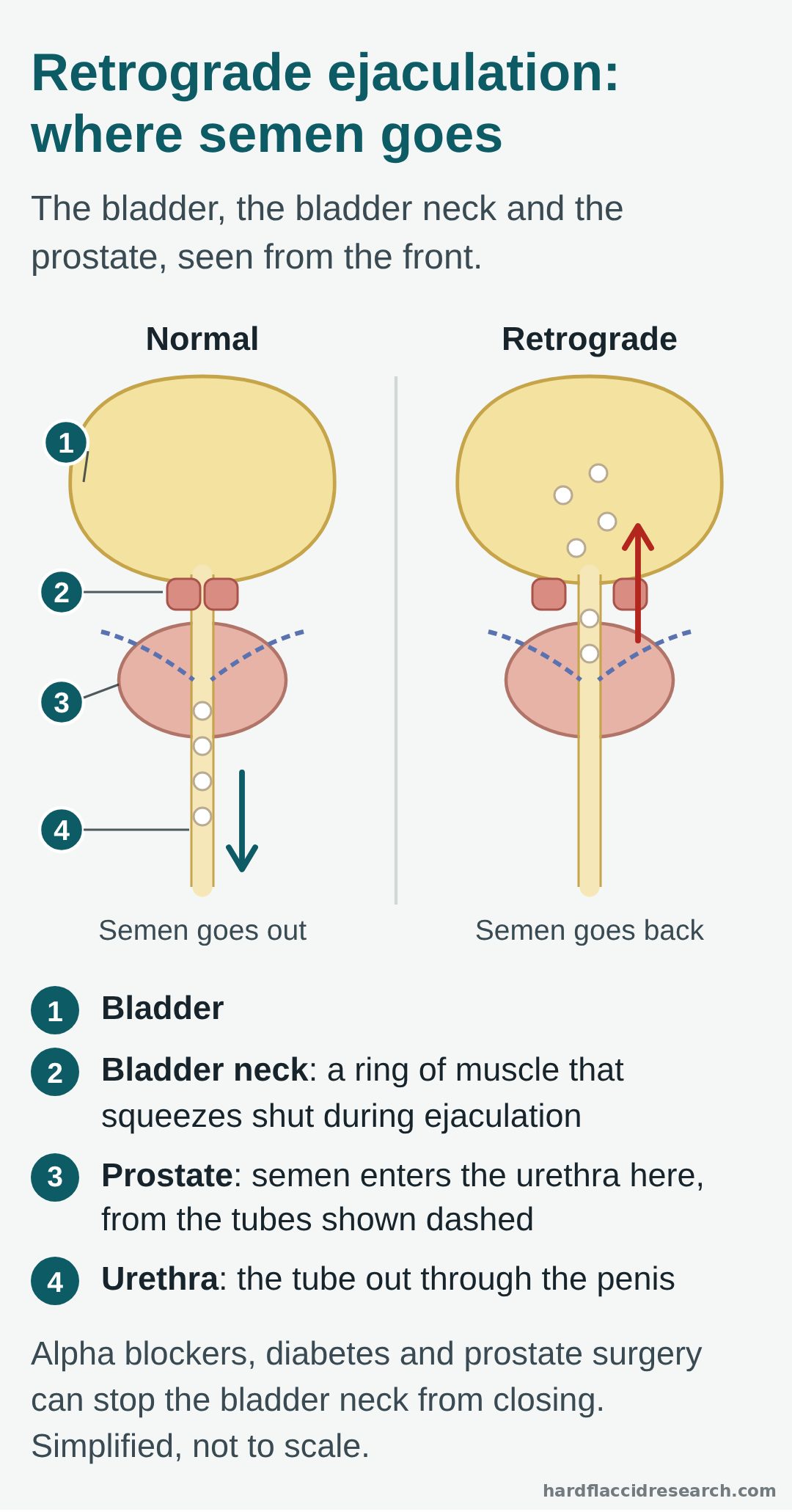
It happens when the ring of muscle at the neck of the bladder doesn't close properly during ejaculation. The most common causes are medicines, diabetes and surgery on the prostate. Retrograde ejaculation isn't harmful, but it can make it harder to have children. This page explains the signs, the causes, how it's diagnosed and what helps.
By the numbers: of the 6,026 men who shared their experiences with hard flaccid syndrome, 2,661 described their symptoms, and 202 of them described a weak or painful orgasm or ejaculation problems.
Key facts
- In retrograde ejaculation, semen goes into the bladder instead of out of the penis.
- The main signs are very little or no semen at orgasm, and cloudy urine the first time you pee afterwards.
- Common causes are medicines (especially alpha blockers such as tamsulosin), diabetes, prostate or bladder surgery, and some nerve injuries.
- It isn't painful or dangerous. The semen simply leaves the body the next time you pee.
- A urine test after orgasm confirms it.
- If a medicine is the cause, ejaculation often returns after a doctor changes it. Other treatments mainly matter if you're trying for a baby.
What are the signs of retrograde ejaculation?
- Little or no semen comes out when you orgasm.
- The orgasm feels normal, or slightly different.
- Your urine looks cloudy the first time you pee after an orgasm, because it's mixed with semen.
- Trying for a baby without success, in some couples.
Retrograde ejaculation doesn't affect erections or sex drive, and it doesn't cause pain. If you have pain with ejaculation, see our page on painful ejaculation.
Is it retrograde ejaculation or something else?
Less semen can have other causes too. Not making semen at all, called failure of emission, can follow some surgeries or nerve damage. A blocked tube, low testosterone or simply ejaculating often can all lower the amount. A urine test after orgasm tells these apart: if sperm are found in the urine, the semen went backward.
Related: Alpha Blockers for Hard Flaccid: 45% of Men Said They Help »
What causes retrograde ejaculation?
During ejaculation, a ring of smooth muscle at the bladder neck, where the bladder joins the urethra, squeezes shut. This means semen can only travel forward, down the urethra and out. If this muscle doesn't close, semen takes the easier path back into the bladder.
Medicines
Medicines that relax the bladder neck are the most common cause:
- Alpha blockers, such as tamsulosin, silodosin and alfuzosin, which are used to make peeing easier with an enlarged prostate, and sometimes tried for pelvic pain. Some alpha blockers are more likely than others to affect ejaculation.
- Some antidepressants and antipsychotic medicines.
- Some blood pressure medicines.
If a medicine is the cause, ejaculation usually returns once the medicine is stopped or changed. Never stop a medicine on your own: ask the doctor who prescribed it.
Diabetes and nerve damage
Long-term high blood sugar can damage the nerves that control the bladder neck. Multiple sclerosis, spinal cord injuries and some nerve conditions can do the same.
Surgery
- Surgery for an enlarged prostate, such as a transurethral resection of the prostate (TURP), very often causes retrograde ejaculation, because it changes the bladder neck.
- Surgery on the bladder neck.
- Surgery in the back of the abdomen near the nerves for ejaculation, such as removing lymph nodes after testicular cancer.
Other causes
Some men are born with differences in the bladder neck or urethra. Sometimes no cause is found.
Retrograde ejaculation and hard flaccid syndrome
Hard flaccid syndrome is a firm, shrunken penis at rest, often with numbness, weaker erections and pelvic pain. Some men with hard flaccid are prescribed or try alpha blockers, because these medicines relax smooth muscle.
In separate counts, 378 men discussed alpha blockers. In a May 2023 poll, 45% said an alpha blocker had helped their hard flaccid symptoms (22 of 49 men). That's what men reported, not evidence that it works, and any man taking one should know that a drier orgasm is a common side effect.
Of the 2,661 men who described their symptoms, 8% described a weak or painful orgasm or ejaculation problems (202 men), and 13% described urinary problems (337 men). Our members' guide, Hard Flaccid Syndrome Medicines: What to Ask Your Doctor, lists questions to ask about side effects like this before you start a medicine.
Related: Prostate Anatomy: Where It Is, Its Zones and What It Does »
How is retrograde ejaculation diagnosed?
A primary care provider or a urologist (a doctor for urinary and sexual health) will ask about your symptoms, your medicines, any diabetes and any past surgery.
The key test is a urine sample taken soon after an orgasm. If it contains sperm, the semen went backward into the bladder. Your doctor may also suggest:
- A semen test, to see how much semen comes out and how many sperm it holds.
- Blood tests for diabetes or hormones.
- Tests of the nerves or a scan, if the cause isn't clear.
Our doctor visit kit helps you list your medicines and when the change began, which is often the fastest clue.
How is retrograde ejaculation treated?
If you aren't trying for a baby, you may not need treatment at all, because retrograde ejaculation doesn't harm your health. If it bothers you, or you want children, there are options.
Changing a medicine
If a medicine is the cause, your doctor may change the dose, switch to a medicine less likely to affect ejaculation, or stop it. Ejaculation often returns within days to weeks.
Medicines that tighten the bladder neck
Some medicines can help the bladder neck close, such as pseudoephedrine, a decongestant, or imipramine, an older antidepressant. They work for some men, mostly when nerve damage is the cause, and less often after surgery. They can raise blood pressure and heart rate and cause other side effects, so they should only be used with a doctor's advice.
Fertility treatment
If you're trying for a baby, sperm can often be collected from urine after orgasm, cleaned in a lab and used for insemination or IVF. A fertility specialist can explain the steps, including how to prepare the urine beforehand.
Surgery
Surgery to rebuild the bladder neck has been tried, but it's rarely done.
Can you prevent retrograde ejaculation?
You can't always prevent it, but you can lower the chances:
- Before starting an alpha blocker or another medicine for peeing, ask whether it can affect ejaculation and whether there's an option less likely to.
- Before prostate surgery, ask how likely retrograde ejaculation is with each type of procedure. Some newer procedures aim to protect ejaculation.
- If you have diabetes, keeping your blood sugar in a healthy range helps protect the nerves that control the bladder neck.
- If you plan to have children and need surgery near the bladder neck or in the back of the abdomen, ask about storing sperm beforehand.
When should I see a doctor?
See a primary care provider or a urologist if little or no semen comes out when you orgasm, especially if it started after a new medicine or if you're trying for a baby. Also get checked if you have other signs of diabetes, such as thirst and peeing often.
Get urgent care straight away (call 911 or go to the emergency room) if you have:
- Sudden, severe pain in the penis, testicles or pelvis.
- New numbness around your back passage, genitals or inner thighs, or new weakness in your legs.
- New trouble starting or controlling your pee, not being able to pee, or not feeling when your bladder is full.
- Loss of control of your bladder or bowel.
- A fever or chills with pelvic pain or pain when peeing.
Frequently asked questions
Is retrograde ejaculation harmful?
No. The semen mixes with urine and leaves your body the next time you pee. The main effect is on fertility.
Does retrograde ejaculation go away?
If a medicine is the cause, it usually does once the medicine is changed. When it comes from surgery or long-standing nerve damage, it's often permanent, though fertility treatment can still help.
Can you still get someone pregnant?
It's harder, but often possible. Sperm can be collected from urine for fertility treatment, and some men respond to medicines.
Does tamsulosin always cause retrograde ejaculation?
No, but changes in ejaculation are a common side effect. Ask your doctor about it before starting, and about alternatives if it bothers you.
Is a dry orgasm the same as retrograde ejaculation?
Not always. A dry orgasm can also mean no semen was made at all. A urine test after orgasm tells the difference.
Takeaway
Retrograde ejaculation is when semen goes back into the bladder because the bladder neck doesn't close. It isn't harmful, but it can affect fertility.
Medicines, diabetes and prostate surgery are the usual causes. Ask your doctor before changing any medicine, and see a fertility specialist if you're trying for a baby. Take our free self-check if you also notice changes in your penis at rest.
This article is for general information and isn't a substitute for advice from your own doctor. Hard Flaccid Research doesn't diagnose or treat. If you have new or worsening symptoms, see a qualified clinician. In an emergency, call 911.
Free tools that can help
- Self-check: do I have hard flaccid?Compare your symptoms with what 6,026 men report.
- Doctor visit kitA one-page summary to take to your appointment.
- Habit trackerCount your days without porn or masturbation, and get through urges.
- Diaphragm breathing toolBreathe with a moving picture of your diaphragm and pelvic floor.
- Add your experienceTell us what you tried and how it went. No name needed.
- Hard Flaccid Syndrome CensusWhat men answered in 818 polls.
- Symptom trackerLog your symptoms and see what helps you.
- Ask us a questionThe questions men ask most become new articles.
The numbers behind this article
Every number in this article comes from what men with hard flaccid syndrome shared between December 2020 and October 2026, counted once per person, or from their polls. These are self-selected reports, not a clinical study. See hard flaccid syndrome statistics, the Hard Flaccid Syndrome Census and how we count.
8% of men who described their symptoms described orgasm or ejaculation problems
Share of the 2,661 men who described their symptoms. Each man is counted once.These are self-selected reports, not a clinical study.
Source: Hard Flaccid Research, hardflaccidresearch.com
45% said an alpha blocker had helped their hard flaccid symptoms
How 49 men answered a May 2023 poll.In our polls, men choose to answer. This isn't evidence that a medicine works.
Source: Hard Flaccid Research, hardflaccidresearch.com
Every number in this article, with its source
| In this article | Source |
|---|---|
| 8% of the men who described their symptoms described a weak or painful orgasm or ejaculation problems (202 of 2,661) | 202 of 2,661 men, counted |
| 13% of the men who described their symptoms described urinary problems (337 of 2,661) | 337 of 2,661 men, counted |
| 6,026 men shared their experiences, and 2,661 of them described their symptoms | 2,661 of 6,026 men, counted |
| 378 men discussed alpha blockers | 378 men discussing alpha blockers, counted from what men wrote |
| 45% said an alpha blocker had helped their hard flaccid symptoms (22 of 49 men) | 22 of 49 men, poll, May 2023 |
Medical sources
What this article says about medical research, guidelines and urgent care comes from these sources.
- Parnham A, Serefoglu EC. Retrograde ejaculation, painful ejaculation and hematospermia. Transl Androl Urol. 2016;5(4):592-601. https://doi.org/10.21037/tau.2016.06.05
- Shindel AW, Althof SE, Carrier S, et al. Disorders of ejaculation: an AUA/SMSNA guideline. J Urol. 2022;207(3):504-512. https://doi.org/10.1097/JU.0000000000002392
- Recent advances in the diagnosis and management of retrograde ejaculation: a narrative review. Diagnostics. 2025;15(6):726. https://doi.org/10.3390/diagnostics15060726
- Ejaculatory dysfunction in the treatment of lower urinary tract symptoms. Transl Androl Urol. 2016;5(4):450-459. https://doi.org/10.21037/tau.2016.06.06
- MedlinePlus. Retrograde ejaculation. US National Library of Medicine. https://medlineplus.gov/ency/article/001282.htm
- Jimbo M. Retrograde ejaculation. MSD Manual Consumer Version. 2024. https://www.msdmanuals.com/home/men-s-health-issues/sexual-function-and-dysfunction-in-men/retrograde-ejaculation
How we made this article
We started from the question many men asked. Every number was checked against our data. Our editorial team edited it and Dr. Julian Reyes reviewed it medically. Read our editorial policy.
Read next
See more of us on Google
Add Hard Flaccid Research as a preferred source, and Google shows you our pages more often when you search.
Add as a preferred sourceDon't see your question? Ask us. We answer the most-asked ones in new articles.
Cite and share this article
You're welcome to quote this article. Please name Hard Flaccid Research and link to this page, so others can find the full answer and the data behind it. To cite this page, use its link.
Citation
Hard Flaccid Research. (2026). Retrograde Ejaculation: Causes, Signs and Treatment. Written by the Editorial Team, medically reviewed by Dr. Julian Reyes. https://hardflaccidresearch.com/articles/retrograde-ejaculation
Credit link for your article
Source: <a href="https://hardflaccidresearch.com/articles/retrograde-ejaculation">Hard Flaccid Research</a>
Wikipedia reference
<ref>{{cite web |url=https://hardflaccidresearch.com/articles/retrograde-ejaculation |title=Retrograde Ejaculation: Causes, Signs and Treatment |website=Hard Flaccid Research |date=2026 |access-date=22 November 2026}}</ref>
How the data was collected: our methodology. Journalists and researchers: key numbers, data and contact.