Low Ejaculate Volume: Why You Have Less Semen and What Helps
In short
- Low ejaculate volume means less semen comes out than usual.
- It's often temporary, from ejaculating often or not drinking enough, but it can also come from medicines such as finasteride and alpha blockers, low testosterone, retrograde ejaculation or a blocked duct.
- A doctor can check with a urine test after orgasm, blood tests and a semen test, especially if you're trying for a baby.
Low ejaculate volume means less semen comes out when you ejaculate than you're used to. Doctors sometimes call it hypospermia. Some men notice only a few drops, or a thinner, clearer fluid.
It's often temporary and harmless. Ejaculating often, not drinking enough and going a short time between ejaculations can all lower the amount. But it can also come from medicines, low testosterone, semen going backward into the bladder, or a blockage in the tubes. If it's new, lasts, or you're trying for a baby, it's worth a check. This page explains where semen comes from, what lowers its volume, the tests a doctor may do and what helps.
By the numbers: of the 6,026 men who shared their experiences with hard flaccid syndrome, 2,661 described their symptoms, and 202 of them described a weak or painful orgasm or ejaculation problems.
Key facts
- Most of the fluid in semen comes from the seminal vesicles and the prostate, not the testicles.
- Volume naturally varies from day to day and falls with frequent ejaculation.
- Common medical causes include medicines such as finasteride, dutasteride and alpha blockers, low testosterone, retrograde ejaculation and blocked ejaculatory ducts.
- Diabetes, nerve damage and some surgeries can lower or stop the flow.
- A semen test measures volume against reference values set by the World Health Organization.
- Treatment depends on the cause, and changing a medicine often restores volume.
Where does semen come from?
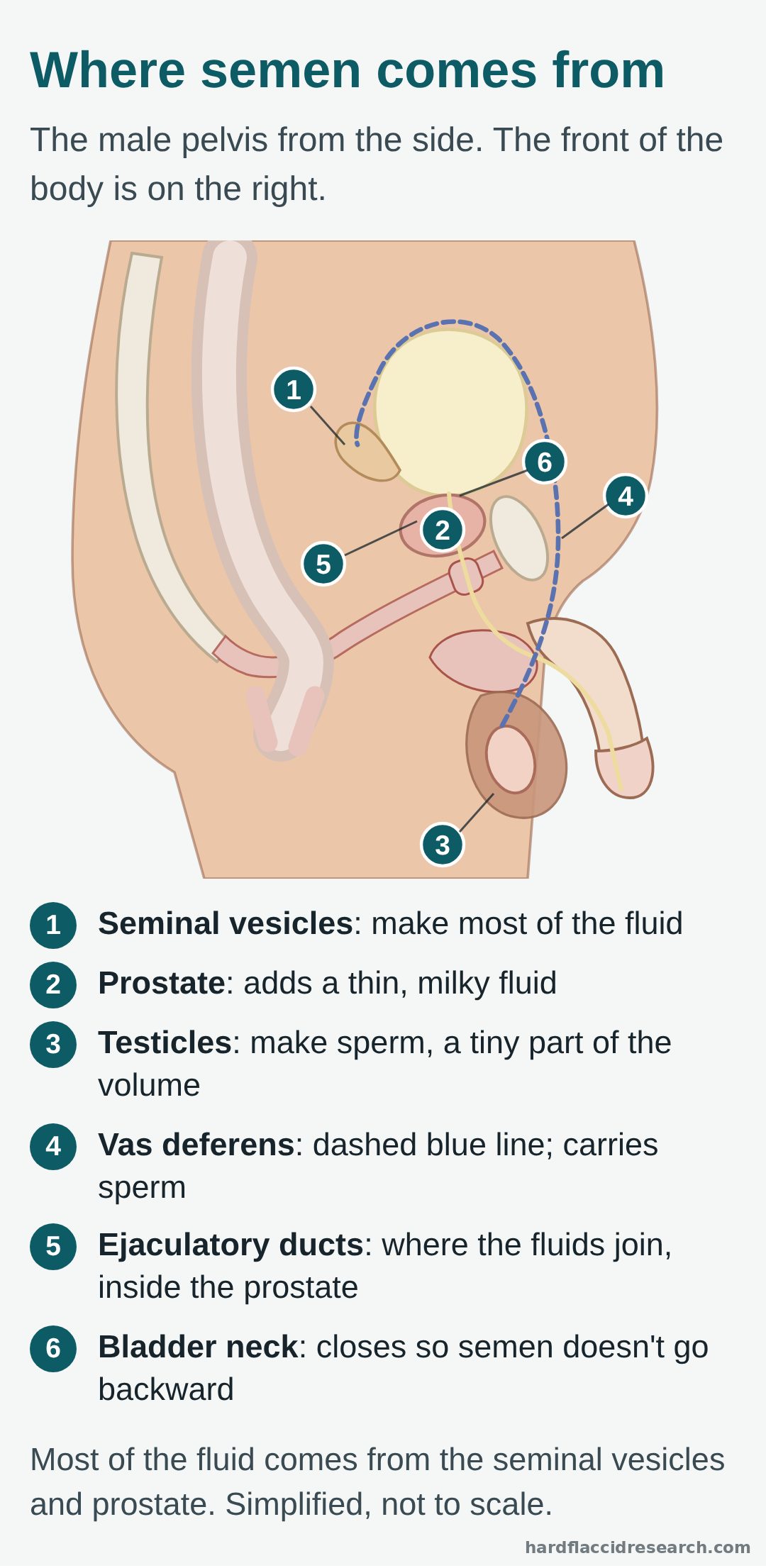
Semen is a mix of fluids from several glands:
- The seminal vesicles, two glands behind the bladder, make most of the fluid. It's rich in fructose, a sugar that feeds sperm.
- The prostate adds a thin, milky fluid that helps sperm swim.
- The testicles make sperm, which travel up the vas deferens. Sperm are only a tiny part of the volume.
- The bulbourethral glands add a small amount of clear fluid during arousal.
These fluids join in the ejaculatory ducts inside the prostate and empty into the urethra. The bladder neck must close at the same time, or semen goes backward into the bladder.
Related: Antidepressants and Hard Flaccid: Help or Hidden Problem? »
What causes low ejaculate volume?
Everyday causes
- Ejaculating often, or several times in a short period.
- Short arousal before ejaculating.
- Not drinking enough fluid.
- Tiredness, stress, alcohol and age. Volume tends to fall gradually as men get older.
Medicines
- Finasteride and dutasteride, used for an enlarged prostate or hair loss, shrink the prostate and lower semen volume.
- Alpha blockers, such as tamsulosin and silodosin, can lower or stop the flow of semen.
- Some antidepressants and antipsychotics can affect ejaculation.
Low testosterone
Testosterone supports the prostate and seminal vesicles. Low levels can lower semen volume and sex drive.
Retrograde ejaculation
If the bladder neck doesn't close, some or all of the semen goes backward into the bladder. Diabetes, alpha blockers and prostate surgery are common causes.
Blocked ejaculatory ducts
A blockage where the ducts pass through the prostate, from a cyst, scarring or a stone, can sharply lower volume. It may come with pain on ejaculation or blood in the semen.
Missing or damaged structures
Rarely, a man is born without the vas deferens or seminal vesicles, or they're damaged by infection or surgery. This is usually found during fertility tests.
Infection and inflammation
Prostatitis or an infection of the seminal vesicles can affect the amount and quality of semen.
Low ejaculate volume and hard flaccid syndrome
Hard flaccid syndrome is a firm, shrunken penis at rest, often with numbness, weaker erections and pelvic pain. Some men with hard flaccid notice changes in semen volume or orgasm, though these have many possible causes.
Of the 2,661 men who described their symptoms, 9% described low libido (230 men) and 8% described a weak or painful orgasm or ejaculation problems (202 men). In a March 2023 poll asking how they got hard flaccid, 4% blamed DHT blockers such as finasteride (6 of 164 men). That's what men believed, not a diagnosis.
If you're wondering whether hormones are part of the picture, our members' guide, Hard Flaccid Blood Tests: Testosterone, Sugar and Hormones, explains which tests to ask for.
Related: Post-Finasteride Syndrome and Hard Flaccid: The Overlap »
How is low ejaculate volume diagnosed?
A primary care provider or a urologist (a doctor for urinary and sexual health) will ask when it started, about your medicines, health and sexual function, and whether you're trying for a baby. They may suggest:
- A semen test, after a few days without ejaculating, to measure volume, sperm count and other features.
- A urine test after orgasm, to check for sperm in the urine (retrograde ejaculation).
- Blood tests for testosterone and other hormones, and for diabetes.
- An ultrasound scan of the prostate from inside the rectum, if a blockage is possible.
Our doctor visit kit helps you list your medicines and describe the change.
What helps low ejaculate volume?
Treatment depends on the cause:
- Space out ejaculations by a day or two if you ejaculate often.
- Drink enough water through the day.
- Take time to get fully aroused before ejaculating.
- Ask your doctor whether a medicine could be the cause, and whether there's an alternative. Never stop a medicine on your own.
- Low testosterone can be treated, but testosterone therapy can lower sperm production, so tell your doctor if you want children.
- Retrograde ejaculation may respond to medicines that tighten the bladder neck, prescribed by a doctor.
- A blocked ejaculatory duct can sometimes be opened with a procedure by a urologist.
- If you're trying for a baby, a fertility specialist can help, even if volume stays low.
Supplements marketed to "increase load" have little good evidence behind them. Talk to a doctor before taking them.
When should I see a doctor?
See a primary care provider or a urologist if your semen volume has dropped noticeably and stays low, especially if it started with a new medicine, comes with pain, blood in your semen, low sex drive or erection problems, or if you're trying for a baby.
Get urgent care straight away (call 911 or go to the emergency room) if you have:
- Not being able to pee at all, or a painful, swollen bladder.
- A fever or chills with pelvic pain or pain when peeing.
- New numbness around your back passage, genitals or inner thighs, or new weakness in your legs.
- Sudden, severe pain in the penis, testicles or pelvis.
Is it normal for the amount to change?
Yes. Semen volume varies quite a lot from one ejaculation to the next, even in healthy men. It's usually lower if you ejaculated recently, were only briefly aroused, are tired or haven't drunk much. It's usually higher after a few days without ejaculating and after longer arousal.
Because of this, one low reading or one small ejaculation doesn't mean something is wrong. Doctors look at the pattern over time, and a semen test is usually repeated before drawing conclusions. What matters more is a clear, lasting drop, especially one that started with a new medicine or comes with other symptoms.
Frequently asked questions
Is low semen volume a sign of infertility?
It can be, but many men with lower volume are fertile. A semen test gives a clearer answer.
Can drinking more water increase semen volume?
Being well hydrated helps your body make fluids, but drinking extra water beyond your needs won't make a big difference.
Does finasteride permanently lower semen volume?
In most men, volume recovers after stopping, but talk to your doctor before making any change.
Why is my semen watery and low?
Frequent ejaculation often makes semen thinner and lower in volume for a while. If it stays that way, a semen test can check.
Can a vasectomy lower semen volume?
Hardly at all, because sperm make up only a tiny part of semen. Men usually notice little or no change in volume after a vasectomy.
Does age lower semen volume?
Yes, volume often falls gradually with age, along with changes in the prostate and seminal vesicles.
Can stress lower semen volume?
Stress and tiredness can lower arousal and make ejaculation feel smaller. Volume usually returns when stress eases.
Can a tight pelvic floor lower semen volume?
It may make ejaculation feel weaker or less complete, though it doesn't change how much semen the glands make.
Can low semen volume come back to normal?
Often, yes. When the cause is frequent ejaculation, a medicine or low testosterone that gets treated, volume usually improves.
Does a dry orgasm mean low semen volume?
Not exactly. A dry orgasm means no semen comes out at all, which can be from retrograde ejaculation, a medicine or surgery. A doctor can check which it is.
Takeaway
Low ejaculate volume is often temporary, from ejaculating often or not drinking enough. Medicines, low testosterone, retrograde ejaculation and blocked ducts are the common medical causes.
A doctor can find the cause with a few simple tests, and changing a medicine or treating the cause often helps. Take our free self-check if you also notice changes in your penis at rest.
This article is for general information and isn't a substitute for advice from your own doctor. Hard Flaccid Research doesn't diagnose or treat. If you have new or worsening symptoms, see a qualified clinician. In an emergency, call 911.
Free tools that can help
- Self-check: do I have hard flaccid?Compare your symptoms with what 6,026 men report.
- Doctor visit kitA one-page summary to take to your appointment.
- Habit trackerCount your days without porn or masturbation, and get through urges.
- Diaphragm breathing toolBreathe with a moving picture of your diaphragm and pelvic floor.
- Add your experienceTell us what you tried and how it went. No name needed.
- Hard Flaccid Syndrome CensusWhat men answered in 818 polls.
- Symptom trackerLog your symptoms and see what helps you.
- Ask us a questionThe questions men ask most become new articles.
The numbers behind this article
Every number in this article comes from what men with hard flaccid syndrome shared between December 2020 and October 2026, counted once per person, or from their polls. These are self-selected reports, not a clinical study. See hard flaccid syndrome statistics, the Hard Flaccid Syndrome Census and how we count.
8% of men who described their symptoms described orgasm or ejaculation problems
Share of the 2,661 men who described their symptoms. Each man is counted once.These are self-selected reports, not a clinical study.
Source: Hard Flaccid Research, hardflaccidresearch.com
Every number in this article, with its source
| In this article | Source |
|---|---|
| 8% of the men who described their symptoms described a weak or painful orgasm or ejaculation problems (202 of 2,661) | 202 of 2,661 men, counted |
| 9% of the men who described their symptoms described low libido (230 of 2,661) | 230 of 2,661 men, counted |
| 6,026 men shared their experiences, and 2,661 of them described their symptoms | 2,661 of 6,026 men, counted |
| 4% blamed DHT blockers such as finasteride for their hard flaccid (6 of 164 men) | 6 of 164 men, poll, Mar 2023 |
Medical sources
What this article says about medical research, guidelines and urgent care comes from these sources.
- WHO laboratory manual for the examination and processing of human semen. 6th ed. Geneva: World Health Organization; 2021. https://www.who.int/publications/i/item/9789240030787
- Shindel AW, Althof SE, Carrier S, et al. Disorders of ejaculation: an AUA/SMSNA guideline. J Urol. 2022;207(3):504-512. https://doi.org/10.1097/JU.0000000000002392
- Parnham A, Serefoglu EC. Retrograde ejaculation, painful ejaculation and hematospermia. Transl Androl Urol. 2016;5(4):592-601. https://doi.org/10.21037/tau.2016.06.05
- Ejaculatory dysfunction in the treatment of lower urinary tract symptoms. Transl Androl Urol. 2016;5(4):450-459. https://doi.org/10.21037/tau.2016.06.06
- Sandhu JS, Bixler BR, Dahm P, et al. Management of lower urinary tract symptoms attributed to benign prostatic hyperplasia (BPH): AUA guideline amendment 2023. J Urol. 2024;211(1):11-19. https://doi.org/10.1097/JU.0000000000003698
- Review of recent data on disorders of ejaculation and orgasm in men: recommendations from the Fifth International Consultation on Sexual Medicine. Sex Med Rev. 2025;13(3):318-337. https://doi.org/10.1093/sxmrev/qeaf016
How we made this article
We started from the question many men asked. Every number was checked against our data. Our editorial team edited it and Dr. Julian Reyes reviewed it medically. Read our editorial policy.
Read next
See more of us on Google
Add Hard Flaccid Research as a preferred source, and Google shows you our pages more often when you search.
Add as a preferred sourceDon't see your question? Ask us. We answer the most-asked ones in new articles.
Cite and share this article
You're welcome to quote this article. Please name Hard Flaccid Research and link to this page, so others can find the full answer and the data behind it. To cite this page, use its link.
Citation
Hard Flaccid Research. (2026). Low Ejaculate Volume: Why You Have Less Semen and What Helps. Written by the Editorial Team, medically reviewed by Dr. Julian Reyes. https://hardflaccidresearch.com/articles/low-ejaculate-volume
Credit link for your article
Source: <a href="https://hardflaccidresearch.com/articles/low-ejaculate-volume">Hard Flaccid Research</a>
Wikipedia reference
<ref>{{cite web |url=https://hardflaccidresearch.com/articles/low-ejaculate-volume |title=Low Ejaculate Volume: Why You Have Less Semen and What Helps |website=Hard Flaccid Research |date=2026 |access-date=22 November 2026}}</ref>
How the data was collected: our methodology. Journalists and researchers: key numbers, data and contact.