Shy Bladder (Paruresis): Why You Can't Pee Around Others
In short
- Shy bladder, or paruresis, is difficulty or being unable to pee when other people are nearby, such as in a public restroom.
- It's a form of anxiety: worry makes the pelvic floor and the sphincter around the urethra tighten, so urine can't start.
- It's common, it can be mild or severe, and gradual practice with a type of talk therapy called CBT helps many people.
Shy bladder, called paruresis (par-yoo-REE-sis), is difficulty peeing, or being unable to pee at all, when other people are nearby. It most often happens in public restrooms, at work, at sports events or at a friend's house, but some people struggle even at home if someone is in the next room.
It's a form of anxiety, not a problem with the bladder itself. Worry about being heard, watched or judged makes the muscles around the urethra tighten, and urine can't start. Shy bladder is common, it can be mild or severe, and it usually gets better with gradual practice and a type of talk therapy called cognitive behavioral therapy (CBT). This page explains what's happening and what helps.
By the numbers: of the 6,026 men who shared their experiences with hard flaccid syndrome, 2,661 described their symptoms, and 337 of them described urinary problems.
Key facts
- Shy bladder is trouble starting to pee when others are around, even when you really need to go.
- It's an anxiety response: the pelvic floor and the external urethral sphincter tighten and won't let go.
- It's common in men and women, and can start at any age, often in the teenage years.
- Severe shy bladder can affect work, travel and social life, and some people cut back on drinking to avoid restrooms.
- Graded practice and CBT help many people. Breathing and relaxation can help in the moment.
- A doctor should check for a physical cause if you also have trouble peeing when you're alone.
What does shy bladder feel like?
- You need to pee, but nothing happens when someone is nearby, in the next stall or waiting outside.
- The longer you wait, the harder it gets, and you may feel embarrassed, tense or panicky.
- It's easier in a stall than at a urinal, and easier when the restroom is quiet.
- Once you're alone, you can usually pee normally.
- You may plan your day around restrooms, avoid drinking before going out, or leave events early.
Related: Your Breathing May Be Keeping Your Hard Flaccid Tight »
Why does shy bladder happen?
To pee, two things have to happen together: the bladder muscle (the detrusor) squeezes, and the muscles that keep the urethra closed, the external sphincter and the pelvic floor, relax. That relaxing step needs you to feel safe.
When you feel anxious, the body's stress response kicks in. It tightens the pelvic floor and sphincter and tells the bladder to hold on. This is useful when you're in danger, but in a restroom it means urine can't start. Then worrying that you can't go makes you tenser, which keeps the cycle going.
What can trigger it
- An embarrassing or upsetting experience in a restroom, such as teasing.
- General or social anxiety.
- Being in a hurry, or someone waiting.
- Noise, lack of privacy, or urinals without dividers.
Is it a mental health condition?
Shy bladder is often grouped with social anxiety. A review of the research found that many people with shy bladder don't have wider social anxiety, so it may be its own condition. Either way, it's real, common and treatable.
Shy bladder and hard flaccid syndrome
Hard flaccid syndrome is a firm, shrunken penis at rest, often with numbness, weaker erections and pelvic pain. Anxiety and a tense pelvic floor are common with hard flaccid, and both can make it harder to start peeing.
Of the 2,661 men who described their symptoms, 13% described urinary problems (337 men). In an April 2023 poll, 76% said they had anxiety before hard flaccid (94 of 123 men). In separate counts, 603 men discussed therapy, CBT, mindfulness or meditation, and 425 men discussed breathing exercises.
Our members' guide, Hard Flaccid and Anxiety: How to Get Your Life Back, covers ways to calm the body's stress response, which can help with shy bladder too.
Related: Hard Flaccid Ruining Your Life? How Men Cope Mentally »
How is shy bladder treated?
Graded practice
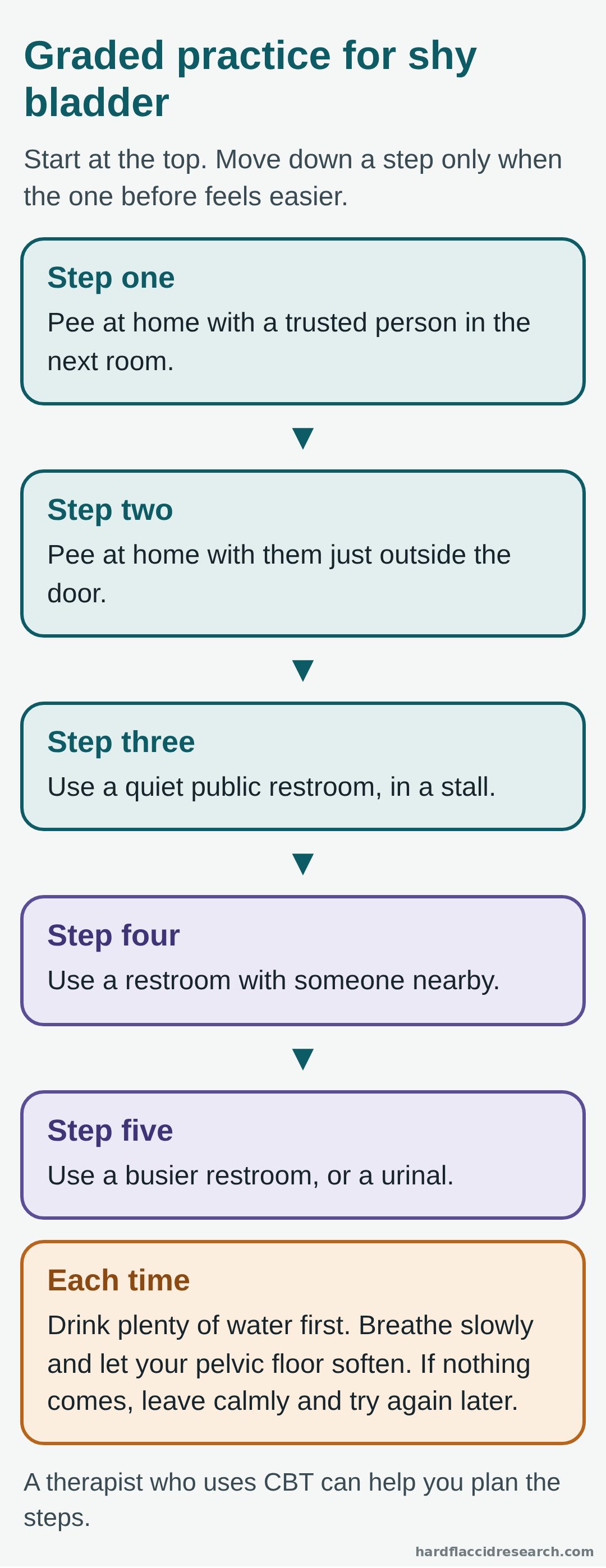
The most widely used approach is graded practice, sometimes with a therapist. You make a list of situations from easiest to hardest, then practice peeing in each one, starting with the easiest, until it feels easier. For example:
- Peeing at home with a trusted person in the next room.
- Peeing at home with them just outside the door.
- A quiet public restroom.
- A restroom with someone nearby.
- A busier restroom, or a urinal.
Drink plenty of water beforehand so you really need to go, give yourself time, and stay at each step until it's easier before moving up.
Cognitive behavioral therapy
CBT helps you notice and change the worried thoughts that keep the cycle going, such as "everyone is listening", and combines this with graded practice. Studies are small, but CBT and graded practice help many people.
Relaxing the muscles in the moment
- Breathe slowly into your belly. As you breathe out, let your pelvic floor drop and soften, as if you were starting to pee.
- Don't push or strain, which tightens the muscles more.
- Distract yourself: count backward, read something on your phone, or focus on a sound.
- Try a stall rather than a urinal, run a tap, or flush to cover the sound.
- If nothing comes after a minute or two, leave, relax and try again later.
Medicines
Medicines for anxiety are sometimes used alongside therapy for severe shy bladder. Ask a doctor about the options and side effects.
Tips for public restrooms
- Choose quieter times or less busy restrooms when you can, while you build up practice.
- Use a stall if it's easier, and take your time. No one is timing you.
- Run a tap, flush or play something on your phone to cover the sound.
- Breathe slowly and let your belly and pelvic floor soften before you try.
- If it isn't happening, leave calmly and try again later, rather than straining.
- Keep drinking normally through the day. Cutting back on fluids makes urine more concentrated and can irritate the bladder.
When should I see a doctor?
See a primary care provider if shy bladder affects your work, travel or social life, or if you've started drinking less to avoid restrooms. A therapist who uses CBT can help with the anxiety. Our doctor visit kit helps you explain what happens.
Also see a doctor or a urologist (a doctor for urinary and sexual health) if you have trouble peeing even when you're alone, a weak stream, pain, blood in your urine or a feeling that your bladder doesn't empty, because these suggest a physical cause.
Get urgent care straight away (call 911 or go to the emergency room) if you have:
- Not being able to pee at all for many hours, even when alone, or a painful, swollen bladder.
- New numbness around your back passage, genitals or inner thighs, or new weakness in your legs.
- Loss of control of your bladder or bowel.
- A fever or chills with pelvic pain or pain when peeing.
Frequently asked questions
How common is shy bladder?
Surveys suggest it's common, with many people having at least mild difficulty peeing in public restrooms. Many never talk about it.
Is it bad to hold in urine because of shy bladder?
Holding on now and then isn't harmful, but doing it often can lead to bladder discomfort and, rarely, problems emptying. Drinking less to avoid restrooms can cause dehydration and constipation.
Does shy bladder go away on its own?
It can come and go with stress. For many people, it improves a lot with graded practice and CBT.
Can a tight pelvic floor cause shy bladder?
A tight pelvic floor can make it harder to start peeing in any setting, and anxiety tightens it further. A pelvic floor physical therapist can help if you have other pelvic floor symptoms.
Is shy bladder the same as an enlarged prostate?
No. With an enlarged prostate, peeing is slow or hard even when you're alone. Shy bladder mainly happens around other people.
What if I need to give a urine sample?
Many people with shy bladder struggle with urine samples, including drug tests. Tell the staff beforehand, drink plenty of water, and ask whether you can have extra time or a more private setting.
Can children have shy bladder?
Yes. It often starts in childhood or the teenage years. Gentle support and graded practice help, and a doctor can check that there's no physical cause.
Does shy bladder affect bowel movements too?
Some people have a similar problem with bowel movements in public toilets, sometimes called shy bowel. The same steps, graded practice and relaxation, can help.
Takeaway
Shy bladder is difficulty peeing around other people, caused by anxiety tightening the muscles that keep the urethra closed. It's common and it isn't your fault.
Graded practice, CBT and slow breathing help many people, and a doctor should check for a physical cause if you also struggle when you're alone. Take our free self-check if you also notice changes in your penis at rest.
This article is for general information and isn't a substitute for advice from your own doctor. Hard Flaccid Research doesn't diagnose or treat. If you have new or worsening symptoms, see a qualified clinician. In an emergency, call 911.
Free tools that can help
- Self-check: do I have hard flaccid?Compare your symptoms with what 6,026 men report.
- Doctor visit kitA one-page summary to take to your appointment.
- Habit trackerCount your days without porn or masturbation, and get through urges.
- Diaphragm breathing toolBreathe with a moving picture of your diaphragm and pelvic floor.
- Add your experienceTell us what you tried and how it went. No name needed.
- Hard Flaccid Syndrome CensusWhat men answered in 818 polls.
- Symptom trackerLog your symptoms and see what helps you.
- Ask us a questionThe questions men ask most become new articles.
The numbers behind this article
Every number in this article comes from what men with hard flaccid syndrome shared between December 2020 and October 2026, counted once per person, or from their polls. These are self-selected reports, not a clinical study. See hard flaccid syndrome statistics, the Hard Flaccid Syndrome Census and how we count.
76% said they had anxiety before hard flaccid
How 123 men answered an April 2023 poll.In our polls, men choose to answer. This doesn't show that anxiety causes hard flaccid.
Source: Hard Flaccid Research, hardflaccidresearch.com
603 men discussed therapy, CBT, mindfulness or meditation
Men counted once each from what men wrote.Source: Hard Flaccid Research, hardflaccidresearch.com
Every number in this article, with its source
| In this article | Source |
|---|---|
| 13% of the men who described their symptoms described urinary problems (337 of 2,661) | 337 of 2,661 men, counted |
| 6,026 men shared their experiences, and 2,661 of them described their symptoms | 2,661 of 6,026 men, counted |
| 76% said they had anxiety before hard flaccid (94 of 123 men) | 94 of 123 men, poll, Apr 2023 |
| 603 men discussed therapy, CBT, mindfulness or meditation | 603 men discussing therapy, CBT, mindfulness or meditation, counted from what men wrote, once per person |
| 425 men discussed breathing exercises | 425 men discussing breathing exercises, counted from what men wrote, once per person |
Medical sources
What this article says about medical research, guidelines and urgent care comes from these sources.
- A systematic review of paruresis: clinical implications and future directions. J Psychosom Res. 2017;98:122-129. https://doi.org/10.1016/j.jpsychores.2017.05.015
- Hutchings HA, Kehinde A. Exploring paruresis ('shy bladder syndrome') and factors that may contribute to it: a cross-sectional UK survey study. BMJ Open. 2024;14:e086097. https://doi.org/10.1136/bmjopen-2024-086097
- Is "shy bladder syndrome" a subtype of social anxiety disorder? A survey of people with paruresis. Depress Anxiety. 2002;16(2):84-87. https://doi.org/10.1002/da.10061
- Paruresis or shy bladder syndrome: an unknown urologic malady? Urol Nurs. 2009;29(2):87-93. https://pubmed.ncbi.nlm.nih.gov/19507406/
- Cleveland Clinic. Shy bladder syndrome (paruresis). https://my.clevelandclinic.org/health/diseases/22208-shy-bladder-syndrome-paruresis
How we made this article
We started from the question many men asked. Every number was checked against our data. Our editorial team edited it and Dr. Julian Reyes reviewed it medically. Read our editorial policy.
Read next
See more of us on Google
Add Hard Flaccid Research as a preferred source, and Google shows you our pages more often when you search.
Add as a preferred sourceDon't see your question? Ask us. We answer the most-asked ones in new articles.
Cite and share this article
You're welcome to quote this article. Please name Hard Flaccid Research and link to this page, so others can find the full answer and the data behind it. To cite this page, use its link.
Citation
Hard Flaccid Research. (2026). Shy Bladder (Paruresis): Why You Can't Pee Around Others. Written by the Editorial Team, medically reviewed by Dr. Julian Reyes. https://hardflaccidresearch.com/articles/shy-bladder
Credit link for your article
Source: <a href="https://hardflaccidresearch.com/articles/shy-bladder">Hard Flaccid Research</a>
Wikipedia reference
<ref>{{cite web |url=https://hardflaccidresearch.com/articles/shy-bladder |title=Shy Bladder (Paruresis): Why You Can't Pee Around Others |website=Hard Flaccid Research |date=2026 |access-date=22 November 2026}}</ref>
How the data was collected: our methodology. Journalists and researchers: key numbers, data and contact.