Testicle Anatomy: Parts, What They Do and What's Normal
In short
- Each testicle is an oval gland inside the scrotum that makes sperm and testosterone.
- It's wrapped in protective layers, and sperm leave it through tiny ducts into the epididymis, a coiled tube on its back, then travel up the vas deferens in the spermatic cord.
- Knowing what's normal makes it easier to spot changes that need a doctor.
Each testicle, or testis, is an oval gland that hangs in the scrotum. The testicles have two jobs: making sperm and making testosterone, the main male sex hormone.
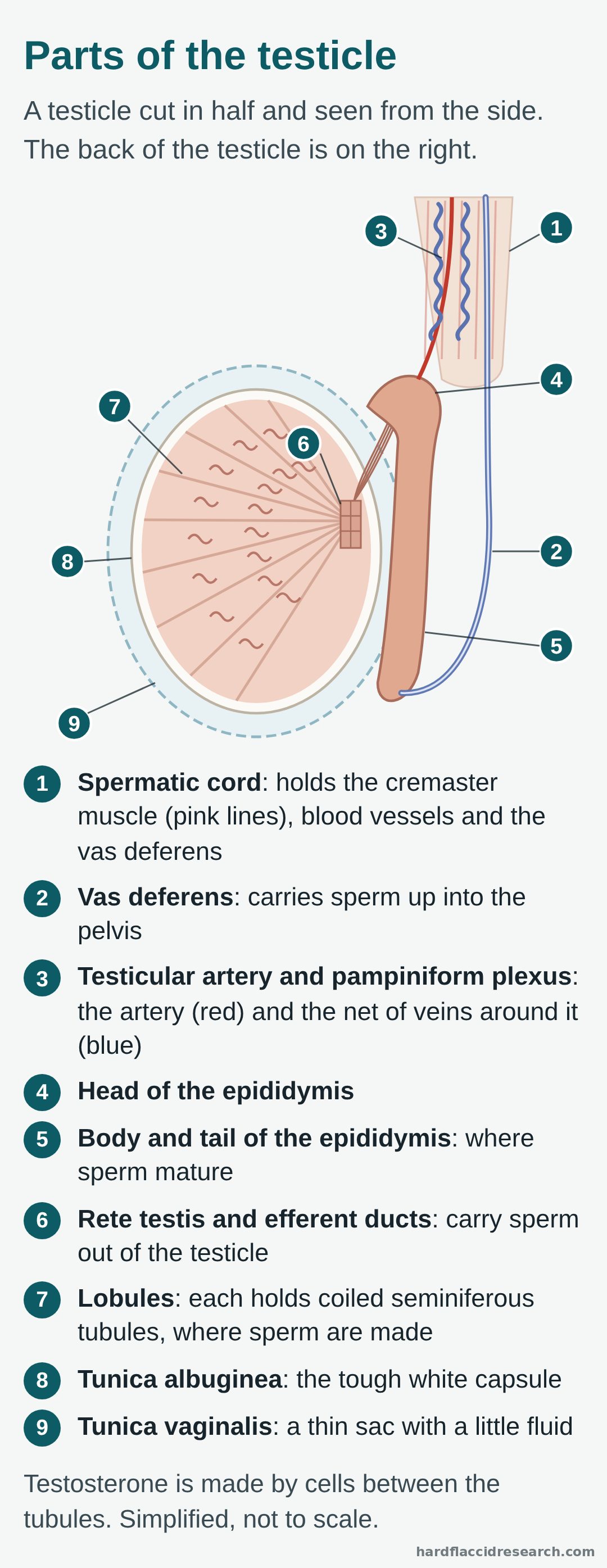
A testicle isn't just a solid ball. It's made of hundreds of tiny coiled tubes packed into sections, wrapped in tough protective layers, with a coiled tube on its back and a cord that carries its blood supply, nerves and sperm duct. This page walks through each part with a labeled drawing, explains what each one does and describes what a normal testicle feels like.
By the numbers: of the 6,026 men who shared their experiences with hard flaccid syndrome, 2,661 described their symptoms, and 102 of them described testicle pain or a tight scrotum.
Key facts
- The testicles make sperm and testosterone.
- Inside, each testicle is divided into lobules filled with coiled seminiferous tubules, where sperm are made.
- Cells between the tubules, called Leydig cells, make testosterone.
- Sperm mature in the epididymis, a coiled tube on the back of each testicle, then travel up the vas deferens.
- The spermatic cord holds the vas deferens, the testicular artery, a network of veins, nerves and the cremaster muscle.
- The testicles sit outside the body because sperm develop best slightly below body temperature.
What are the parts of the testicle?
Working from the outside in, and then out along the path sperm take:
The scrotum
The scrotum is the pouch of skin that holds the testicles. A thin layer of muscle under the skin, the dartos, wrinkles and tightens it in the cold and relaxes it in the warmth. A wall down the middle keeps each testicle in its own space. It's normal for one testicle, often the left, to hang a little lower.
The tunica vaginalis
A thin, smooth, two-layered sac that covers most of the testicle. A little fluid between its layers lets the testicle move freely. If too much fluid collects here, it's called a hydrocele.
The tunica albuginea
A tough, white, fibrous capsule just under the tunica vaginalis. It protects the testicle and sends thin walls inward, dividing the inside into a few hundred wedge-shaped lobules.
The lobules and seminiferous tubules
Each lobule holds a few tightly coiled seminiferous tubules. This is where sperm are made, from cells along the tubule walls, with support from Sertoli cells. Uncoiled, the tubules in one testicle would stretch a very long way.
The Leydig cells
Between the tubules sit the Leydig cells. They make testosterone, which passes into the blood and supports sex drive, erections, muscle, bone and mood.
The rete testis and efferent ducts
The tubules drain into a network of channels at the back of the testicle, the rete testis. From there, a group of small efferent ducts carries sperm out of the testicle into the epididymis.
The epididymis
A long, tightly coiled tube that sits along the back of the testicle like a comma. It has a head at the top, a body and a tail at the bottom. Sperm spend days here maturing and learning to swim. You can feel the epididymis as a soft ridge at the back of the testicle, and it's where a spermatocele, a harmless cyst, can form.
The vas deferens
A firm, muscular tube that leaves the tail of the epididymis and runs up through the spermatic cord into the pelvis, where it joins the duct from the seminal vesicle near the prostate. In a vasectomy, this is the tube that's cut.
The spermatic cord
The cord that hangs each testicle from the body. It runs up through the groin into the abdomen and holds:
- The vas deferens.
- The testicular artery, which brings blood straight from the main artery in the abdomen.
- The pampiniform plexus, a net of veins around the artery that cools the incoming blood. When these veins swell, it's called a varicocele.
- Nerves and lymph vessels.
- The cremaster muscle, which wraps the cord and pulls the testicle up in the cold, during arousal or when the inner thigh is touched.
Related: Adderall and Erectile Dysfunction: Why It Happens, What Helps »
How do the testicles develop?
Before birth, the testicles form inside the abdomen, near the kidneys. As the baby grows, they move down through the groin, through a passage called the inguinal canal, into the scrotum. They take their blood vessels, nerves and the vas deferens with them, which is why these all run up through the groin in the spermatic cord.
Sometimes a testicle doesn't finish this journey and stays in the groin or abdomen. This is called an undescended testicle. It's usually treated with surgery in early childhood, because a testicle that stays up is more likely to have problems with fertility and cancer later. The same passage can also leave a weak spot in the groin where a hernia can form.
What does a normal testicle feel like?
- Smooth, firm but not hard, and oval, a bit like a peeled hard-boiled egg.
- About the same size as the other one, though one is often slightly larger.
- Movable inside the scrotum.
- With a soft, rope-like ridge at the back (the epididymis) and a firm tube rising from it into the cord (the vas deferens). These are normal.
A monthly check after a warm shower helps you learn what's normal for you. Roll each testicle gently between your thumb and fingers and note any lump, hard spot, swelling or change in size.
Related: Antidepressants and Hard Flaccid: Help or Hidden Problem? »
What can go wrong?
- Testicular torsion: the cord twists and cuts off the blood supply, causing sudden, severe pain. It's an emergency, and surgery within hours can save the testicle.
- Epididymitis: an inflamed, tender epididymis, often from an infection.
- Hydrocele, varicocele and spermatocele: usually harmless swellings around the testicle, in the cord veins or on the epididymis.
- Testicular cancer: most often a painless lump or hard area in the testicle itself. It's most common in young men and very treatable when found early.
- Low testosterone: can cause low sex drive, tiredness and weaker erections.
The testicles and hard flaccid syndrome
Hard flaccid syndrome is a firm, shrunken penis at rest, often with numbness, weaker erections and pelvic pain. It doesn't start in the testicles, but some men notice testicle symptoms alongside it.
Of the 2,661 men who described their symptoms, 4% described testicle pain or a tight scrotum (102 men), and 9% described low libido (230 men). A tense pelvic floor can make the scrotum sit high and tight and cause aching that feels like it comes from the testicles. In separate counts, 99 men discussed testosterone or other hormones.
If you're wondering whether your hormones are part of the picture, our members' guide, Hard Flaccid Blood Tests: Testosterone, Sugar and Hormones, explains which tests to ask for and what the results mean.
When should I see a doctor?
See a primary care provider or a urologist (a doctor for urinary and sexual health) if you notice a lump, hard spot, swelling or change in size in a testicle, an ache that keeps coming back, or a change in sex drive. Our doctor visit kit helps you note what you've found and when.
Get urgent care straight away (call 911 or go to the emergency room) if you have:
- Sudden, severe pain or swelling in a testicle, especially with nausea or vomiting.
- A testicle that suddenly sits higher than usual or lies sideways, with pain.
- A fever or chills with a painful, swollen scrotum.
- A hard, swollen scrotum after an injury.
Frequently asked questions
Why is one testicle bigger or lower than the other?
It's very common for one testicle to be slightly larger and for one, often the left, to hang lower. A sudden change in size or position is worth checking.
What is the lump on the back of my testicle?
Usually it's the epididymis, a normal coiled tube. A separate round lump above or behind the testicle is often a harmless cyst, but any new lump should be checked.
Why do testicles move up and down?
The cremaster muscle and the dartos muscle in the scrotum lift the testicles in the cold, during arousal and with stress, and relax them in the warmth.
Where is testosterone made?
In the Leydig cells between the tubules of the testicles, with a small amount made by the adrenal glands.
Can the testicles cause pain somewhere else?
Yes. Testicle problems can cause pain in the groin or lower belly, and pain from the back, groin or pelvic floor can be felt in the testicles.
Takeaway
Each testicle is a gland packed with coiled tubes that make sperm, with cells between them that make testosterone. Sperm mature in the epididymis and leave through the vas deferens, which runs up the spermatic cord with the testicle's blood vessels and the cremaster muscle.
Knowing what's normal helps you spot changes early. See a doctor about any new lump, and get urgent care for sudden, severe testicle pain. Take our free self-check if you also notice changes in your penis at rest.
This article is for general information and isn't a substitute for advice from your own doctor. Hard Flaccid Research doesn't diagnose or treat. If you have new or worsening symptoms, see a qualified clinician. In an emergency, call 911.
Free tools that can help
- Self-check: do I have hard flaccid?Compare your symptoms with what 6,026 men report.
- Doctor visit kitA one-page summary to take to your appointment.
- Habit trackerCount your days without porn or masturbation, and get through urges.
- Diaphragm breathing toolBreathe with a moving picture of your diaphragm and pelvic floor.
- Add your experienceTell us what you tried and how it went. No name needed.
- Hard Flaccid Syndrome CensusWhat men answered in 818 polls.
- Symptom trackerLog your symptoms and see what helps you.
- Ask us a questionThe questions men ask most become new articles.
The numbers behind this article
Every number in this article comes from what men with hard flaccid syndrome shared between December 2020 and October 2026, counted once per person, or from their polls. These are self-selected reports, not a clinical study. See hard flaccid syndrome statistics, the Hard Flaccid Syndrome Census and how we count.
9% of men who described their symptoms described low libido
Share of the 2,661 men who described their symptoms. Each man is counted once.These are self-selected reports, not a clinical study.
Source: Hard Flaccid Research, hardflaccidresearch.com
Every number in this article, with its source
| In this article | Source |
|---|---|
| 4% of the men who described their symptoms described testicle pain or a tight scrotum (102 of 2,661) | 102 of 2,661 men, counted |
| 9% of the men who described their symptoms described low libido (230 of 2,661) | 230 of 2,661 men, counted |
| 6,026 men shared their experiences, and 2,661 of them described their symptoms | 2,661 of 6,026 men, counted |
| 99 men discussed testosterone or other hormones | 99 men discussing testosterone or other hormones, counted from what men wrote |
Medical sources
What this article says about medical research, guidelines and urgent care comes from these sources.
- Anatomy, Abdomen and Pelvis: Testes. In: StatPearls. Treasure Island (FL): StatPearls Publishing. https://www.ncbi.nlm.nih.gov/books/NBK470201/
- Embryology, Testicle. In: StatPearls. Treasure Island (FL): StatPearls Publishing. https://www.ncbi.nlm.nih.gov/books/NBK557763/
- Acute Scrotum Pain. In: StatPearls. Treasure Island (FL): StatPearls Publishing. https://www.ncbi.nlm.nih.gov/books/NBK470335/
- Testicular Torsion. In: StatPearls. Treasure Island (FL): StatPearls Publishing. https://www.ncbi.nlm.nih.gov/books/NBK448199/
- Testicular torsion: diagnosis, evaluation, and management. Am Fam Physician. 2013;88(12):835-840. https://pubmed.ncbi.nlm.nih.gov/24364548/
- Crawford P, Crop JA. Evaluation of scrotal masses. Am Fam Physician. 2014;89(9):723-727. https://www.aafp.org/pubs/afp/issues/2014/0501/p723.html
How we made this article
We started from the question many men asked. Every number was checked against our data. Our editorial team edited it and Dr. Julian Reyes reviewed it medically. Read our editorial policy.
Read next
See more of us on Google
Add Hard Flaccid Research as a preferred source, and Google shows you our pages more often when you search.
Add as a preferred sourceDon't see your question? Ask us. We answer the most-asked ones in new articles.
Cite and share this article
You're welcome to quote this article. Please name Hard Flaccid Research and link to this page, so others can find the full answer and the data behind it. To cite this page, use its link.
Citation
Hard Flaccid Research. (2026). Testicle Anatomy: Parts, What They Do and What's Normal. Written by the Editorial Team, medically reviewed by Dr. Julian Reyes. https://hardflaccidresearch.com/articles/testicle-anatomy
Credit link for your article
Source: <a href="https://hardflaccidresearch.com/articles/testicle-anatomy">Hard Flaccid Research</a>
Wikipedia reference
<ref>{{cite web |url=https://hardflaccidresearch.com/articles/testicle-anatomy |title=Testicle Anatomy: Parts, What They Do and What's Normal |website=Hard Flaccid Research |date=2026 |access-date=22 November 2026}}</ref>
How the data was collected: our methodology. Journalists and researchers: key numbers, data and contact.