Weak Ejaculation: Causes, When to Worry and What Helps
In short
- Weak ejaculation is when semen dribbles out rather than spurts, or orgasm feels less intense than before.
- It's often linked to age, a weak or tight pelvic floor, ejaculating often, some medicines such as alpha blockers, low testosterone and nerve problems.
- It isn't usually dangerous, and pelvic floor exercises, a medicine review and treating the cause often help.
Weak ejaculation is when semen dribbles or oozes out instead of spurting, or when orgasm feels less powerful than it used to. Some men also notice less semen, or an orgasm that feels flat or muted.
It's common, especially as men get older, and it isn't usually a sign of anything dangerous. Doctors include it among the less well-known disorders of ejaculation. Common causes include a weak or tight pelvic floor, ejaculating often, certain medicines, low testosterone and nerve problems, and many of these can be helped. This page explains what makes ejaculation strong, what weakens it, and what you can do.
By the numbers: of the 6,026 men who shared their experiences with hard flaccid syndrome, 2,661 described their symptoms, and 202 of them described a weak or painful orgasm or ejaculation problems.
Key facts
- A strong ejaculation needs enough semen, a bladder neck that closes, and strong waves of contraction from the pelvic floor muscles.
- Weakness can come from less semen, from weaker or poorly coordinated muscle contractions, or from semen going backward.
- Common causes include age, a weak or tight pelvic floor, ejaculating often, alpha blockers and some other medicines, low testosterone, diabetes and nerve damage.
- Weak ejaculation isn't usually harmful, but it can affect sexual satisfaction and, sometimes, fertility.
- Pelvic floor exercises, reviewing medicines with a doctor and treating the cause often help.
What makes ejaculation strong?
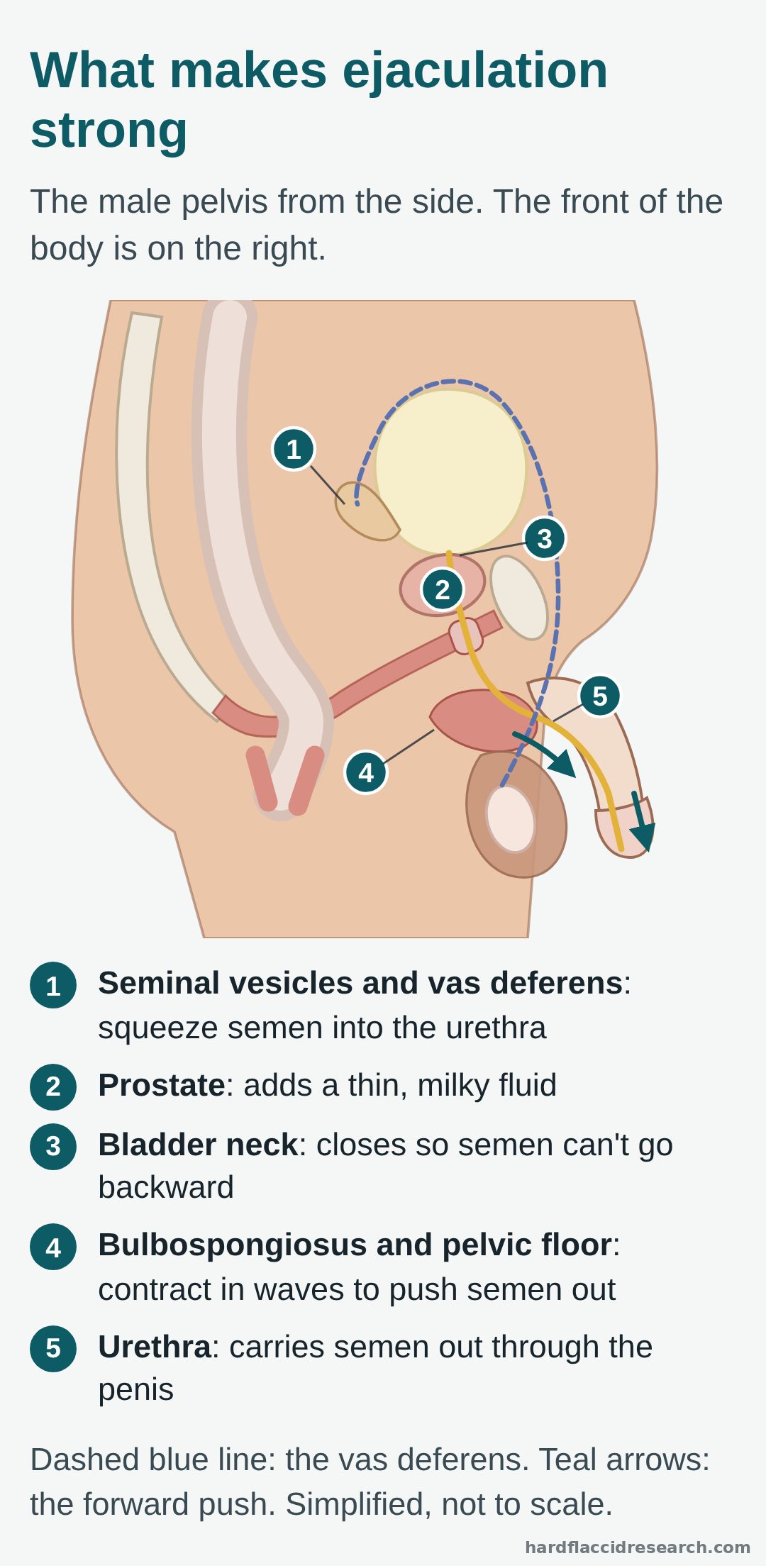
Ejaculation happens in two steps:
- Emission: the vas deferens, the seminal vesicles and the prostate squeeze semen into the first part of the urethra. At the same time, the bladder neck closes so semen can't go backward.
- Expulsion: the bulbospongiosus and other pelvic floor muscles at the base of the penis contract in rhythmic waves, pushing semen out through the urethra.
The force you feel comes mainly from the second step. The amount of semen and how well the bladder neck closes matter too.
Related: Alpha Blockers for Hard Flaccid: 45% of Men Said They Help »
What causes weak ejaculation?
Age
With age, the pelvic floor muscles can weaken, semen volume often falls and the prostate changes. A gradual decline in force is common and normal.
A weak pelvic floor
If the bulbospongiosus and other pelvic floor muscles are weak, the waves that push semen out are weaker. This is more common with age, inactivity and after prostate surgery.
A tight pelvic floor
Muscles that are always tense don't contract well when needed. A tight pelvic floor can make ejaculation feel weak, muted or painful.
Ejaculating often
Ejaculating several times in a short period lowers semen volume, which can make ejaculation feel weaker until the body catches up.
Medicines
- Alpha blockers, such as tamsulosin and silodosin, can reduce or stop semen coming out by affecting the bladder neck and the muscles of emission.
- Medicines that shrink the prostate, such as finasteride and dutasteride, can lower semen volume.
- Some antidepressants can delay ejaculation and make orgasm feel weaker.
- Some blood pressure medicines and antipsychotics can affect ejaculation too.
Low testosterone
Low testosterone can lower sex drive, semen volume and the intensity of orgasm.
Retrograde ejaculation
If some semen goes backward into the bladder, less comes out. A urine test after orgasm can check for this.
Nerve damage and diabetes
Diabetes, spinal problems, multiple sclerosis and pelvic surgery can affect the nerves that control ejaculation.
Other causes
Prostatitis, a blocked ejaculatory duct, low arousal, tiredness, alcohol and stress can all play a part.
Weak ejaculation and hard flaccid syndrome
Hard flaccid syndrome is a firm, shrunken penis at rest, often with numbness, weaker erections and pelvic pain. Many men with hard flaccid notice changes in ejaculation and orgasm, which may be linked to pelvic floor tension or reduced sensation. This isn't proven.
Of the 2,661 men who described their symptoms, 23% described pelvic floor tightness, spasm or twitching (601 men), 9% described low libido (230 men) and 8% described a weak or painful orgasm or ejaculation problems (202 men). In separate counts, 378 men discussed alpha blockers, which can make ejaculation weaker or drier.
Our members' guide, Hard Flaccid Syndrome Medicines: What to Ask Your Doctor, lists questions to ask about side effects like this.
Related: Bulbospongiosus Muscle: Erections, Ejaculation and Dribbling »
How is weak ejaculation diagnosed?
A primary care provider or a urologist (a doctor for urinary and sexual health) will ask when it started, whether the amount of semen has changed, and about your medicines, health and sexual function. They may suggest:
- A urine test after orgasm, to check for retrograde ejaculation.
- Blood tests for testosterone and diabetes.
- A semen test, especially if you're trying for a baby.
- A pelvic floor assessment by a physical therapist.
Our doctor visit kit helps you list your medicines and describe the change.
What helps weak ejaculation?
Pelvic floor exercises
If your pelvic floor is weak, exercises can strengthen the muscles that power ejaculation. A small trial found pelvic floor exercises helped some men with erection problems, and the same muscles drive ejaculation. A pelvic floor physical therapist can teach the right technique.
Relaxation, if the pelvic floor is tight
If your pelvic floor is tight, relaxation work, breathing and stretching usually come first.
Reviewing medicines
Never stop a medicine on your own. Ask your doctor whether a medicine could be the cause, and whether a different dose, timing or medicine might help.
Treating the cause
Low testosterone, diabetes or prostatitis can be treated by your doctor, which may improve ejaculation.
Lifestyle
- Allow a day or two between ejaculations if volume is low.
- Drink enough water, eat well and stay active.
- Cut back on alcohol and stop smoking.
- Take time to get fully aroused, which can make orgasm stronger.
When should I see a doctor?
See a primary care provider or a urologist if your ejaculation has become noticeably weaker or drier, especially if it started with a new medicine, comes with low sex drive or erection problems, or you're trying for a baby.
Get urgent care straight away (call 911 or go to the emergency room) if you have:
- New numbness around your back passage, genitals or inner thighs, or new weakness in your legs.
- New trouble starting or controlling your pee, not being able to pee, or not feeling when your bladder is full.
- Loss of control of your bladder or bowel.
- Sudden, severe pain in the penis, testicles or pelvis.
Weak ejaculation or weak orgasm?
These often go together, but they aren't the same:
- Weak ejaculation is about the force and amount of semen. Semen dribbles out instead of spurting.
- A weak orgasm is about the feeling. The pleasure feels muted or flat, even if semen comes out normally. Doctors sometimes call this anhedonic or reduced-sensation orgasm.
A weak orgasm can come from reduced sensation in the penis, low sex drive, some antidepressants, low testosterone, tiredness or stress. Telling your doctor which one you notice, or both, helps them look for the right cause.
Frequently asked questions
Is weak ejaculation normal with age?
A gradual decline in force and volume is common with age. A sudden change is worth checking.
Can Kegels make ejaculation stronger?
They can help if your pelvic floor is weak. If it's tight, relaxing it may help more.
Does weak ejaculation affect fertility?
It can if less semen comes out. A semen test can show whether fertility is affected.
Can masturbating too often cause weak ejaculation?
Ejaculating often lowers semen volume for a while, which can make ejaculation feel weaker. It recovers with time.
Can low testosterone cause weak orgasms?
Yes. Low testosterone can lower sex drive, semen volume and orgasm intensity. A blood test can check.
Is weak ejaculation the same as retrograde ejaculation?
Not always. In retrograde ejaculation, semen goes backward into the bladder. Weak ejaculation can also come from weak muscles or low volume.
Can stress make ejaculation weaker?
Yes. Stress can lower arousal, tighten the pelvic floor and make orgasm feel less intense. Managing stress often helps.
Does weak ejaculation mean my prostate is enlarged?
Not necessarily. An enlarged prostate and the medicines for it can affect ejaculation, but there are many other causes. A doctor can check.
Can weak ejaculation get better on its own?
If it's from ejaculating often, tiredness or stress, it often improves on its own. If it comes from a medicine or a health condition, treating the cause usually helps more than waiting.
Should I see a urologist or a pelvic floor physical therapist?
Start with a primary care provider or a urologist, who can check for medical causes. If your pelvic floor seems weak or tight, they can refer you to a pelvic floor physical therapist.
Can diabetes cause weak ejaculation?
Yes. Over time, diabetes can affect the nerves that control the bladder neck and the muscles of ejaculation, which can make ejaculation weaker or send semen backward.
Takeaway
Weak ejaculation is common and usually not dangerous. It can come from age, a weak or tight pelvic floor, ejaculating often, medicines, low testosterone or nerve problems.
Pelvic floor work, a medicine review with your doctor and treating the cause often help. Take our free self-check if you also notice changes in your penis at rest.
This article is for general information and isn't a substitute for advice from your own doctor. Hard Flaccid Research doesn't diagnose or treat. If you have new or worsening symptoms, see a qualified clinician. In an emergency, call 911.
Free tools that can help
- Self-check: do I have hard flaccid?Compare your symptoms with what 6,026 men report.
- Doctor visit kitA one-page summary to take to your appointment.
- Habit trackerCount your days without porn or masturbation, and get through urges.
- Diaphragm breathing toolBreathe with a moving picture of your diaphragm and pelvic floor.
- Add your experienceTell us what you tried and how it went. No name needed.
- Hard Flaccid Syndrome CensusWhat men answered in 818 polls.
- Symptom trackerLog your symptoms and see what helps you.
- Ask us a questionThe questions men ask most become new articles.
The numbers behind this article
Every number in this article comes from what men with hard flaccid syndrome shared between December 2020 and October 2026, counted once per person, or from their polls. These are self-selected reports, not a clinical study. See hard flaccid syndrome statistics, the Hard Flaccid Syndrome Census and how we count.
8% of men who described their symptoms described orgasm or ejaculation problems
Share of the 2,661 men who described their symptoms. Each man is counted once.These are self-selected reports, not a clinical study.
Source: Hard Flaccid Research, hardflaccidresearch.com
Every number in this article, with its source
| In this article | Source |
|---|---|
| 8% of the men who described their symptoms described a weak or painful orgasm or ejaculation problems (202 of 2,661) | 202 of 2,661 men, counted |
| 23% of the men who described their symptoms described pelvic floor tightness, spasm or twitching (601 of 2,661) | 601 of 2,661 men, counted |
| 9% of the men who described their symptoms described low libido (230 of 2,661) | 230 of 2,661 men, counted |
| 6,026 men shared their experiences, and 2,661 of them described their symptoms | 2,661 of 6,026 men, counted |
| 378 men discussed alpha blockers | 378 men discussing alpha blockers, counted from what men wrote, once per person |
Medical sources
What this article says about medical research, guidelines and urgent care comes from these sources.
- Shindel AW, Althof SE, Carrier S, et al. Disorders of ejaculation: an AUA/SMSNA guideline. J Urol. 2022;207(3):504-512. https://doi.org/10.1097/JU.0000000000002392
- Review of recent data on disorders of ejaculation and orgasm in men: recommendations from the Fifth International Consultation on Sexual Medicine. Sex Med Rev. 2025;13(3):318-337. https://doi.org/10.1093/sxmrev/qeaf016
- Ejaculatory dysfunction in the treatment of lower urinary tract symptoms. Transl Androl Urol. 2016;5(4):450-459. https://doi.org/10.21037/tau.2016.06.06
- Parnham A, Serefoglu EC. Retrograde ejaculation, painful ejaculation and hematospermia. Transl Androl Urol. 2016;5(4):592-601. https://doi.org/10.21037/tau.2016.06.05
- Dorey G, Speakman MJ, Feneley RCL, Swinkels A, Dunn CDR. Pelvic floor exercises for erectile dysfunction. BJU Int. 2005;96:595-597. https://doi.org/10.1111/j.1464-410X.2005.05690.x
- Anatomy, Abdomen and Pelvis, Penis. In: StatPearls. Treasure Island (FL): StatPearls Publishing. https://www.ncbi.nlm.nih.gov/books/NBK482236/
How we made this article
We started from the question many men asked. Every number was checked against our data. Our editorial team edited it and Dr. Julian Reyes reviewed it medically. Read our editorial policy.
Read next
See more of us on Google
Add Hard Flaccid Research as a preferred source, and Google shows you our pages more often when you search.
Add as a preferred sourceDon't see your question? Ask us. We answer the most-asked ones in new articles.
Cite and share this article
You're welcome to quote this article. Please name Hard Flaccid Research and link to this page, so others can find the full answer and the data behind it. To cite this page, use its link.
Citation
Hard Flaccid Research. (2026). Weak Ejaculation: Causes, When to Worry and What Helps. Written by the Editorial Team, medically reviewed by Dr. Julian Reyes. https://hardflaccidresearch.com/articles/weak-ejaculation
Credit link for your article
Source: <a href="https://hardflaccidresearch.com/articles/weak-ejaculation">Hard Flaccid Research</a>
Wikipedia reference
<ref>{{cite web |url=https://hardflaccidresearch.com/articles/weak-ejaculation |title=Weak Ejaculation: Causes, When to Worry and What Helps |website=Hard Flaccid Research |date=2026 |access-date=22 November 2026}}</ref>
How the data was collected: our methodology. Journalists and researchers: key numbers, data and contact.