Surgery for Hard Flaccid? What 126 Recovery Stories Show
In short
- Surgery for hard flaccid syndrome may help only when tests show a separate problem it can fix, such as a trapped nerve, and no operation is designed for hard flaccid itself.
- In the 126 recovery stories men shared, pudendal surgery came up in none, while stretching came up in 40.
- Many men get better with gentler steps, so try those first and get a second opinion before any operation.
112 men with hard flaccid asked this question.
Surgery for hard flaccid syndrome means an operation on a nerve, a blood vessel or the penis to try to ease its symptoms. An operation may help only when tests show a separate problem it can fix, such as a trapped nerve. In the 126 recovery stories men shared, pudendal surgery came up in none, while stretching came up in 40.
Many men get better with gentler steps. This page covers the operations men ask about, what each can fix, what to ask a surgeon, and what helped the men who got better.
By the numbers: of the 6,026 men who shared their experiences between December 2020 and October 2026, 112 asked whether surgery is an option. What men wrote and what they answered in our polls are self-selected reports, not a clinical study.

Key facts
- Men do get better. In a June 2023 poll, 42% said they were at least half better (56 of 132 men). Men who recover may stop answering polls, so this may undercount recovery.
- Stretching came up in 40 of the 126 recovery stories, more than anything else; vein procedures came up in 2 and other surgery in 1.
- No operation is designed for hard flaccid syndrome: each one fixes a separate problem, such as a trapped nerve.
- US guidelines on erectile dysfunction don't recommend vein surgery.
- Get a second opinion before agreeing to any operation.
Hard Flaccid Explorerby Hard Flaccid Research
Could surgery help hard flaccid?
A 7-minute animated explainer of this article. Press play, or skip between chapters. The first minute is free for everyone.
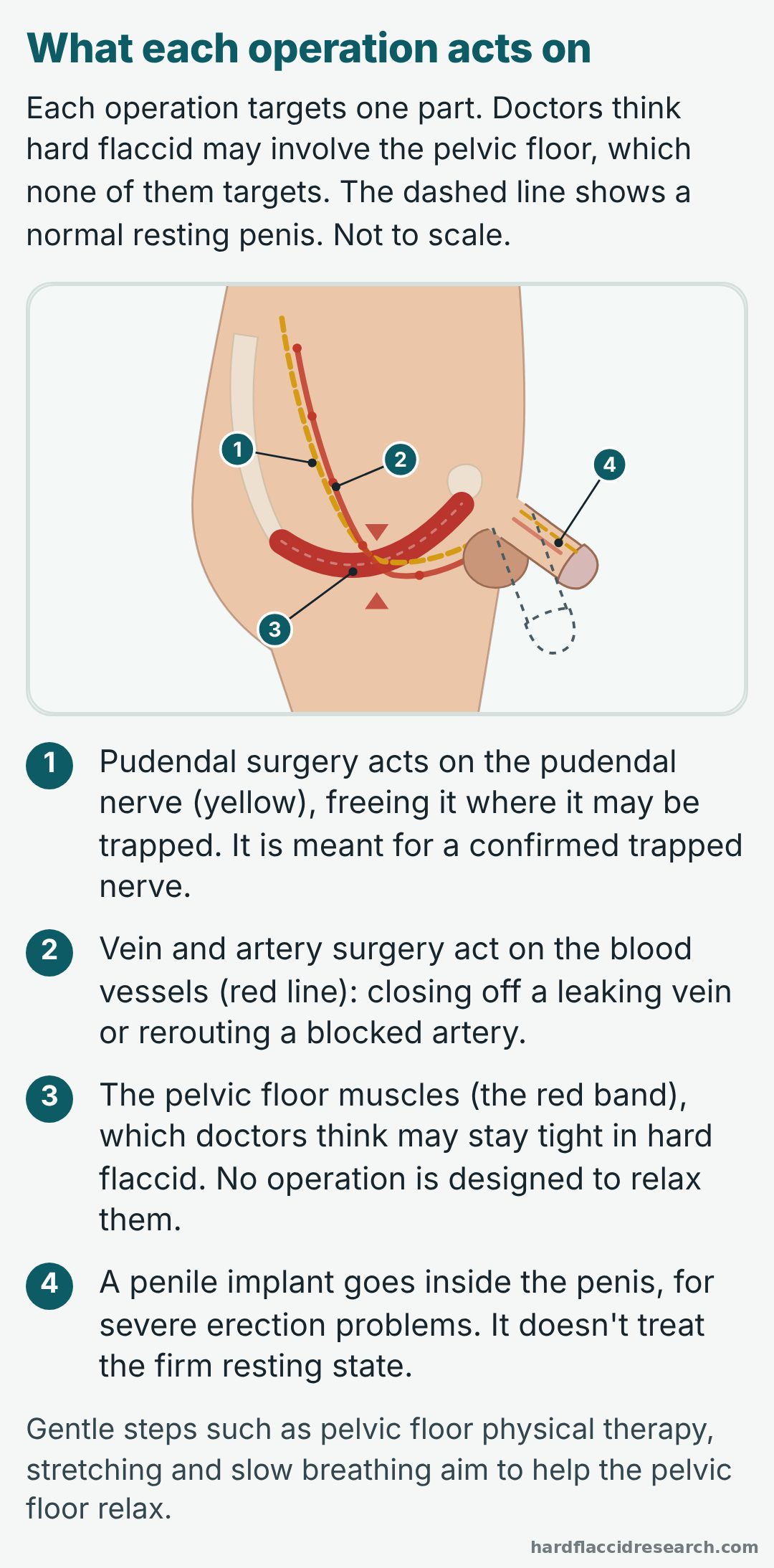
A picture to explain, not a diagnosis. The drawing shows what each operation acts on, not how anyone will do after one.
What operations do men ask about for hard flaccid?
Men ask about several operations. Each one was designed for a different condition, not for hard flaccid:
- Pudendal surgery (pudendal nerve decompression). It frees the pudendal nerve (pyoo-DEN-dul), the main nerve between the legs, where it may be trapped in the pelvis.
- Vein surgery. It ties off veins, or blocks them from inside (embolization), when blood drains out of the penis too fast during an erection. Doctors call this a venous leak.
- Artery surgery (penile revascularization). It reroutes blood around a blocked artery that feeds the penis.
- A penile implant. Bendable or inflatable rods are placed inside the penis for severe erection problems.
- Other operations, such as ligament repair, hernia repair, spine surgery for a slipped disc, and circumcision.
Men discussed these far less than gentle steps: 1,288 men discussed stretching, against 140 who discussed other surgery, 112 vein procedures and 82 pudendal surgery. Here, other surgery means operations such as ligament repair, an implant or hernia repair. Injections such as Botox, PRP (platelet-rich plasma) and nerve blocks aren't surgery, but men ask about them alongside it.
If you've been offered an operation, write down its exact name, so you can ask the right questions about it.
Related: Nerve Blocks or Botox for Hard Flaccid? Read This First »
Could surgery help hard flaccid?
Only if you also have a separate problem that the operation fixes. Surgery can free a squeezed nerve, reroute a blocked artery or close off a leaking vein. Doctors think hard flaccid may instead involve a tight pelvic floor, overactive nerve signals and stress, and no operation is designed to change those.
Tests point the same way. In a study of men with hard flaccid at one US clinic, presented at a medical meeting, blood flow into the penis was normal in all the men scanned. Those scans looked only at blood flow, not at the nerves.
Among the men who discussed other surgery and also described their symptoms, 77% described the firm flaccid state, 70% weaker erections and 63% numbness. None of these operations is aimed at the firm resting state.
Ask your doctor which of your symptoms an operation is meant to change, and which it won't.
What does the research say about surgery for hard flaccid?
No study has set out to test an operation for hard flaccid, and only single case reports mention one. The research on hard flaccid is small: case reports, small case series, surveys and reviews. What is known about each operation comes from other conditions:
- Pudendal surgery. In a small trial in people with a confirmed trapped pudendal nerve, more improved after surgery than without it. A trapped nerve isn't the same condition as hard flaccid.
- Vein surgery. US guidelines on erectile dysfunction don't recommend penile vein surgery. Blocking veins from inside has only small studies, with results that vary widely and no long-term answers yet.
- Artery surgery. The same guidelines say it may be considered for young men with a single blocked spot in an artery, often after an injury. The veins must work normally, with no wider artery disease.
- A penile implant. The guidelines say men with erectile dysfunction should be told about this option, with its benefits and risks. It isn't a treatment for hard flaccid.
- Spine surgery and circumcision. Case reports describe a man who improved after surgery for a slipped disc, in a report that wasn't peer reviewed, and a man whom circumcision didn't help.
- Prostate surgery. US guidelines on pelvic pain in men say doctors shouldn't operate on the prostate to relieve pain.
If anyone quotes success rates for hard flaccid surgery, ask to see the published study behind them.
Related: Hard Flaccid Pudendal Surgery: 82 Men, 0 Recovery Stories »
What do the 126 recovery stories show?
Of the 126 stories men shared of getting much better, pudendal surgery came up in 0, vein procedures in 2 and other surgery in 1. Stretching came up in 40, more than anything else.
Injections came up a few times: nerve blocks in 3 of the 126 stories, PRP in 2 and Botox in 0. Men who had an operation may not have written a story, so this can't show that surgery never helps anyone.
What the stories do show is how much men credited gentle, low-risk steps. Before you decide, read what men who got better did, step by step.
What tests come before an operation?
A careful surgeon first looks for a problem the operation can fix. The tests depend on the operation:
- Pudendal surgery: a check against the Nantes criteria for a trapped nerve. Two of the signs are pain that is worse when sitting, and pain that eases for a while after a numbing injection near the nerve (a diagnostic nerve block).
- Vein or artery surgery: a penile Doppler ultrasound, which measures blood flow after an injection that brings on an erection. Ask first whether the result would change your care.
- A penile implant: a check of how severe the erection problems are, and which treatments have been tried.
- Spine surgery: an exam and an MRI scan that match your back or leg symptoms.
Before any exam, the doctor should explain each step and ask before touching you, and you can ask for a chaperone. An internal check, through the back passage, happens only if you agree.
Normal results make some fixable problems less likely, which points back to the gentler steps below. Our doctor visit kit helps you set out your symptoms and what you've tried.
Is surgery for hard flaccid safe?
Every operation has risks, so the benefit for your own problem needs to be clear. Possible problems include:
- Infection, bleeding, scarring and the risks of an anesthetic.
- New or worse numbness, more pain or shortening.
- After pudendal surgery, a long recovery, and pain that may not improve.
- After a vein procedure, the leak coming back through other veins.
- With an implant, infection, which typically shows up in the first three months.
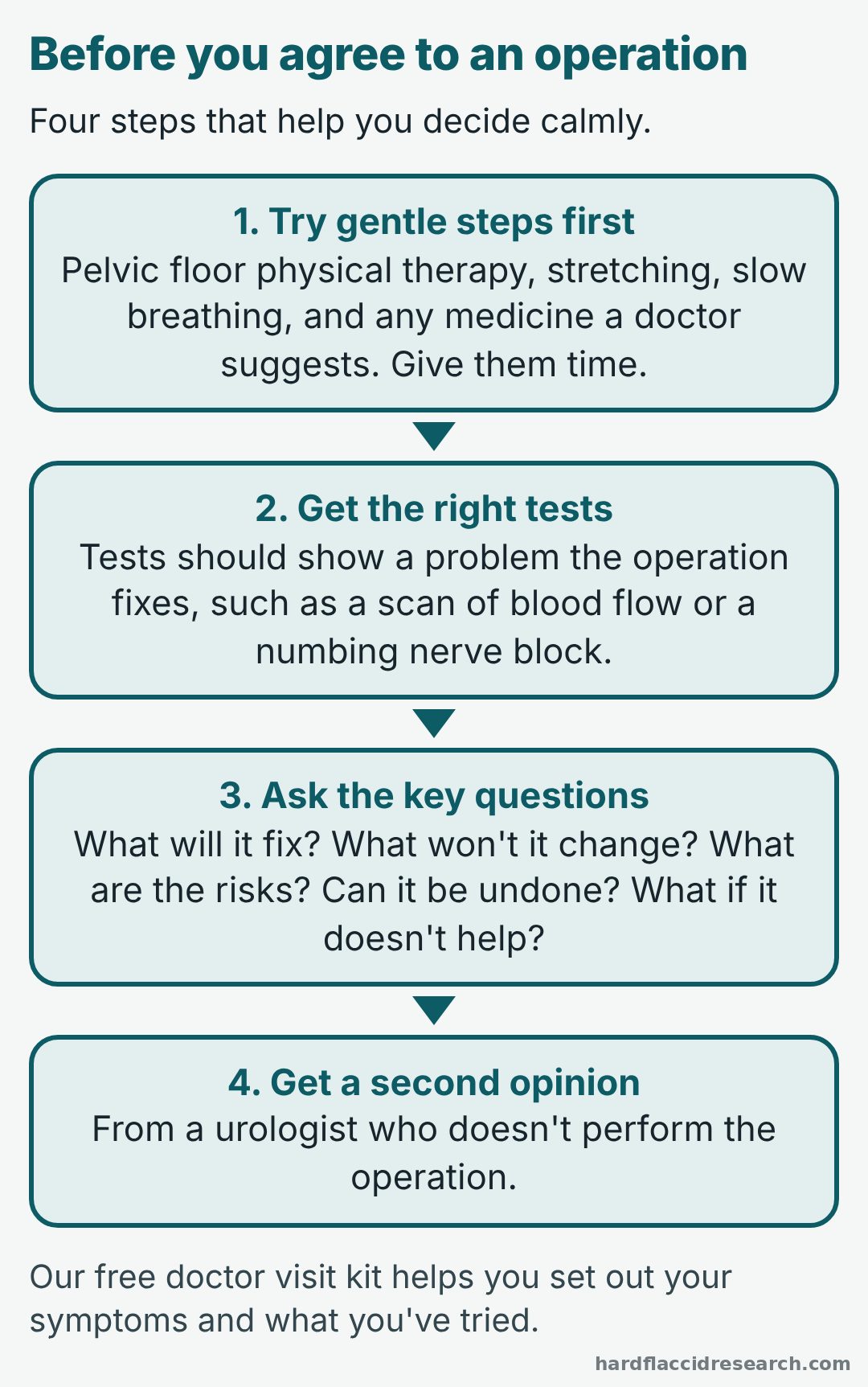
Talk to a doctor first. Surgery isn't proven for hard flaccid, it carries real risks, and some operations, such as an implant, can't be undone. Agree to one only after tests show a problem it fixes and a second doctor who doesn't perform it agrees.
Take the questions below to your appointment, and bring someone you trust if that helps.
What should I ask a surgeon?
Ask what the operation fixes, which test shows you have that problem, and what happens if it doesn't help. A good surgeon welcomes your questions and a second opinion. Take these with you:
- What exactly will this fix, and which test shows I have that problem?
- Which of my symptoms won't it change, such as the firm resting state or numbness?
- What are the risks for me, and can any of them be undone?
- What happens if it doesn't help, or makes things worse?
- What should I try first, and for how long?
- How many of these operations have you done, and how did those patients do?
Be wary of anyone who offers surgery for hard flaccid itself, or promises a result. Ask a urologist (a doctor for the bladder and male sex organs) who doesn't perform the operation for a second opinion: it's a normal request, not a rude one.
What should I try before surgery?
Start with low-risk steps, and give them time. Besides stretching, men who got better credited a break from masturbation and porn in 28 of the 126 recovery stories, and tadalafil in 20.
Reverse Kegels or pelvic floor relaxation came up in 20, breathing exercises in 16, and pelvic floor physical therapy, talking therapy or mindfulness, and core strengthening in 15 each. Kegels came up in 19, but if your pelvic floor feels tight, ask a physical therapist first, and let go fully between squeezes.
Doctors suggest some of these too. US guidelines on pelvic pain in men say doctors may offer hands-on physical therapy for tight, tender pelvic floor muscles. In a November 2022 poll of men who had seen a pelvic floor physical therapist, 36% said it helped quite a bit or cured them (17 of 47 men).
A doctor may suggest tadalafil (Cialis), which may help blood flow. In a June 2023 poll, 76% said Cialis helped them (34 of 45 men), and 20% said it helped a lot (9 of 45).
Talk to a doctor first. Tadalafil needs a prescription and isn't safe for everyone. Side effects such as headache, flushing, indigestion and back pain usually ease within a day or two. Never take it with nitrate medicines for chest pain or with poppers, because together they can drop your blood pressure dangerously. If you get chest pain, tell the ambulance crew or doctor that you've taken tadalafil, and when: nitrate medicines must not be given within 48 hours of a dose.
This week, try slow belly breathing for a few minutes a day, and a reverse Kegel, a gentle letting go, never a push. Note your good and bad days, so you and your doctor can see whether things are changing.
Our members' guide, Hard Flaccid Treatments: Read This Before You Pay, goes through each option, its risks and the questions to ask.
When should I see a doctor?
See a primary care provider or a urologist before considering any operation, or if symptoms haven't eased with gentler steps. If numbness between your legs is new, get urgent care (see the list below). If you've had it a while, or pain is clearly worse when sitting, ask a doctor to check your nerves, including the pudendal nerve.
Take your doctor visit kit, and ask for a referral to a pelvic floor physical therapist while you wait for a specialist.
Get urgent care straight away (call 911 or go to the emergency room) if you have:
- After an operation on the penis, pelvis or spine: a fever, or a wound that becomes red, hot, swollen or starts to leak.
- An erection lasting more than 4 hours.
- A plan to end your life, or feeling you can't keep yourself safe.
- Sudden, severe pain in the penis, testicles or pelvis.
- New numbness around your back passage, genitals or inner thighs, or new weakness in your legs.
- New trouble starting or controlling your pee, not being able to pee, or not feeling when your bladder is full.
- Loss of control of your bladder or bowel.
- A fever or chills with pelvic pain or pain when peeing.
Frequently asked questions
Can hard flaccid get better without surgery?
Yes. In a June 2023 poll, 11% said they were about 90% better or fully healed (14 of 132 men). The 126 recovery stories credited gentle steps far more than any operation, so give them a fair trial, even if it takes a long time.
Can a penile implant fix hard flaccid?
No. An implant is for severe erectile dysfunction, usually when other treatments haven't worked or don't suit. It doesn't treat the firm resting state, numbness or a tight pelvic floor, so it treats erections, not hard flaccid.
Is pudendal or vein surgery worth it for hard flaccid?
Only for a separate problem that tests confirm. Pudendal surgery is meant for a confirmed trapped nerve, and vein surgery for a leak shown on a scan. Our two pages on these operations explain who each one is for, and its risks.
What if nothing else has worked?
Ask for a fresh check, because symptoms can change and another condition may have been missed. US guidelines on pelvic pain in men suggest seeing a pain specialist if pain isn't well controlled. They also say doctors may offer CBT (cognitive behavioral therapy) alongside other treatment.
If hard flaccid is wearing you down, or you're thinking about suicide, call or text 988, or visit our Support page for more crisis lines. If you can't keep yourself safe, call 911.
Takeaway
Surgery fixes specific problems that tests can show, such as a trapped nerve or a blocked artery. No operation is designed for hard flaccid, and the men who got better credited gentle steps far more.
Start with our free self-check, take the doctor visit kit to your next appointment, and if you've had an operation, add your experience so the next man has better numbers.
This article is for general information and isn't a substitute for advice from your own doctor. Hard Flaccid Research doesn't diagnose or treat. If you have new or worsening symptoms, see a qualified clinician. In an emergency, call 911.
Free tools that can help
- Self-check: do I have hard flaccid?Compare your symptoms with what 6,026 men report.
- Doctor visit kitA one-page summary to take to your appointment.
- Habit trackerCount your days without porn or masturbation, and get through urges.
- Diaphragm breathing toolBreathe with a moving picture of your diaphragm and pelvic floor.
- Add your experienceTell us what you tried and how it went. No name needed.
- Hard Flaccid Syndrome CensusWhat men answered in 818 polls.
- Symptom trackerLog your symptoms and see what helps you.
- Ask us a questionThe questions men ask most become new articles.
The numbers behind this article
Every number in this article comes from what men with hard flaccid syndrome shared between December 2020 and October 2026, counted once per person, or from their polls. These are self-selected reports, not a clinical study. See hard flaccid syndrome statistics, the Hard Flaccid Syndrome Census and how we count.
What men who got better credited: gentle steps far more than surgery
Number of the 126 stories men shared of getting much better that mentioned each, from most to least.A story mentioning something is what the man credited, not proof it worked. Polls are self-selected.
Source: Hard Flaccid Research, hardflaccidresearch.com
Men discussed gentle steps far more often than surgery
Number of men who discussed each, counted once per person. Discussing something is not the same as trying it.Source: Hard Flaccid Research, hardflaccidresearch.com
112 men asked whether surgery is an option
Number of men who asked each question, counted once per person.Source: Hard Flaccid Research, hardflaccidresearch.com
Of men who discussed other surgery and described their symptoms, 77% described the firm flaccid state, 70% weaker erections and 63% numbness
Share of the men who discussed other surgery (such as ligament repair, an implant or hernia repair) and also described their symptoms.Men who discussed any treatment tended to describe more symptoms of every kind.
Source: Hard Flaccid Research, hardflaccidresearch.com
In a June 2023 poll, 42% said they were at least half better and 11% about 90% better or fully healed
How 132 men answered: have you healed?Men who recover may stop answering polls, so these numbers may undercount recovery.
Source: Hard Flaccid Research, hardflaccidresearch.com
In a June 2023 poll, 76% said Cialis helped them and 20% that it helped a lot
How 45 men answered: has Cialis helped?Source: Hard Flaccid Research, hardflaccidresearch.com
In a November 2022 poll, 36% said pelvic floor physical therapy helped quite a bit or cured them, 36% a little and 28% not at all
How the 47 men who had seen a pelvic floor physical therapist answered: did it help you?Source: Hard Flaccid Research, hardflaccidresearch.com
Every number in this article, with its source
| In this article | Source |
|---|---|
| 6,026 men | 6,026 men, counted from what men wrote, once per person |
| 112 men asked whether surgery is an option | Question group, 112 men, research data |
| 218 men asked whether hard flaccid is a blood flow or vein problem | Question group, 218 men, research data |
| 100 men asked whether hard flaccid is a nerve problem, such as the pudendal nerve | Question group, 100 men, research data |
| 42 men asked whether nerve blocks or Botox help | Question group, 42 men, research data |
| 126 recovery stories | 126 men, counted from what men wrote, once per person |
| Pudendal nerve decompression surgery came up in 0 of 126 recovery stories | 0 of 126 recovery stories |
| Vein or vascular procedures came up in 2 of 126 recovery stories | 2 of 126 recovery stories |
| Other surgery came up in 1 of 126 recovery stories | 1 of 126 recovery stories |
| Nerve blocks came up in 3 of 126 recovery stories | 3 of 126 recovery stories |
| PRP injections came up in 2 of 126 recovery stories | 2 of 126 recovery stories |
| Botox came up in 0 of 126 recovery stories | 0 of 126 recovery stories |
| Stretching came up in 40 of 126 recovery stories | 40 of 126 recovery stories |
| A break from masturbation and porn came up in 28 of 126 recovery stories | 28 of 126 recovery stories |
| Tadalafil came up in 20 of 126 recovery stories | 20 of 126 recovery stories |
| Reverse Kegels or pelvic floor relaxation came up in 20 of 126 recovery stories | 20 of 126 recovery stories |
| Kegels came up in 19 of 126 recovery stories | 19 of 126 recovery stories |
| Breathing exercises came up in 16 of 126 recovery stories | 16 of 126 recovery stories |
| Pelvic floor physical therapy came up in 15 of 126 recovery stories | 15 of 126 recovery stories |
| Talking therapy, CBT, mindfulness or meditation came up in 15 of 126 recovery stories | 15 of 126 recovery stories |
| Core, glute and posture strengthening came up in 15 of 126 recovery stories | 15 of 126 recovery stories |
| 1,288 men discussed stretching | 1,288 men discussing stretching, counted from what men wrote, once per person |
| 969 men discussed tadalafil | 969 men discussing tadalafil, counted from what men wrote, once per person |
| 846 men discussed Kegels | 846 men discussing Kegels, counted from what men wrote, once per person |
| 779 men discussed a break from masturbation and porn | 779 men discussing abstinence or rest, counted from what men wrote, once per person |
| 704 men discussed reverse Kegels or pelvic floor relaxation | 704 men discussing reverse Kegels, counted from what men wrote, once per person |
| 656 men discussed pelvic floor physical therapy | 656 men discussing pelvic floor physical therapy, counted from what men wrote, once per person |
| 246 men discussed nerve blocks | 246 men discussing nerve blocks, counted from what men wrote, once per person |
| 140 men discussed other surgery | 140 men discussing other surgery, counted from what men wrote, once per person |
| 137 men discussed Botox | 137 men discussing Botox, counted from what men wrote, once per person |
| 112 men discussed vein or vascular procedures | 112 men discussing vein or vascular procedures, counted from what men wrote, once per person |
| 106 men discussed PRP injections | 106 men discussing PRP injections, counted from what men wrote, once per person |
| 82 men discussed pudendal nerve decompression surgery | 82 men discussing pudendal nerve decompression, counted from what men wrote, once per person |
| Among the men who discussed other surgery and also described their symptoms: 77% described the firm flaccid state, 70% weaker erections, 63% numbness | 140 men who discussed other surgery, counted from what men wrote, once per person; shares are of those who also described their symptoms |
| 42% said they were at least half better (56 of 132 men) | 56 of 132 men, poll, Jun 2023 |
| 11% said they were about 90% better or fully healed (14 of 132 men) | 14 of 132 men, poll, Jun 2023 |
| 76% said Cialis helped them (34 of 45 men) | 34 of 45 men, poll, Jun 2023 |
| 20% said Cialis helped a lot (9 of 45 men) | 9 of 45 men, poll, Jun 2023 |
| Of men who had seen a pelvic floor physical therapist, 36% said it helped quite a bit or cured them (17 of 47 men) | 17 of 47 men, poll, Nov 2022 |
| Of men who had seen a pelvic floor physical therapist, 36% said it helped a little (17 of 47 men) | 17 of 47 men, poll, Nov 2022 |
| Of men who had seen a pelvic floor physical therapist, 28% said it didn't help at all (13 of 47 men) | 13 of 47 men, poll, Nov 2022 |
| Counting since December 2020 | Research data, December 2020 to October 2026 |
Medical sources
What this article says about medical research, guidelines and urgent care comes from these sources.
- Gul M, Towe M, Yafi FA, Serefoglu EC. Hard flaccid syndrome: initial report of four cases. Int J Impot Res. 2020;32:176-179. https://doi.org/10.1038/s41443-019-0133-z
- Abdessater M, Kanbar A, Akakpo W, Beley S. Hard flaccid syndrome: state of current knowledge. Basic Clin Androl. 2020;30:7. https://doi.org/10.1186/s12610-020-00105-5
- Pang KH, Feng J, Zhang Y. Hard-flaccid syndrome: a systematic review of aetiopathophysiology, clinical presentation and management. Int J Impot Res. 2026;38:393-403. https://doi.org/10.1038/s41443-025-01118-2
- Sullivan J, Salter C, Flores J, Ghuring P, Parker M, Mulhall J. Exploring erectile hemodynamics in men complaining of hard-flaccid syndrome (meeting abstract). J Sex Med. 2023;20(Suppl 1):i124-i125. https://doi.org/10.1093/jsxmed/qdad060.194
- Robert R, Labat JJ, Bensignor M, et al. Decompression and transposition of the pudendal nerve in pudendal neuralgia: a randomized controlled trial and long-term evaluation. Eur Urol. 2005;47:403-408. https://doi.org/10.1016/j.eururo.2004.09.003
- Labat JJ, Riant T, Robert R, Amarenco G, Lefaucheur JP, Rigaud J. Diagnostic criteria for pudendal neuralgia by pudendal nerve entrapment (Nantes criteria). Neurourol Urodyn. 2008;27:306-310. https://pubmed.ncbi.nlm.nih.gov/17828787/
- Hoppe H, Diehm N. Percutaneous treatment of venous erectile dysfunction. Front Cardiovasc Med. 2021;7:626943. https://doi.org/10.3389/fcvm.2020.626943
- Burnett AL, Nehra A, Breau RH, et al. Erectile dysfunction: AUA guideline. J Urol. 2018;200:633. https://www.auanet.org/guidelines-and-quality/guidelines/erectile-dysfunction-(ed)-guideline
- Lai HH, Pontari MA, Argoff CE, et al. Male chronic pelvic pain: AUA guideline. J Urol. 2025. https://www.auanet.org/guidelines-and-quality/guidelines/male-chronic-pelvic-pain
- Goldstein I, Komisaruk BR. Hard flaccid syndrome proposed to be secondary to pathological activation of a pelvic/pudendal-hypogastric reflex. AUA News, May 2023 (not peer reviewed). https://auanews.net/issues/articles/2023/may-2023/hard-flaccid-syndrome-proposed-to-be-secondary-to-pathological-activation-of-a-pelvic/pudendal-hypogastric-reflex
- Pang KH, Feng J, Zhang Y. Hard-flaccid syndrome: a report of two cases. Int J Impot Res. 2025;37:486-489. https://doi.org/10.1038/s41443-025-01058-x
- Niedenfuehr J, Stevens DM. Hard flaccid syndrome symptoms, comorbidities, and self-reported efficacy and satisfaction of treatments: a cross-sectional survey. Int J Impot Res. 2025;37:458-464. https://doi.org/10.1038/s41443-024-00853-2
- Bivalacqua TJ, Allen BK, Brock G, et al. Acute ischemic priapism: an AUA/SMSNA guideline. J Urol. 2021;206(5):1114-1121. https://doi.org/10.1097/JU.0000000000002236
- Substance Abuse and Mental Health Services Administration. 988 Suicide and Crisis Lifeline. https://988lifeline.org/
How we made this article
We started from the question 112 men asked. Every number was checked against our data. Our editorial team edited it and Dr. Julian Reyes reviewed it medically. Read our editorial policy.
Read next
See more of us on Google
Add Hard Flaccid Research as a preferred source, and Google shows you our pages more often when you search.
Add as a preferred sourceDon't see your question? Ask us. We answer the most-asked ones in new articles.
Cite and share this article
You're welcome to quote this article. Please name Hard Flaccid Research and link to this page, so others can find the full answer and the data behind it. To cite this page, use its link.
Citation
Hard Flaccid Research. (2026). Surgery for Hard Flaccid? What 126 Recovery Stories Show. Written by the Editorial Team, medically reviewed by Dr. Julian Reyes. https://hardflaccidresearch.com/articles/hard-flaccid-surgery
Credit link for your article
Source: <a href="https://hardflaccidresearch.com/articles/hard-flaccid-surgery">Hard Flaccid Research</a>
Wikipedia reference
<ref>{{cite web |url=https://hardflaccidresearch.com/articles/hard-flaccid-surgery |title=Surgery for Hard Flaccid? What 126 Recovery Stories Show |website=Hard Flaccid Research |date=2026 |access-date=28 October 2026}}</ref>
How the data was collected: our methodology. Journalists and researchers: key numbers, data and contact.