Shockwave Therapy for Hard Flaccid: Worth the Money?
In short
- Low-intensity shockwave therapy sends pulses of sound energy through the skin.
- For chronic pelvic pain in men it is one of the better-tested treatments, and US urology guidelines say doctors should discuss it, but for erection problems the benefit is modest and mainly in men with poor blood flow, and it hasn't been properly tested in hard flaccid syndrome. 303 men with hard flaccid syndrome discussed it, and it came up in 4 of 126 recovery stories.
- See a doctor first, and ask the right questions before paying for a course.
37 men with hard flaccid asked this question.
Shockwave therapy, also called extracorporeal shockwave therapy (ESWT) or acoustic wave therapy, sends pulses of sound energy through the skin from a handheld probe. It is used for tendon and heel pain, and a low-intensity kind is used for chronic pelvic pain in men and for erection problems. Some men with hard flaccid syndrome, where the penis stays firm, rubbery or shrunken when it should be soft, ask about it. For pelvic pain it is one of the better-tested treatments, but for erections the benefit is modest, and it hasn't been properly tested in hard flaccid.
303 men with hard flaccid discussed shockwave therapy, and separately, 37 men with hard flaccid asked whether it helps. It came up in 4 of 126 recovery stories. This page explains what shockwave therapy is, how it may work, focused and radial devices, what studies show for pelvic pain and for erections, what men with hard flaccid report, what it can't do, side effects, and what to ask before you pay. Our doctor visit kit helps you list your main symptoms first.
By the numbers: between December 2020 and October 2026, 2,661 of the 6,026 men with hard flaccid who shared their experiences described their symptoms: 35% described weaker erections (926 of 2,661), 10% pelvic, perineal or tailbone pain (267 of 2,661) and 8% penile pain or burning (206 of 2,661). These are men with hard flaccid, not men in general.
What is shockwave therapy?
Shockwave therapy uses a probe held against the skin to send short pulses of sound energy into the tissue below. It is not electricity, and there are no needles or cuts. The strength varies a lot:
- High-energy shockwaves, used to break up kidney stones (lithotripsy). This is a different treatment.
- Lower-energy shockwave therapy, used for long-lasting tendon and heel problems, and, at low intensity, for chronic pelvic pain in men and for erection problems. In urology the low-intensity kind is often shortened to Li-ESWT. This is the kind men with hard flaccid syndrome ask about.
Outside urology, shockwave therapy is mostly used for long-lasting tendon and heel problems that haven't settled with rest, exercises and physio, such as heel pain (plantar fasciitis), tennis elbow, pain at the back of the heel (Achilles tendon) and calcium deposits in a shoulder tendon, which are often treated at a higher energy. Results vary from one problem to another, and it is usually tried after simpler treatments. This page is about its use for pelvic pain and erections, and what that may mean for hard flaccid.
Hard Flaccid Explorerby Hard Flaccid Research
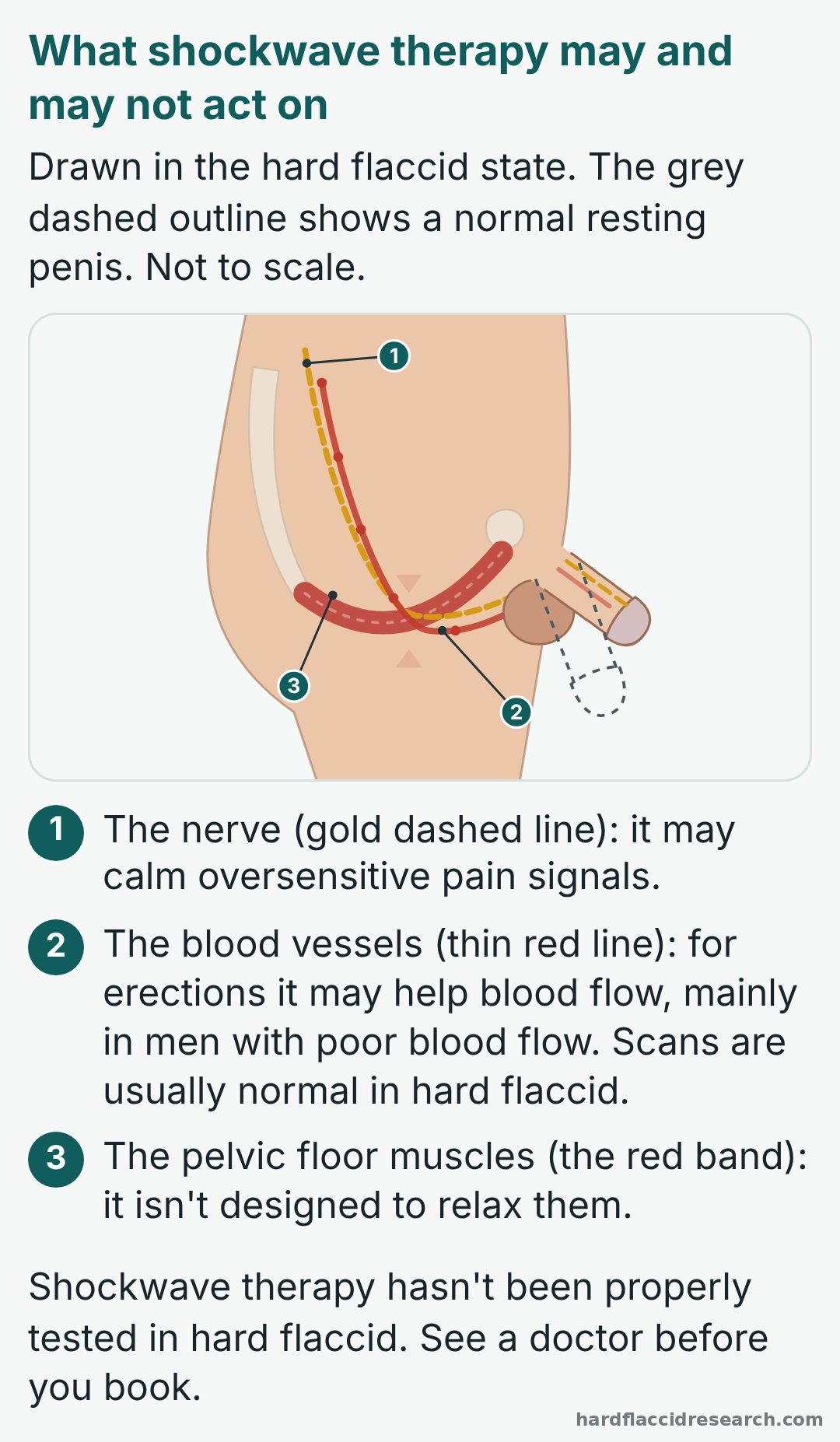
What shockwave therapy may and may not do
A 7-minute animated explainer of this article. Press play, or skip between chapters. The first minute is free for everyone.
A picture to explain, not a diagnosis. Shockwave therapy hasn't been properly tested in hard flaccid syndrome.
How shockwave therapy works
Nobody knows exactly, and it may work differently for different problems. These are the main ideas:
- Pain. The pulses may calm oversensitive pain nerves, and may calm inflammation in the tissue, so the area hurts less. This is the idea behind its use for chronic pelvic pain.
- Blood flow. For erections, the pulses may encourage new small blood vessels to grow and improve blood flow into the penis. That is why it seems to help mainly men whose erection problems come from poor blood flow.
- Healing. For tendons, the pulses may trigger the body's own repair of damaged tissue.
Blood flow scans are usually normal in men with hard flaccid syndrome, so the blood flow idea may not apply to many of them. A Doppler ultrasound scan of the penis can show whether blood flow is a problem, if a urologist thinks it would change your care.
Related: Weak Erections With Hard Flaccid: Will They Come Back? »
Focused vs radial shockwave therapy
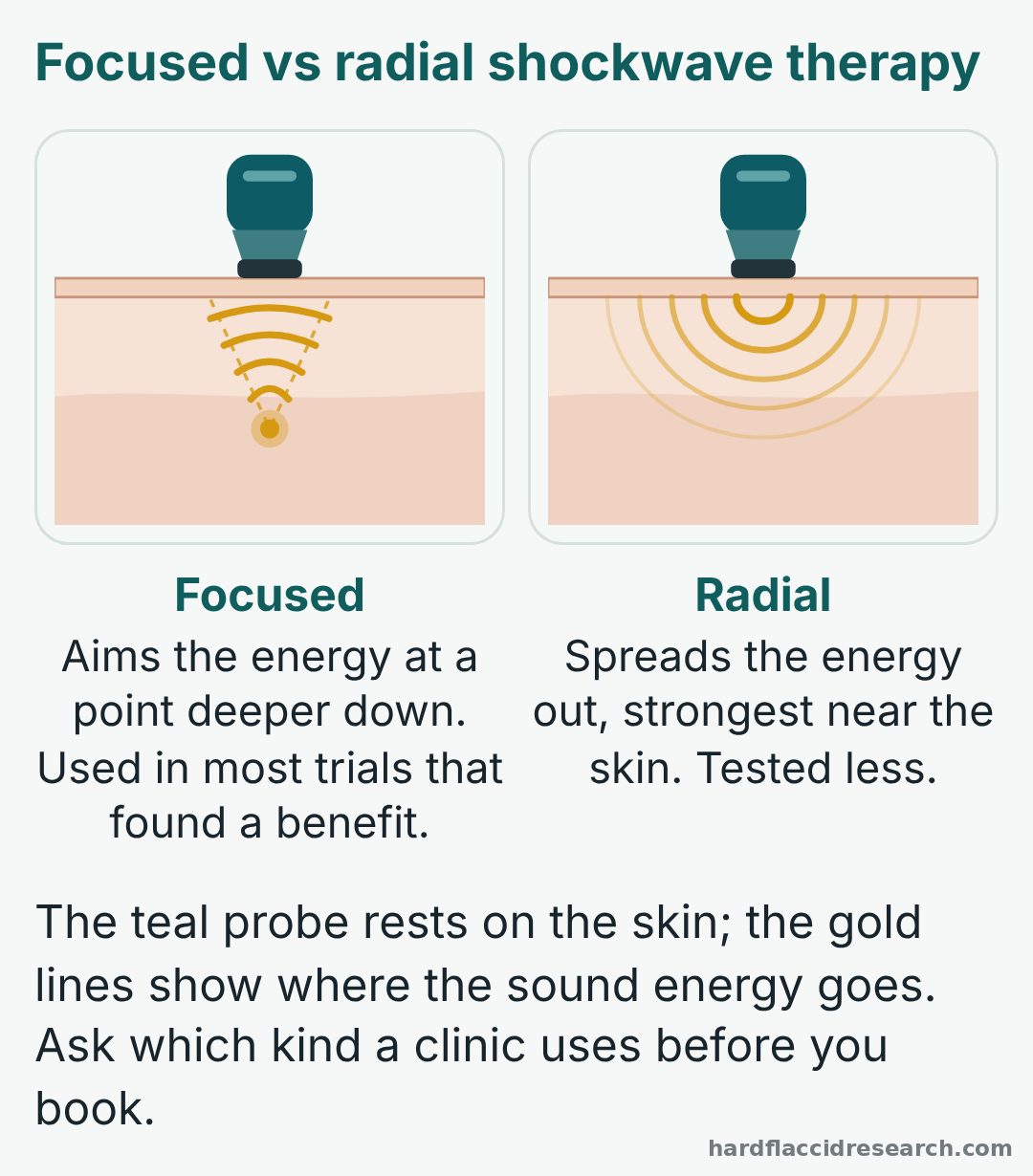
Devices differ: most of the trials that showed a benefit used focused shockwave. Radial devices, often sold more cheaply, have been tested less, and their results are unclear.
- Focused shockwave concentrates the energy at a point deeper in the tissue. Most of the trials that found a benefit used focused devices.
- Radial shockwave spreads the energy out from the probe, so it is strongest at the skin and weaker deeper down. It is common in sports and physio clinics.
Some clinics use other names, such as acoustic wave therapy, for similar devices, and settings vary from clinic to clinic. Devices sold for use at home have hardly been studied. Ask which device a clinic uses before you book.
What a shockwave therapy session is like
You usually lie on a couch. The clinician puts gel on the skin and moves the probe over the area, and most people don't need numbing.
For pelvic pain or erections, a course is usually a series of sessions, often once a week, and each one takes around a quarter of an hour. It isn't painful for most people, though it can feel like a tapping or flicking on the skin.
For pelvic pain, the probe is usually placed on the perineum, the area between the scrotum and the back passage. For erection problems it is placed along the shaft and the base of the penis. Most people go back to their normal day straight away, though some feel a little sore where the probe was used.
A trained clinician should give it, after a proper check of your symptoms. Before the first session, they should ask about your medicines, any bleeding problems and any infection in the area.
Related: Hard Flaccid Syndrome Treatment: What Men Tried and What Helped »
Shockwave therapy for pelvic pain
For chronic pelvic pain in men, which often has no infection behind it, shockwave therapy is one of the better-tested treatments. Trials that compared it with a fake (sham) treatment found less pain for up to about three months, though it is less clear how long the benefit lasts after that. US urology guidelines say doctors should discuss it with men who have chronic prostatitis or chronic pelvic pain syndrome (a moderate recommendation, based on strong evidence).
This condition is also called chronic prostatitis or chronic pelvic pain syndrome. It shares many symptoms with hard flaccid syndrome, but they aren't the same condition, so these results may not carry over. Our article on prostatitis or hard flaccid explains the overlap.
Shockwave therapy for erectile dysfunction
For erection problems, the benefit in trials is modest, and mainly in men with mild erection problems caused by poor blood flow. Results vary a lot between studies, and it is unclear how long any benefit lasts. US erection guidelines say it should be considered investigational, meaning not yet proven (a weaker, conditional recommendation), while European guidelines say it may be used for mild erection problems caused by poor blood flow, for men with poor blood flow whose erection pills haven't worked well, or for men who can't or don't want to take them (a weak recommendation).
This matters for men with hard flaccid syndrome, because many describe weaker erections, but in hard flaccid these usually seem to come from somewhere other than blood flow, such as a tight pelvic floor, though this isn't proven. If your erections have changed, see a doctor: a blood test for blood sugar (HbA1c) and cholesterol is worth asking for, and a doctor may discuss erection medicines such as tadalafil, which have much stronger evidence for erection problems in general, though they haven't been properly tested in hard flaccid either. Tadalafil is a prescription medicine that can cause headaches, flushing and back pain. Never take it with nitrate medicines for chest pain or with poppers, because together they can drop your blood pressure dangerously, and never buy it online without a prescription.
Does shockwave therapy help hard flaccid? What men told us
No proper trial has tested shockwave therapy for hard flaccid syndrome. In the first published hard flaccid cases it helped one man for a while, but his symptoms came back within months. In a later case report, a man improved after shockwave therapy combined with tadalafil and physio, so its own effect can't be separated out (tadalafil must never be taken with nitrate medicines for chest pain or with poppers). In a published survey of men with hard flaccid, it was rated as giving no or little help.
Among the men with hard flaccid who discussed shockwave therapy and also described their symptoms, 71% described the firm flaccid state, 52% weaker erections, 50% numbness, 39% shrinkage and 33% pelvic floor tightness. Men who wrote about a treatment tended to describe more symptoms of every kind, so these shares run higher than among all men who described symptoms. It came up in 4 of 126 recovery stories, and a story mentioning something is not proof that it worked.
Erections matter a lot to men with hard flaccid: in one May 2023 poll of men with hard flaccid asked which one symptom they would fix first, 43% chose erection problems (45 of 104 men), 27% loss of sensation (28 of 104 men), 20% the hard flaccid state itself (21 of 104 men) and 7% pain or discomfort (7 of 104 men). The poll asked nothing about shockwave therapy, whose best evidence is for pain, in chronic pelvic pain. Separately, 343 men with hard flaccid asked why their erections are weaker and whether they will recover, and 218 men with hard flaccid asked whether it is a blood flow or vein problem. These are self-selected reports, not a clinical study.
What shockwave therapy can't do
Pain signals from the pelvis can become oversensitive, so the area hurts or aches more easily. Shockwave therapy may help that part, though this hasn't been tested in hard flaccid syndrome. It isn't designed to relax a tight pelvic floor or calm stress, and it can't fix a blood flow problem that isn't there. The pelvic floor is the sling of muscles between your legs that supports your bladder and bowel and helps control erections. Pelvic floor physio and relaxation work on a tight pelvic floor.
Is shockwave therapy worth it for hard flaccid?
There's no proof that it helps hard flaccid syndrome, so think of it as an experiment you pay for, not a cure. It may be more worth discussing with a doctor if:
- Pelvic, perineal or tailbone pain is one of your main symptoms, since pain is where the evidence is best, in chronic pelvic pain.
- A doctor has checked you, and simpler steps such as pelvic floor physio and relaxation haven't been enough.
- Tests suggest poor blood flow plays a part in your erection problems.
It is less likely to help if your main problems are the firm resting state, numbness or shrinkage, which it isn't known to change. If you decide to try it, agree with the clinician what better would look like, and when you will review it.
Side effects and safety
Side effects are usually mild and short-lived: some redness, bruising, mild soreness, swelling or tingling where the probe was used, usually for a few days at most. Rarely, men have noticed a little blood in their urine or semen afterwards: tell the clinician. Blood in your urine that you can see needs urgent care; for blood in the semen, see a doctor soon. A session can feel like tapping or flicking on the skin, and some people find it uncomfortable rather than painful.
It may not be suitable if you have a bleeding problem or take blood thinners, a heart pacemaker or another implanted device, an infection or open wound in the area, or a tumour nearby. Tell the clinician about every medicine you take.
Talk to a doctor first. Shockwave therapy should be given by a trained clinician after a proper check. It can be expensive, and private clinics sometimes sell long courses with big promises. Get any pain, long-standing numbness or a change in your erections checked by a doctor before you book; new numbness around your back passage, genitals or inner thighs needs urgent care. If a doctor suggests an erection medicine such as tadalafil as well, they should check your heart and blood pressure first. Never take tadalafil with nitrate medicines for chest pain, with riociguat or with poppers, because together they can drop your blood pressure dangerously. If you get chest pain, tell the ambulance crew or doctor that you've taken tadalafil, and when: nitrate medicines must not be given within 48 hours of a dose. Side effects such as headache or flushing usually ease within a day or two. Get urgent care for an erection lasting more than 4 hours, or a sudden loss of sight or hearing. Never buy it online without a prescription. Never start, stop or change a medicine on your own.
Questions to ask before you pay
- Is it focused or radial shockwave, and which was used in the trials you are relying on?
- Is it aimed at pain, at erections, or both, and what does the evidence show for my symptoms?
- How many sessions, what does the whole course cost, and what happens if it doesn't help?
- Should I try pelvic floor physio and relaxation first, or alongside it?
- Who will give it, what training do they have, and what checks will they do first?
- Has a doctor checked my symptoms, and would a blood flow scan change anything for me?
Be wary of clinics that promise a cure, push you to pay for a long course up front, or say it works for everyone. Our members' guide, Hard Flaccid Treatments: Read This Before You Pay, goes through each option men with hard flaccid syndrome discuss.
Common questions about shockwave therapy
Does shockwave therapy hurt? For pelvic pain and erections, usually not much: most people describe tapping or flicking, and some find it uncomfortable. Treatment for tendon problems is often more uncomfortable, because it is aimed at the sore spot. Tell the clinician if it hurts, as the settings can be changed.
How long does shockwave therapy take to work? In the pelvic pain trials, any benefit tended to show after a few weeks of sessions. For erections it can take longer, and not everyone notices a change.
How long do the results last? Nobody knows for sure. In pelvic pain, the benefit was clearest for up to about three months. For erections, some clinics offer repeat courses, and the evidence on how long any benefit lasts is weak.
Is shockwave therapy for erectile dysfunction worth it? It depends on why your erections have changed. It seems to help mainly mild erection problems caused by poor blood flow, which usually isn't the problem in hard flaccid syndrome, where blood flow scans are usually normal. A doctor can help you weigh it against options with stronger evidence.
How many sessions will I need? It varies: a course is usually a series of weekly or twice-weekly sessions, and clinics use different schedules. Some clinics sell longer or repeat courses: ask why, and what happens if it hasn't helped by then.
Do at-home shockwave devices work? They have hardly been studied, and their strength and settings vary. Ask a doctor before using one, especially between your legs or on your genitals.
Is acoustic wave therapy the same thing? Sometimes. Acoustic wave therapy, and branded programmes such as GAINSWave, are names some clinics use for low-intensity sound-wave treatments, often marketed for erections. Some use focused shockwave, and some use radial devices, which have much less evidence for erections. US erection guidelines still call shockwave therapy for erections investigational. Ask exactly which device and settings are used, and what evidence there is for them.
Can I have shockwave therapy and pelvic floor physio together? They can be combined, as in one of the published hard flaccid cases, and physio works on a tight pelvic floor, which shockwave therapy isn't designed to do. Ask your doctor or physio how to fit them together.
Can shockwave therapy make hard flaccid worse? We don't have numbers on this yet. Side effects are usually mild, but get any new pain or swelling checked by a doctor, and get urgent care for new numbness around your back passage, genitals or inner thighs.
Can shockwave therapy help Peyronie's disease? Peyronie's disease is a bend in the penis caused by scar tissue, which isn't the same as hard flaccid. US urology guidelines say doctors may offer shockwave therapy to ease the pain (a weaker, conditional recommendation), but shouldn't use it to straighten a curve or shrink a plaque. A new bend or lump is worth getting checked early, because Peyronie's disease responds best to early care.
When to see a doctor
See a GP before booking shockwave therapy, especially if your erections have changed or you have pain. A doctor can check for other causes and, if needed, arrange a blood flow scan. If you've had numbness for a while, or pain that is clearly worse when sitting, ask the doctor to check the nerves, including for pudendal nerve entrapment.
Get urgent care straight away if you have:
- An erection lasting more than 4 hours.
- Blood in your urine that you can see.
- Sudden, severe pain in the penis, testicles or pelvis.
- New numbness around your back passage, genitals or inner thighs, or new weakness in your legs.
- New trouble starting or controlling your pee, not being able to pee, or not feeling when your bladder is full.
- Loss of control of your bladder or bowel.
- A fever or chills with pelvic pain or pain when peeing.
What to do next
- Make a doctor visit kit listing your main symptoms: pain, erections or both.
- If you consider shockwave therapy, ask the questions above before paying for a course.
- Ask about pelvic floor physio and relaxation, whatever you decide about shockwave therapy.
- Take our self-check to see how your symptoms compare.
If you're worried about how a visit will go, many men with hard flaccid syndrome feel the same: in one November 2022 poll of men with hard flaccid who had seen a urologist, 95% called their visits bad and unhelpful (63 of 66 men). It's a reason to prepare well with the doctor visit kit, not to skip the visit.
Free tools that can help
- Self-check: do I have hard flaccid?Compare your symptoms with what 6,026 men report.
- Doctor visit kitA one-page summary to take to your appointment.
- Habit trackerCount your days without porn or masturbation, and get through urges.
- Diaphragm breathing toolBreathe with a moving picture of your diaphragm and pelvic floor.
- Add your experienceTell us what you tried and how it went. No name needed.
- Hard Flaccid Syndrome CensusWhat men answered in 818 polls.
- Symptom trackerLog your symptoms and see what helps you.
- Ask us a questionThe questions men ask most become new articles.
The numbers behind this article
Every number in this article comes from what men with hard flaccid syndrome shared between December 2020 and October 2026, counted once per person, or from their polls. These are self-selected reports, not a clinical study. See hard flaccid syndrome statistics, the Hard Flaccid Syndrome Census and how we count.
Shockwave therapy came up in 4 of the 126 hard flaccid syndrome recovery stories
Share of the 126 stories from men with hard flaccid syndrome who got better that mention shockwave therapy. Mentioned is not the same as worked.A story mentioning something is not proof that it worked.
Source: Hard Flaccid Research, hardflaccidresearch.com
More men with hard flaccid syndrome described weaker erections than pain
Share of the 2,661 men with hard flaccid syndrome who described their symptoms. Each man is counted once.These count men who raised a symptom on their own, so they are lower than poll answers.
Source: Hard Flaccid Research, hardflaccidresearch.com
303 men with hard flaccid syndrome discussed shockwave therapy; 37 men with hard flaccid syndrome asked whether it helps
Number of men with hard flaccid syndrome who discussed shockwave therapy, and in three question groups. Each man is counted once in each.Source: Hard Flaccid Research, hardflaccidresearch.com
In one poll, 43% of men with hard flaccid syndrome would fix erection problems first (45 of 104 men)
How 104 men with hard flaccid syndrome answered a May 2023 poll: "If you could fix one symptom, which would it be?" One more answer, urinary or rectal symptoms, is not shown.These are self-selected reports, not a clinical study.
Source: Hard Flaccid Research, hardflaccidresearch.com
In one poll, 95% of men with hard flaccid syndrome who had seen a urologist called their visits bad and unhelpful (63 of 66 men)
How the 66 men with hard flaccid syndrome who had seen a urologist answered a November 2022 poll on their experience with urologists.It's a reason to prepare well with the doctor visit kit, not to skip the visit.
Source: Hard Flaccid Research, hardflaccidresearch.com
Every number in this article, with its source
| In this article | Source |
|---|---|
| 303 men discussed shockwave therapy | 303 men discussing shockwave therapy, counted from what men wrote, once per person |
| Among men who discussed shockwave therapy and also described their symptoms: 71% firm flaccid state, 52% weaker erections, 50% numbness, 39% shrinkage, 33% pelvic floor tightness | 303 men discussing shockwave therapy, counted from what men wrote, once per person; shares are of those who also described their symptoms |
| 37 men asked whether shockwave therapy helps | Question group, 37 men, research data |
| 343 men asked why their erections are weaker and whether they will recover | Question group, 343 men, research data |
| 218 men asked whether it is a blood flow or vein problem | Question group, 218 men, research data |
| Shockwave therapy came up in 4 of 126 recovery stories | 4 of 126 recovery stories |
| 2,661 of the 6,026 men who shared their experiences described their symptoms | Research data, December 2020 to October 2026 |
| 35% described weaker erections (926 of 2,661) | 926 of 2,661 men, counted from what men wrote, once per person |
| 10% described pelvic, perineal or tailbone pain (267 of 2,661) | 267 of 2,661 men, counted from what men wrote, once per person |
| 8% described penile pain or burning (206 of 2,661) | 206 of 2,661 men, counted from what men wrote, once per person |
| 43% would fix erection problems first (45 of 104 men) | 45 of 104 men, poll, May 2023 |
| 27% would fix loss of sensation first (28 of 104 men) | 28 of 104 men, poll, May 2023 |
| 20% would fix the hard flaccid state first (21 of 104 men) | 21 of 104 men, poll, May 2023 |
| 7% would fix pain or discomfort first (7 of 104 men) | 7 of 104 men, poll, May 2023 |
| 95% called urologist visits bad and unhelpful (63 of 66 men) | 63 of 66 men, poll, Nov 2022 |
How we made this article
We started from the question 37 men asked. Every number was checked against our data. Our editorial team edited it and Dr. Julian Reyes reviewed it medically. Read our editorial policy.
Read next
See more of us on Google
Add Hard Flaccid Research as a preferred source, and Google shows you our pages more often when you search.
Add as a preferred sourceDon't see your question? Ask us. We answer the most-asked ones in new articles.
Cite and share this article
You're welcome to quote this article. Please name Hard Flaccid Research and link to this page, so others can find the full answer and the data behind it. To cite this page, use its link.
Citation
Hard Flaccid Research. (2026). Shockwave Therapy for Hard Flaccid: Worth the Money? Written by the Editorial Team, medically reviewed by Dr. Julian Reyes. https://hardflaccidresearch.com/articles/shockwave-therapy-hard-flaccid
Credit link for your article
Source: <a href="https://hardflaccidresearch.com/articles/shockwave-therapy-hard-flaccid">Hard Flaccid Research</a>
Wikipedia reference
<ref>{{cite web |url=https://hardflaccidresearch.com/articles/shockwave-therapy-hard-flaccid |title=Shockwave Therapy for Hard Flaccid: Worth the Money? |website=Hard Flaccid Research |date=2026 |access-date=28 October 2026}}</ref>
How the data was collected: our methodology. Journalists and researchers: key numbers, data and contact.