Bulbospongiosus Muscle: Erections, Ejaculation and Dribbling
In short
- The bulbospongiosus is a pelvic floor muscle that wraps the bulb of the penis, just behind the scrotum.
- It squeezes the last drops of urine out after peeing, contracts in rhythmic waves to push semen out during ejaculation, and helps make an erection firmer.
- When it's weak, men may dribble after peeing; when it's tight, it can add to perineal pain.
The bulbospongiosus (BUL-boh-spon-jee-OH-sus) is a muscle of the pelvic floor that wraps around the bulb of the penis, the base of the penis that sits inside the body just behind the scrotum. It's also called the bulbocavernosus.
It has three main jobs: squeezing the last drops of urine out after you pee, pushing semen out in rhythmic waves during ejaculation, and helping make an erection firmer. This page explains where it is, how it works, what happens when it's weak or too tight, and what helps.
By the numbers: of the 6,026 men who shared their experiences with hard flaccid syndrome, 2,661 described their symptoms, and 601 of them described pelvic floor tightness, spasm or twitching.
Key facts
- The bulbospongiosus is a pair of muscles joined in the middle, wrapped around the bulb of the penis in the perineum.
- It sits just under the skin between the scrotum and the anus, in front of the perineal body.
- It clears urine from the urethra after peeing, contracts during ejaculation and helps keep blood in the penis during an erection.
- It's supplied by the pudendal nerve.
- A weak bulbospongiosus can cause dribbling after peeing. A tight one can add to perineal pain and pain with ejaculation.
- Pelvic floor physical therapy can help it work well, whether it needs strengthening or relaxing.
Where is the bulbospongiosus muscle?
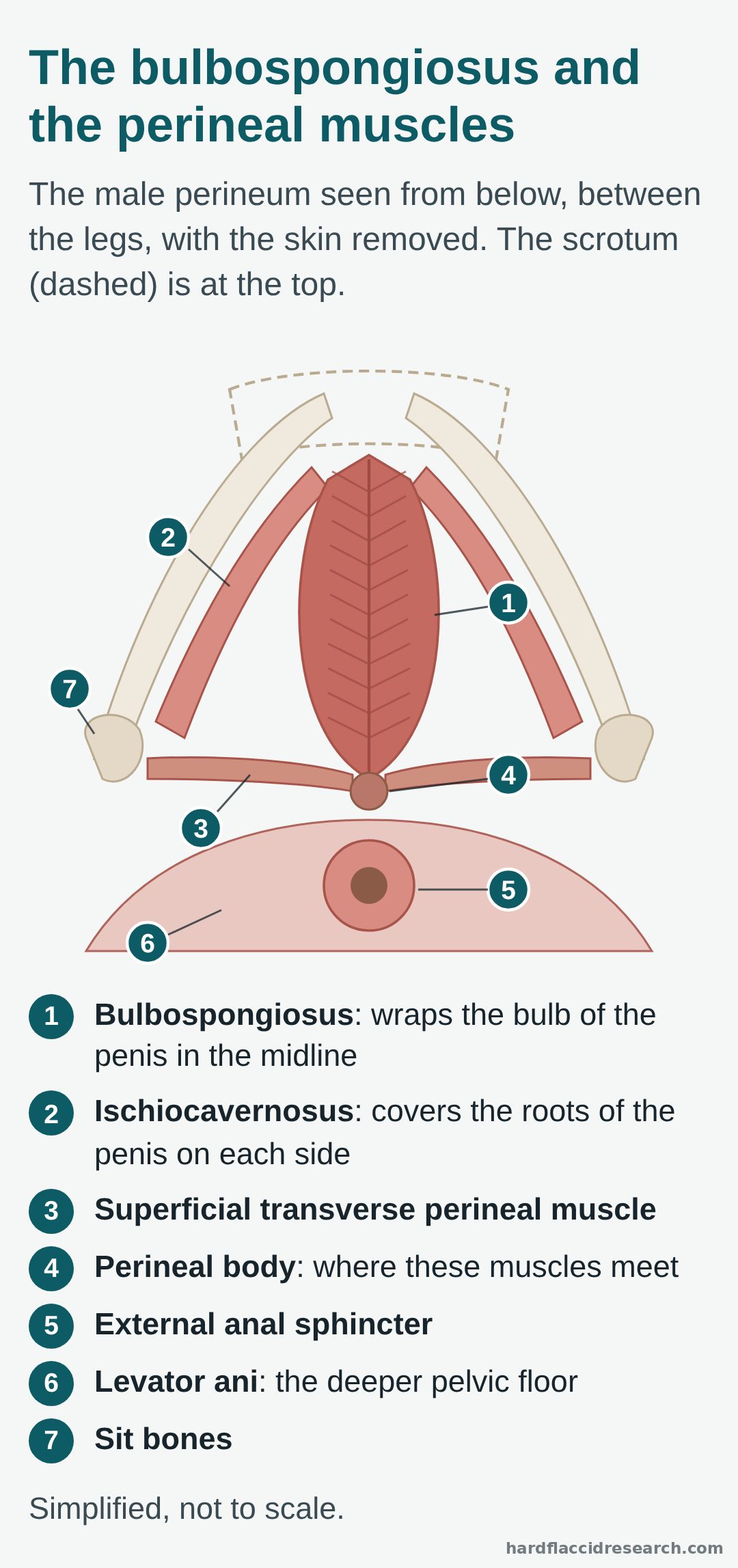
The bulbospongiosus lies in the perineum, the area between the scrotum and the anus. If you could look up from below with the skin removed, you'd see it as a muscle in the midline shaped a bit like a feather, its two halves joined along a central seam.
- It starts at the perineal body, a firm knot of tissue in the center of the perineum, and from the seam underneath the bulb.
- Its fibers wrap up and around the bulb of the penis and the start of the corpus spongiosum, the spongy column that carries the urethra.
- Some fibers reach forward and wrap over the top of the penis, near the deep dorsal vein.
On each side, the ischiocavernosus muscles cover the roots of the penis, where it attaches to the pelvic bones. The superficial transverse perineal muscles run across from the sit bones to the perineal body. Together these form the superficial layer of the pelvic floor, with the levator ani above them.
Related: Ischiocavernosus Muscle: Erection Rigidity, Exercises and Pain »
What does the bulbospongiosus do?
Clearing urine
After the bladder has emptied, some urine stays in the bulbar part of the urethra. The bulbospongiosus squeezes it out. If it doesn't, the last drops can leak out after you've zipped up.
Ejaculation
During ejaculation, the bulbospongiosus contracts in strong, rhythmic waves, along with the other pelvic floor muscles. These waves push semen out through the urethra. They're part of what you feel during orgasm.
Erections
During an erection, the bulbospongiosus helps compress the bulb and the veins at the base of the penis, which helps keep blood in. Along with the ischiocavernosus, it helps make a full erection firmer.
The bulbocavernosus reflex
When the head of the penis is gently squeezed, the bulbospongiosus and the anal sphincter contract as a reflex. Doctors sometimes test this to check the nerves in the lower spine and the pudendal nerve.
What happens when it's weak?
A weak bulbospongiosus, for example after prostate surgery, with age or with a weak pelvic floor, can cause:
- Dribbling a few drops after peeing.
- A weaker feeling of ejaculation.
- Erections that are a little less firm.
A small study found that pelvic floor exercises, taught by a therapist, helped some men with erection problems and dribbling after peeing. Squeezing the pelvic floor firmly after peeing, or pressing gently behind the scrotum and stroking forward, can also clear the last drops.
Related: Dribbling After Urination: Why It Happens and How to Stop It »
What happens when it's too tight?
A bulbospongiosus that stays tight or goes into spasm, often along with the rest of the pelvic floor, can cause:
- An ache or pressure in the perineum, especially when sitting.
- Pain during or after ejaculation.
- A slow or stop-start stream, or a feeling of not emptying.
- Discomfort at the base of the penis.
In this case, strengthening exercises such as Kegels may make things worse. The muscle needs to learn to relax first.
How to find your bulbospongiosus
- Sit or lie comfortably and place two fingers on the perineum, just behind the scrotum.
- Gently squeeze as if you were trying to stop peeing midstream or lift the base of the penis. You should feel the muscle firm up under your fingers.
- Now let go completely and feel it soften. Breathing out slowly can help it relax.
- Don't hold your breath, squeeze your buttocks or press your thighs together.
This is only to help you notice the muscle. Don't practice stopping your stream while peeing, which can interfere with normal emptying.
The bulbospongiosus and hard flaccid syndrome
Hard flaccid syndrome is a firm, shrunken penis at rest, often with numbness, weaker erections and pelvic pain. Doctors think a tense pelvic floor may help keep it going, and the bulbospongiosus is the pelvic floor muscle closest to the base of the penis. This isn't proven.
Of the 2,661 men who described their symptoms, 35% described weaker or lost erections (926 men), 23% described pelvic floor tightness, spasm or twitching (601 men) and 8% described a weak or painful orgasm or ejaculation problems (202 men). In separate counts, 846 men discussed Kegels.
Finding the right therapist matters. Our members' guide, Pelvic Floor PT for Hard Flaccid: How to Find the Right One, explains what to look for.
How do you know if it needs strengthening or relaxing?
It's hard to tell on your own. A pelvic floor physical therapist can check the muscles from the outside and, with your consent, from the inside, and see whether they're weak, tight or both. Our doctor visit kit helps you describe your symptoms clearly.
If it needs relaxing
- Slow belly breathing, letting the perineum soften and drop as you breathe in.
- Reverse Kegels: gently letting the muscles at the base of the penis and around the anus lengthen, as if starting to pee, without pushing.
- Warm baths and gentle hip and inner-thigh stretches.
- Hands-on release by a therapist.
If it needs strengthening
- Kegels, done as a therapist shows you: squeezing as if to stop peeing and lift the base of the penis, holding briefly, then fully relaxing.
- Building up slowly, and always relaxing fully between squeezes.
When should I see a doctor?
See a primary care provider, a urologist (a doctor for urinary and sexual health) or a pelvic floor physical therapist if you have dribbling that bothers you, perineal pain, pain with ejaculation, a weak or stop-start stream, or weaker erections.
Get urgent care straight away (call 911 or go to the emergency room) if you have:
- New numbness around your back passage, genitals or inner thighs, or new weakness in your legs.
- New trouble starting or controlling your pee, not being able to pee, or not feeling when your bladder is full.
- Loss of control of your bladder or bowel.
- Sudden, severe pain in the penis, testicles or pelvis.
- An erection lasting more than 4 hours.
Frequently asked questions
Is the bulbospongiosus the same as the bulbocavernosus?
Yes. They're two names for the same muscle.
Can you feel the bulbospongiosus?
You can often feel it tighten if you place your fingers on the perineum, behind the scrotum, and squeeze as if to stop peeing.
Do Kegels work the bulbospongiosus?
Yes, along with the other pelvic floor muscles. They help a weak pelvic floor but can make a tight one worse.
Why do I dribble after peeing?
Usually because a little urine stays in the bulb of the urethra. A firm pelvic floor squeeze, or pressing gently behind the scrotum after peeing, helps clear it.
Can the bulbospongiosus cause pain?
Yes, when it's tight or in spasm, often with the rest of the pelvic floor. It can cause perineal pain and pain with ejaculation.
Does the bulbospongiosus affect how long I last?
It's involved in the waves of ejaculation, and some therapists teach pelvic floor awareness for early ejaculation. Learning to relax the pelvic floor during arousal may help some men, alongside other treatments.
Can cycling affect the bulbospongiosus?
Long rides on a narrow saddle press on the perineum, where this muscle and the nerves that supply it lie. A wider or cut-out saddle and regular breaks help.
Takeaway
The bulbospongiosus wraps the bulb of the penis behind the scrotum. It clears urine after peeing, pushes semen out during ejaculation and helps make erections firmer.
When it's weak, men may dribble. When it's tight, it can add to perineal pain. A pelvic floor physical therapist can tell which you need and show you how. Take our free self-check if you also notice changes in your penis at rest.
This article is for general information and isn't a substitute for advice from your own doctor. Hard Flaccid Research doesn't diagnose or treat. If you have new or worsening symptoms, see a qualified clinician. In an emergency, call 911.
Free tools that can help
- Self-check: do I have hard flaccid?Compare your symptoms with what 6,026 men report.
- Doctor visit kitA one-page summary to take to your appointment.
- Habit trackerCount your days without porn or masturbation, and get through urges.
- Diaphragm breathing toolBreathe with a moving picture of your diaphragm and pelvic floor.
- Add your experienceTell us what you tried and how it went. No name needed.
- Hard Flaccid Syndrome CensusWhat men answered in 818 polls.
- Symptom trackerLog your symptoms and see what helps you.
- Ask us a questionThe questions men ask most become new articles.
The numbers behind this article
Every number in this article comes from what men with hard flaccid syndrome shared between December 2020 and October 2026, counted once per person, or from their polls. These are self-selected reports, not a clinical study. See hard flaccid syndrome statistics, the Hard Flaccid Syndrome Census and how we count.
23% of men who described their symptoms described pelvic floor tightness
Share of the 2,661 men who described their symptoms. Each man is counted once.These are self-selected reports, not a clinical study.
Source: Hard Flaccid Research, hardflaccidresearch.com
Every number in this article, with its source
| In this article | Source |
|---|---|
| 23% of the men who described their symptoms described pelvic floor tightness, spasm or twitching (601 of 2,661) | 601 of 2,661 men, counted |
| 8% of the men who described their symptoms described a weak or painful orgasm or ejaculation problems (202 of 2,661) | 202 of 2,661 men, counted |
| 35% of the men who described their symptoms described weaker or lost erections (926 of 2,661) | 926 of 2,661 men, counted |
| 6,026 men shared their experiences, and 2,661 of them described their symptoms | 2,661 of 6,026 men, counted |
| 846 men discussed Kegels | 846 men discussing Kegels, counted from what men wrote, once per person |
Medical sources
What this article says about medical research, guidelines and urgent care comes from these sources.
- Anatomy, Abdomen and Pelvis, Penis. In: StatPearls. Treasure Island (FL): StatPearls Publishing. https://www.ncbi.nlm.nih.gov/books/NBK482236/
- Anatomy, Abdomen and Pelvis, Perineal Body. In: StatPearls. Treasure Island (FL): StatPearls Publishing. https://www.ncbi.nlm.nih.gov/books/NBK537345/
- Dean RC, Lue TF. Physiology of penile erection and pathophysiology of erectile dysfunction. Urol Clin North Am. 2005;32(4):379-395. https://doi.org/10.1016/j.ucl.2005.08.007
- Dorey G, Speakman MJ, Feneley RCL, Swinkels A, Dunn CDR. Pelvic floor exercises for erectile dysfunction. BJU Int. 2005;96:595-597. https://doi.org/10.1111/j.1464-410X.2005.05690.x
- Shindel AW, Althof SE, Carrier S, et al. Disorders of ejaculation: an AUA/SMSNA guideline. J Urol. 2022;207(3):504-512. https://doi.org/10.1097/JU.0000000000002392
- Lai HH, Pontari MA, Argoff CE, et al. Male chronic pelvic pain: AUA guideline. J Urol. 2025. https://www.auanet.org/guidelines-and-quality/guidelines/male-chronic-pelvic-pain
How we made this article
We started from the question many men asked. Every number was checked against our data. Our editorial team edited it and Dr. Julian Reyes reviewed it medically. Read our editorial policy.
Read next
- Ischiocavernosus Muscle: Erection Rigidity, Exercises and PainArticle
- Dribbling After Urination: Why It Happens and How to Stop ItArticle
- Edging: What It Is, Is It Safe, and Pelvic Floor EffectsArticle
- Pelvic floor tensionSymptom
- Orgasm and ejaculation problemsSymptom
- Weaker erectionsSymptom
- Pelvic floor physioTreatment
See more of us on Google
Add Hard Flaccid Research as a preferred source, and Google shows you our pages more often when you search.
Add as a preferred sourceDon't see your question? Ask us. We answer the most-asked ones in new articles.
Cite and share this article
You're welcome to quote this article. Please name Hard Flaccid Research and link to this page, so others can find the full answer and the data behind it. To cite this page, use its link.
Citation
Hard Flaccid Research. (2026). Bulbospongiosus Muscle: Erections, Ejaculation and Dribbling. Written by the Editorial Team, medically reviewed by Dr. Julian Reyes. https://hardflaccidresearch.com/articles/bulbospongiosus
Credit link for your article
Source: <a href="https://hardflaccidresearch.com/articles/bulbospongiosus">Hard Flaccid Research</a>
Wikipedia reference
<ref>{{cite web |url=https://hardflaccidresearch.com/articles/bulbospongiosus |title=Bulbospongiosus Muscle: Erections, Ejaculation and Dribbling |website=Hard Flaccid Research |date=2026 |access-date=22 November 2026}}</ref>
How the data was collected: our methodology. Journalists and researchers: key numbers, data and contact.