Ischiocavernosus Muscle: Erection Rigidity, Exercises and Pain
In short
- The ischiocavernosus muscles are two small pelvic floor muscles that cover the roots of the penis, where it attaches to the pelvic bones.
- When they contract, they squeeze blood forward into the erect penis and slow its drainage, making an erection fully rigid.
- Pelvic floor exercises can strengthen them, but if they're tight or tender, relaxing them comes first.
The ischiocavernosus (ISS-kee-oh-kav-er-NO-sus) muscles are two small muscles of the pelvic floor, one on each side, that cover the roots of the penis where it attaches to the pelvic bones. They're part of the shallow layer of the pelvic floor, just under the skin between the legs.
Their main job is to make an erection fully rigid. When they contract, they squeeze blood forward from the roots into the shaft and slow it from draining away. This page explains where they are, how they work, how to exercise them, and what happens when they're weak or too tight.
By the numbers: of the 6,026 men who shared their experiences with hard flaccid syndrome, 2,661 described their symptoms, and 926 of them described weaker or lost erections.
Key facts
- There are two ischiocavernosus muscles, one on each side of the perineum.
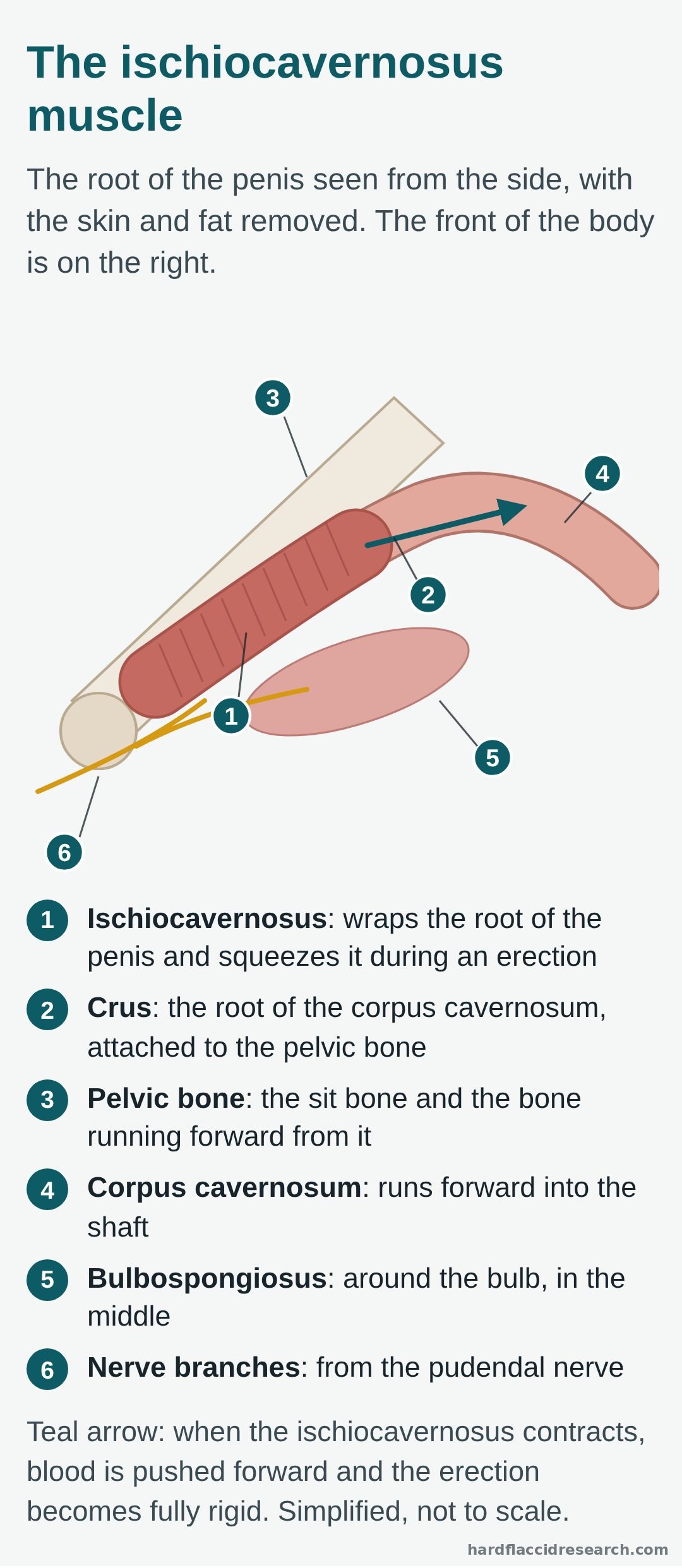
- Each one starts on the sit bone and the bone running forward from it, and wraps over a root of the penis (a crus).
- During an erection, they contract and push pressure inside the penis higher, making it fully rigid.
- They also contract during ejaculation, along with the bulbospongiosus.
- They're supplied by branches of the pudendal nerve.
- Pelvic floor exercises can strengthen them, but if the pelvic floor is tight, relaxation work usually comes first.
Where is the ischiocavernosus muscle?
The penis doesn't start at the skin. Its erectile tissue runs back inside the body. Each corpus cavernosum, one of the two chambers that fill with blood in an erection, divides at the back into a root called a crus, which attaches firmly to the pelvic bone on its own side.
Each ischiocavernosus starts from the inner side of the sit bone (the ischial tuberosity) and the bone that runs forward from it (the ischiopubic ramus). It wraps around its crus and ends in a flat tendon on the side and underside of the crus as it joins the shaft.
In the middle, between the two crura, sits the bulb of the penis, wrapped by the bulbospongiosus muscle. Behind them, a thin band called the superficial transverse perineal muscle runs across. These three pairs form the superficial layer of the pelvic floor, below the deeper levator ani.
Related: Bulbospongiosus Muscle: Erections, Ejaculation and Dribbling »
What does the ischiocavernosus muscle do?
Making an erection rigid
An erection starts with blood flow: the smooth muscle inside the corpora relaxes and blood rushes in, which makes the penis swell. To become fully rigid, the ischiocavernosus muscles then contract and squeeze the crura. This pushes blood forward into the shaft and raises the pressure inside the penis far above normal blood pressure for short moments.
Holding the erection
By pressing on the crura and the veins around them, the ischiocavernosus helps slow blood from draining away, which helps keep the erection firm.
During ejaculation
The ischiocavernosus contracts in rhythm with the bulbospongiosus and other pelvic floor muscles during orgasm and ejaculation.
Steadying the erect penis
It also helps hold the erect penis steady and angled upward.
Ischiocavernosus exercises
Pelvic floor exercises work the ischiocavernosus along with the other pelvic floor muscles. A small trial found that pelvic floor exercises taught by a therapist helped some men with erectile dysfunction.
How to find the muscles
- Sit or lie comfortably.
- Imagine lifting the base of the penis upward, or making the penis twitch, without tightening your buttocks, thighs or stomach.
- If you place a hand on the perineum, behind the scrotum, you should feel a gentle firming.
A simple routine
A pelvic floor physical therapist can tailor a routine. A typical approach looks like this:
- Squeeze firmly, as if lifting the base of the penis, and hold for a few seconds while breathing normally.
- Let go completely, and rest for at least as long as you held.
- Repeat several times, a few times a day.
- Add a few quick, strong squeezes, relaxing fully between each.
- Build up slowly over weeks.
Relaxing fully between squeezes matters as much as the squeeze itself. A muscle that can't relax can't contract well either.
Mistakes to avoid
- Holding your breath while squeezing. Breathe normally throughout.
- Squeezing your buttocks, thighs or stomach instead of the pelvic floor.
- Doing too many, too hard, too soon, which can leave the muscles sore and tight.
- Forgetting to relax fully between squeezes.
- Practicing by stopping your stream while peeing, which can interfere with emptying.
When not to do them
If you have pelvic pain, pain with ejaculation, trouble starting to pee, or a feeling that your pelvic floor is always clenched, strengthening may make things worse. A therapist can check whether you need to relax first.
Related: Kegel Exercises for Men: How to Do Them, Benefits & When to Stop »
What happens when it's weak?
Weak ischiocavernosus muscles, often along with a weak pelvic floor in general, can mean erections that swell but don't become fully rigid, or that fade quickly. This is more common with age, after prostate surgery, or with long-term inactivity. Weakness of these muscles is only one possible part of the picture, so erection problems also need a medical check.
What happens when it's too tight?
Tight or tender ischiocavernosus muscles, usually along with the rest of the pelvic floor, can cause:
- An ache at the base of the penis or along the sit bones.
- Pain during or after erections or ejaculation.
- Pain when sitting on hard seats.
- A feeling of tension or pulling at the root of the penis.
In this case, the muscles need to learn to relax and lengthen before they're strengthened.
The ischiocavernosus and hard flaccid syndrome
Hard flaccid syndrome is a firm, shrunken penis at rest, often with numbness, weaker erections and pelvic pain. One idea is that a tense pelvic floor, including the muscles around the roots of the penis, may help keep it going. This isn't proven.
Of the 2,661 men who described their symptoms, 35% described weaker or lost erections (926 men) and 23% described pelvic floor tightness, spasm or twitching (601 men). In separate counts, 846 men discussed Kegels and 704 discussed reverse Kegels.
Our members' guide, Weak Erections With Hard Flaccid: The Gentle Way Back to Sex, explains a gradual, low-pressure approach to rebuilding erections.
Relaxing the ischiocavernosus
- Slow belly breathing, letting the base of the penis and the perineum soften as you breathe in.
- Reverse Kegels: gently letting the pelvic floor lengthen and drop, without pushing.
- Gentle stretches for the inner thighs and hips.
- Warm baths.
- Hands-on release by a pelvic floor physical therapist.
When should I see a doctor?
See a primary care provider or a urologist (a doctor for urinary and sexual health) if erections are weaker, don't become fully firm, or fade quickly. Erection problems can be an early sign of heart and blood vessel disease. See a pelvic floor physical therapist if you have pain at the base of the penis or when sitting. Our doctor visit kit helps you describe what's happening.
Get urgent care straight away (call 911 or go to the emergency room) if you have:
- An erection lasting more than 4 hours.
- A cracking or popping sound during sex or masturbation, followed by sudden pain, a quick loss of erection, or rapid swelling or dark bruising.
- New numbness around your back passage, genitals or inner thighs, or new weakness in your legs.
- Chest pain, especially during or after sex.
Frequently asked questions
Can you feel the ischiocavernosus?
Sometimes. Placing your fingers just inside the sit bone, beside the base of the penis, and tightening as if to lift the penis can let you feel it firm up.
Do Kegels work the ischiocavernosus?
Yes. Kegels work the whole pelvic floor, including the ischiocavernosus and bulbospongiosus.
Can strengthening the ischiocavernosus improve erections?
In some men, pelvic floor exercises improve erection firmness, especially when the pelvic floor is weak. They're not a substitute for checking the causes of erectile dysfunction.
Why does the base of my penis ache?
It can come from tight pelvic floor muscles, including the ischiocavernosus, from prostatitis or from irritation of the pudendal nerve. A doctor or pelvic floor physical therapist can help find the cause.
Is the ischiocavernosus the same as the bulbospongiosus?
No. The bulbospongiosus is a single muscle in the midline around the bulb. The two ischiocavernosus muscles sit on either side, over the roots of the penis.
Can a tight ischiocavernosus cause erection problems?
Possibly. A pelvic floor that's always tense may not contract well when it's needed and may add to pain at the base of the penis. Relaxation work often comes before strengthening.
How long do pelvic floor exercises take to help?
Many men notice changes within a few weeks to a few months of regular, correct practice.
Takeaway
The ischiocavernosus muscles wrap the roots of the penis. They squeeze blood forward to make an erection fully rigid and help hold it.
Pelvic floor exercises can strengthen them, but if the pelvic floor is tight or painful, relaxing comes first. Take our free self-check if you also notice changes in your penis at rest.
This article is for general information and isn't a substitute for advice from your own doctor. Hard Flaccid Research doesn't diagnose or treat. If you have new or worsening symptoms, see a qualified clinician. In an emergency, call 911.
Free tools that can help
- Self-check: do I have hard flaccid?Compare your symptoms with what 6,026 men report.
- Doctor visit kitA one-page summary to take to your appointment.
- Habit trackerCount your days without porn or masturbation, and get through urges.
- Diaphragm breathing toolBreathe with a moving picture of your diaphragm and pelvic floor.
- Add your experienceTell us what you tried and how it went. No name needed.
- Hard Flaccid Syndrome CensusWhat men answered in 818 polls.
- Symptom trackerLog your symptoms and see what helps you.
- Ask us a questionThe questions men ask most become new articles.
The numbers behind this article
Every number in this article comes from what men with hard flaccid syndrome shared between December 2020 and October 2026, counted once per person, or from their polls. These are self-selected reports, not a clinical study. See hard flaccid syndrome statistics, the Hard Flaccid Syndrome Census and how we count.
35% of men who described their symptoms described weaker or lost erections
Share of the 2,661 men who described their symptoms. Each man is counted once.These are self-selected reports, not a clinical study.
Source: Hard Flaccid Research, hardflaccidresearch.com
846 men discussed Kegels
Men counted once each from what men wrote.Source: Hard Flaccid Research, hardflaccidresearch.com
Every number in this article, with its source
| In this article | Source |
|---|---|
| 35% of the men who described their symptoms described weaker or lost erections (926 of 2,661) | 926 of 2,661 men, counted |
| 23% of the men who described their symptoms described pelvic floor tightness, spasm or twitching (601 of 2,661) | 601 of 2,661 men, counted |
| 6,026 men shared their experiences, and 2,661 of them described their symptoms | 2,661 of 6,026 men, counted |
| 846 men discussed Kegels | 846 men discussing Kegels, counted from what men wrote, once per person |
| 704 men discussed reverse Kegels | 704 men discussing reverse Kegels, counted from what men wrote, once per person |
Medical sources
What this article says about medical research, guidelines and urgent care comes from these sources.
- Physiology, Erection. In: StatPearls. Treasure Island (FL): StatPearls Publishing. https://www.ncbi.nlm.nih.gov/books/NBK513278/
- Anatomy, Abdomen and Pelvis, Penis. In: StatPearls. Treasure Island (FL): StatPearls Publishing. https://www.ncbi.nlm.nih.gov/books/NBK482236/
- Anatomy of the human penis: the relationship of the architecture between skeletal and smooth muscles. J Androl. 2004;25(3):426-431. https://doi.org/10.1002/j.1939-4640.2004.tb02810.x
- Dean RC, Lue TF. Physiology of penile erection and pathophysiology of erectile dysfunction. Urol Clin North Am. 2005;32(4):379-395. https://doi.org/10.1016/j.ucl.2005.08.007
- Dorey G, Speakman MJ, Feneley RCL, Swinkels A, Dunn CDR. Pelvic floor exercises for erectile dysfunction. BJU Int. 2005;96:595-597. https://doi.org/10.1111/j.1464-410X.2005.05690.x
- Lai HH, Pontari MA, Argoff CE, et al. Male chronic pelvic pain: AUA guideline. J Urol. 2025. https://www.auanet.org/guidelines-and-quality/guidelines/male-chronic-pelvic-pain
How we made this article
We started from the question many men asked. Every number was checked against our data. Our editorial team edited it and Dr. Julian Reyes reviewed it medically. Read our editorial policy.
Read next
See more of us on Google
Add Hard Flaccid Research as a preferred source, and Google shows you our pages more often when you search.
Add as a preferred sourceDon't see your question? Ask us. We answer the most-asked ones in new articles.
Cite and share this article
You're welcome to quote this article. Please name Hard Flaccid Research and link to this page, so others can find the full answer and the data behind it. To cite this page, use its link.
Citation
Hard Flaccid Research. (2026). Ischiocavernosus Muscle: Erection Rigidity, Exercises and Pain. Written by the Editorial Team, medically reviewed by Dr. Julian Reyes. https://hardflaccidresearch.com/articles/ischiocavernosus
Credit link for your article
Source: <a href="https://hardflaccidresearch.com/articles/ischiocavernosus">Hard Flaccid Research</a>
Wikipedia reference
<ref>{{cite web |url=https://hardflaccidresearch.com/articles/ischiocavernosus |title=Ischiocavernosus Muscle: Erection Rigidity, Exercises and Pain |website=Hard Flaccid Research |date=2026 |access-date=22 November 2026}}</ref>
How the data was collected: our methodology. Journalists and researchers: key numbers, data and contact.