Pudendal Nerve: Anatomy, Path, Symptoms and Stretches
In short
- The pudendal nerve is the main nerve of the area between the legs.
- It starts from the lower spine, passes behind the pelvis and runs forward in a tunnel called Alcock's canal, supplying feeling to the penis, scrotum, perineum and anus, and the muscles that control urine, bowel and sexual function.
- When it's irritated or squeezed, it can cause burning pain that's worse when sitting, called pudendal neuralgia.
The pudendal (pyoo-DEN-dul) nerve is the main nerve of the area between the legs. There's one on each side. It carries feeling from the penis, scrotum, perineum and anus, and it controls the muscles that help hold in urine and stool and that work during erections and ejaculation.
It takes a long, curving path from the lower spine, behind the pelvis and forward through a narrow tunnel called Alcock's canal. Along the way it can be pressed or irritated, which can cause burning pain, numbness or pins and needles, often worse when sitting. This page explains the nerve's anatomy, what it does, what happens when it's irritated, and gentle stretches that may help.
By the numbers: of the 6,026 men who shared their experiences with hard flaccid syndrome, 2,661 described their symptoms, and 914 of them described numbness or reduced sensation.
Key facts
- The pudendal nerve starts from nerve roots in the lower spine and runs on each side of the pelvis.
- It passes behind the pelvis, hooks around the ischial spine and a ligament, then runs forward in Alcock's canal on the side wall of the pelvis.
- It splits into three main branches: to the anus, to the perineum and pelvic floor muscles, and to the penis.
- It carries sensation from the genitals and anus, and controls the external urethral and anal sphincters and pelvic floor muscles.
- Irritation or squeezing of the nerve can cause pudendal neuralgia: burning, stabbing or numb pain that's worse when sitting and eases when standing or lying down.
- Treatment usually starts with avoiding pressure, physical therapy and medicines for nerve pain. Nerve blocks and surgery are options for severe cases.
Where does the pudendal nerve run?
It starts in the lower spine
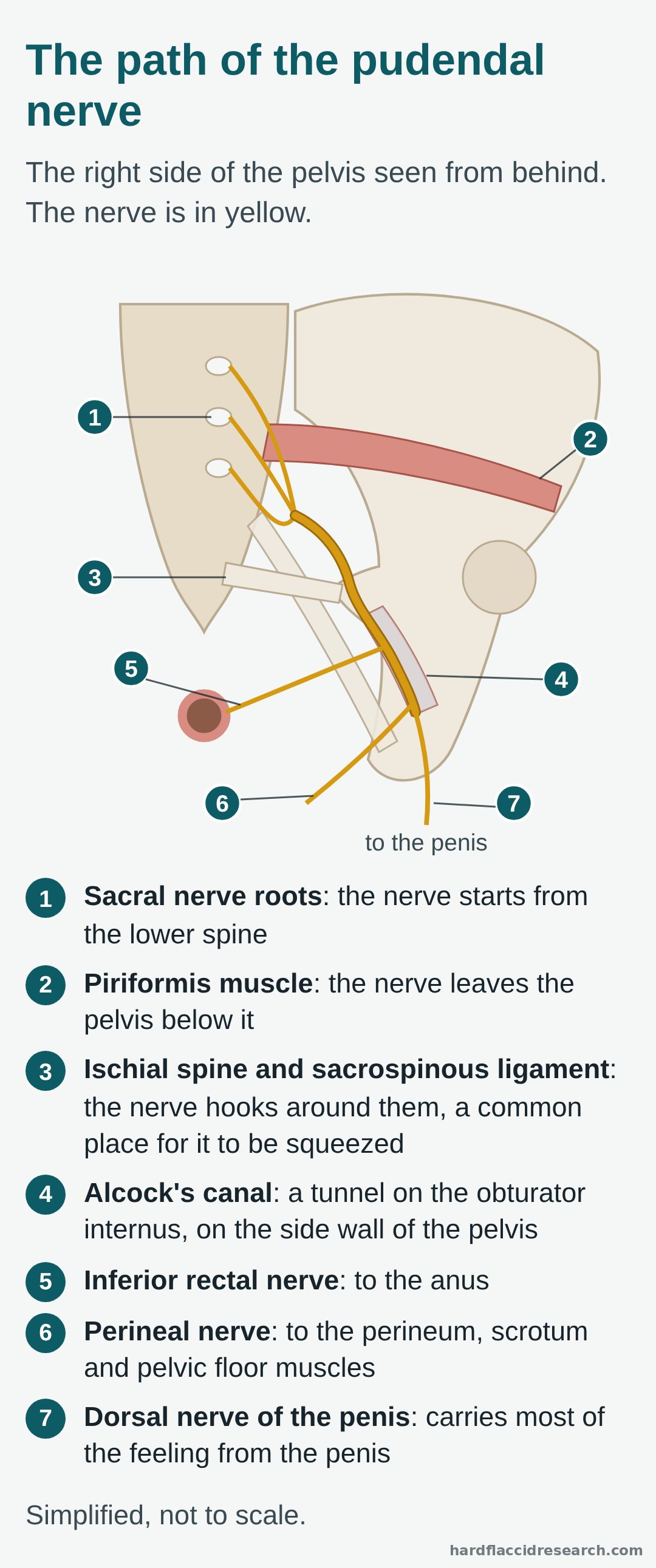
The pudendal nerve forms from the second, third and fourth sacral nerve roots, which leave the lower part of the spine (the sacrum). These roots also control the bladder, bowel and erections.
It leaves the pelvis
The nerve exits the back of the pelvis below the piriformis muscle, deep in the buttock, through a gap called the greater sciatic foramen.
It hooks around the ischial spine
It then wraps tightly around the ischial spine, a bony point on the back of the pelvis, between two strong ligaments: the sacrospinous and the sacrotuberous ligaments. This is one of the places where it can be squeezed.
It runs through Alcock's canal
The nerve re-enters below the pelvic floor and runs forward in Alcock's canal, a tunnel of tough tissue on the inner surface of the obturator internus muscle, along the side wall of the pelvis. Its artery and vein travel with it. This is another place where it can be squeezed.
It branches
- The inferior rectal nerve: to the anal sphincter and the skin around the anus.
- The perineal nerve: to the skin of the perineum and back of the scrotum, the pelvic floor muscles at the base of the penis, and the external urethral sphincter.
- The dorsal nerve of the penis: along the top of the penis to the glans, carrying most of the penis's sensation.
Related: Hard Flaccid Pudendal Surgery: 82 Men, 0 Recovery Stories »
What does the pudendal nerve do?
- Feeling: it carries touch, temperature and sexual sensation from the penis, scrotum, perineum and anus.
- Continence: it controls the external urethral and anal sphincters, which you tighten to hold in urine and stool.
- Sexual function: it supplies the bulbospongiosus and ischiocavernosus muscles, which help make erections rigid and push semen out during ejaculation, and it carries the sensation that triggers these reflexes.
What happens when the pudendal nerve is irritated?
When the nerve is pressed, stretched or irritated, it can cause pudendal neuralgia. Common features include:
- Burning, stabbing, aching or electric pain in the penis, scrotum, perineum or anus.
- Pain that's worse when sitting, and better when standing, lying down or sitting on a toilet seat.
- Numbness, pins and needles, or a feeling of a foreign object in the rectum.
- Changes in sexual sensation, or pain with ejaculation.
- Sometimes urinary urgency or frequency.
Doctors use a set of criteria, called the Nantes criteria, to judge whether pain is likely to come from the pudendal nerve being trapped. One key sign is that the pain doesn't wake you at night.
What can irritate it
- Long hours of sitting or cycling, which press on the area.
- A fall onto the buttocks or a pelvic injury.
- Tight pelvic floor muscles, including the obturator internus, around Alcock's canal.
- Heavy straining, long-term constipation or intense exercise such as squats.
- Surgery in the pelvis, or childbirth in women.
Related: Pudendal Nerve Entrapment: Symptoms, Causes & Treatment »
The pudendal nerve and hard flaccid syndrome
Hard flaccid syndrome is a firm, shrunken penis at rest, often with numbness, weaker erections and pelvic pain. Because the pudendal nerve supplies feeling to the penis and the muscles at its base, some doctors have proposed that irritation of this nerve may play a part in some men. This isn't proven.
Of the 2,661 men who described their symptoms, 34% described numbness or reduced sensation (914 men) and 10% described pelvic, perineal or tailbone pain (267 men). In separate counts, 100 men asked whether it's a nerve problem (pudendal nerve), and 246 men discussed nerve blocks.
Our members' guide, Pudendal Nerve or Hard Flaccid? Signs, Tests, Treatments, compares the two and explains which tests may help tell them apart.
Pudendal nerve stretches and self-care
Nerves don't stretch like muscles, but gentle movement and relaxing the muscles around the nerve may ease irritation. Move slowly, and stop if a stretch makes burning or tingling worse.
- Child's pose: kneel, sit back towards your heels and reach your arms forward, breathing slowly into your belly.
- Happy baby: lie on your back, hold your feet or shins with your knees bent wide, and let your pelvic floor soften.
- Figure-four stretch: lie on your back, cross one ankle over the other knee and gently pull the lower leg towards you.
- Inner-thigh stretch: sit with the soles of your feet together and let your knees fall outward.
- Belly breathing with pelvic floor relaxation, several times a day.
Also:
- Avoid long hours of sitting. Stand up regularly and use a cushion with a cut-out.
- If you cycle, use a cut-out saddle, lower the nose of the saddle and take breaks.
- Avoid heavy squats and straining while the nerve is irritated.
- Treat constipation.
How is pudendal nerve pain treated?
- Pelvic floor physical therapy to relax tight muscles around the nerve.
- Medicines for nerve pain, prescribed by a doctor. These can cause drowsiness and other side effects.
- A pudendal nerve block: an injection of local anesthetic, sometimes with a steroid, around the nerve, guided by a scan. It can help confirm where the pain comes from and may ease it for a while.
- Surgery to free the nerve (pudendal nerve decompression), in specialist centers, for severe cases that haven't responded to other treatment. A small trial found it helped more people than no surgery, but not everyone improves.
When should I see a doctor?
See a primary care provider, a urologist (a doctor for urinary and sexual health) or a pain specialist if you have burning, stabbing or numb pain between the legs that's worse when sitting, or changes in genital sensation. Our doctor visit kit helps you describe the pain and what changes it.
Get urgent care straight away (call 911 or go to the emergency room) if you have:
- New numbness around your back passage, genitals or inner thighs, or new weakness in your legs.
- New trouble starting or controlling your pee, not being able to pee, or not feeling when your bladder is full.
- Loss of control of your bladder or bowel.
- Severe back pain with any of these.
These can be signs of pressure on the nerves at the base of the spine, which needs emergency care.
Frequently asked questions
What does pudendal nerve pain feel like?
Often burning, stabbing, aching or like sitting on a golf ball, in the penis, scrotum, perineum or anus. It's usually worse when sitting.
Can cycling damage the pudendal nerve?
Long rides on a narrow saddle can press on the nerve and cause numbness or pain. This usually settles with rest and a better saddle.
Can the pudendal nerve heal?
Irritated nerves often recover once the pressure is removed, though it can take weeks to months.
What is Alcock's canal?
A tunnel of tough tissue on the side wall of the pelvis, over the obturator internus muscle, that carries the pudendal nerve and its blood vessels.
Does a pudendal nerve problem cause numbness in the penis?
It can, because the dorsal nerve of the penis is a branch of the pudendal nerve. Numbness can have other causes too, so it's worth a check.
Takeaway
The pudendal nerve is the main nerve between the legs. It runs from the lower spine, behind the pelvis and through Alcock's canal, and it carries sensation from the genitals and controls the pelvic floor sphincters.
When it's irritated, it can cause burning pain that's worse when sitting. Less sitting, pelvic floor relaxation and gentle stretches help many people, with nerve blocks and surgery for severe cases. Take our free self-check if you also notice changes in your penis at rest.
This article is for general information and isn't a substitute for advice from your own doctor. Hard Flaccid Research doesn't diagnose or treat. If you have new or worsening symptoms, see a qualified clinician. In an emergency, call 911.
Free tools that can help
- Self-check: do I have hard flaccid?Compare your symptoms with what 6,026 men report.
- Doctor visit kitA one-page summary to take to your appointment.
- Habit trackerCount your days without porn or masturbation, and get through urges.
- Diaphragm breathing toolBreathe with a moving picture of your diaphragm and pelvic floor.
- Add your experienceTell us what you tried and how it went. No name needed.
- Hard Flaccid Syndrome CensusWhat men answered in 818 polls.
- Symptom trackerLog your symptoms and see what helps you.
- Ask us a questionThe questions men ask most become new articles.
The numbers behind this article
Every number in this article comes from what men with hard flaccid syndrome shared between December 2020 and October 2026, counted once per person, or from their polls. These are self-selected reports, not a clinical study. See hard flaccid syndrome statistics, the Hard Flaccid Syndrome Census and how we count.
34% of men who described their symptoms described numbness or reduced sensation
Share of the 2,661 men who described their symptoms. Each man is counted once.These are self-selected reports, not a clinical study. Numbness can have many causes besides the pudendal nerve.
Source: Hard Flaccid Research, hardflaccidresearch.com
Every number in this article, with its source
| In this article | Source |
|---|---|
| 34% of the men who described their symptoms described numbness or reduced sensation (914 of 2,661) | 914 of 2,661 men, counted |
| 10% of the men who described their symptoms described pelvic, perineal or tailbone pain (267 of 2,661) | 267 of 2,661 men, counted |
| 6,026 men shared their experiences, and 2,661 of them described their symptoms | 2,661 of 6,026 men, counted |
| 100 men asked whether it's a nerve problem (pudendal nerve) | 100 men asked whether it's a nerve problem (pudendal nerve), counted from what men wrote, once per person |
| 246 men discussed nerve blocks | 246 men discussing nerve blocks, counted from what men wrote, once per person |
Medical sources
What this article says about medical research, guidelines and urgent care comes from these sources.
- Anatomy, Abdomen and Pelvis, Pudendal Nerve. In: StatPearls. Treasure Island (FL): StatPearls Publishing. https://www.ncbi.nlm.nih.gov/books/NBK554736/
- Pudendal Nerve Entrapment Syndrome. In: StatPearls. Treasure Island (FL): StatPearls Publishing. https://www.ncbi.nlm.nih.gov/books/NBK544272/
- Pudendal Neuralgia. In: StatPearls. Treasure Island (FL): StatPearls Publishing. https://www.ncbi.nlm.nih.gov/books/NBK562246/
- Labat JJ, Riant T, Robert R, Amarenco G, Lefaucheur JP, Rigaud J. Diagnostic criteria for pudendal neuralgia by pudendal nerve entrapment (Nantes criteria). Neurourol Urodyn. 2008;27:306-310. https://pubmed.ncbi.nlm.nih.gov/17828787/
- Robert R, Labat JJ, Bensignor M, et al. Decompression and transposition of the pudendal nerve in pudendal neuralgia: a randomized controlled trial and long-term evaluation. Eur Urol. 2005;47:403-408. https://doi.org/10.1016/j.eururo.2004.09.003
- Lai HH, Pontari MA, Argoff CE, et al. Male chronic pelvic pain: AUA guideline. J Urol. 2025. https://www.auanet.org/guidelines-and-quality/guidelines/male-chronic-pelvic-pain
How we made this article
We started from the question many men asked. Every number was checked against our data. Our editorial team edited it and Dr. Julian Reyes reviewed it medically. Read our editorial policy.
Read next
See more of us on Google
Add Hard Flaccid Research as a preferred source, and Google shows you our pages more often when you search.
Add as a preferred sourceDon't see your question? Ask us. We answer the most-asked ones in new articles.
Cite and share this article
You're welcome to quote this article. Please name Hard Flaccid Research and link to this page, so others can find the full answer and the data behind it. To cite this page, use its link.
Citation
Hard Flaccid Research. (2026). Pudendal Nerve: Anatomy, Path, Symptoms and Stretches. Written by the Editorial Team, medically reviewed by Dr. Julian Reyes. https://hardflaccidresearch.com/articles/pudendal-nerve
Credit link for your article
Source: <a href="https://hardflaccidresearch.com/articles/pudendal-nerve">Hard Flaccid Research</a>
Wikipedia reference
<ref>{{cite web |url=https://hardflaccidresearch.com/articles/pudendal-nerve |title=Pudendal Nerve: Anatomy, Path, Symptoms and Stretches |website=Hard Flaccid Research |date=2026 |access-date=22 November 2026}}</ref>
How the data was collected: our methodology. Journalists and researchers: key numbers, data and contact.