Ischial Spine: Where It Is and Why It Matters for Pelvic Pain
In short
- The ischial spine is a small, pointed bump of bone on the inner side wall of the pelvis, on each side.
- Important ligaments and pelvic floor muscles attach to it, and the pudendal nerve hooks around it on its way to the genitals.
- Because of this, the area around the ischial spine is one of the places where the pudendal nerve can be squeezed, which can cause burning pelvic pain that's worse when sitting.
The ischial spine is a small, pointed bump of bone that sticks inward from the side wall of the pelvis, one on each side. It sits roughly level with the hip joints, above the sit bones, and you can't feel it from the outside. A doctor or pelvic floor physical therapist can sometimes feel it during an internal exam through the back passage.
It's a small bone with a big job. Strong ligaments and the pelvic floor muscles attach to it, and the pudendal nerve, which carries feeling from the genitals and perineum, hooks around it on its way to the perineum. That's why the area around the ischial spine matters for men with pelvic pain: it's one of the places where the pudendal nerve can be squeezed. This page explains where the ischial spine is, what attaches to it and how it relates to pelvic and pudendal nerve pain.
By the numbers: of the 6,026 men who shared their experiences with hard flaccid syndrome, 2,661 described their symptoms, and 914 of them described numbness or reduced sensation.

Key facts
- The ischial spine is part of the ischium, the lower back part of each hip bone.
- It points inward, toward the middle of the pelvis, between the greater and lesser sciatic notches.
- The sacrospinous ligament runs from the ischial spine to the side of the sacrum and tailbone.
- The coccygeus muscle and part of the levator ani attach to it, so it anchors the back of the pelvic floor.
- The pudendal nerve and its blood vessels hook around the back of the ischial spine and sacrospinous ligament.
- Squeezing of the pudendal nerve between the ligaments near the ischial spine, or in Alcock's canal just after it, is a recognized cause of pudendal neuralgia.
- Doctors often aim nerve block injections at the area near the ischial spine.
Where is the ischial spine?
Each hip bone is made of three bones fused together: the ilium at the top, the pubis at the front and the ischium at the bottom back. The ischium includes the sit bone, the bony point you sit on, and above it the ischial spine.
The ischial spine separates two notches in the back edge of the hip bone:
- Above it is the greater sciatic notch, which the sciatic nerve, the piriformis muscle and the pudendal nerve pass through as they leave the pelvis.
- Below it is the lesser sciatic notch, which the pudendal nerve and the tendon of the obturator internus pass through on their way back in.
Two ligaments turn these notches into openings: the sacrospinous ligament, from the ischial spine to the sacrum and tailbone, and the sacrotuberous ligament, from the sit bone to the sacrum.
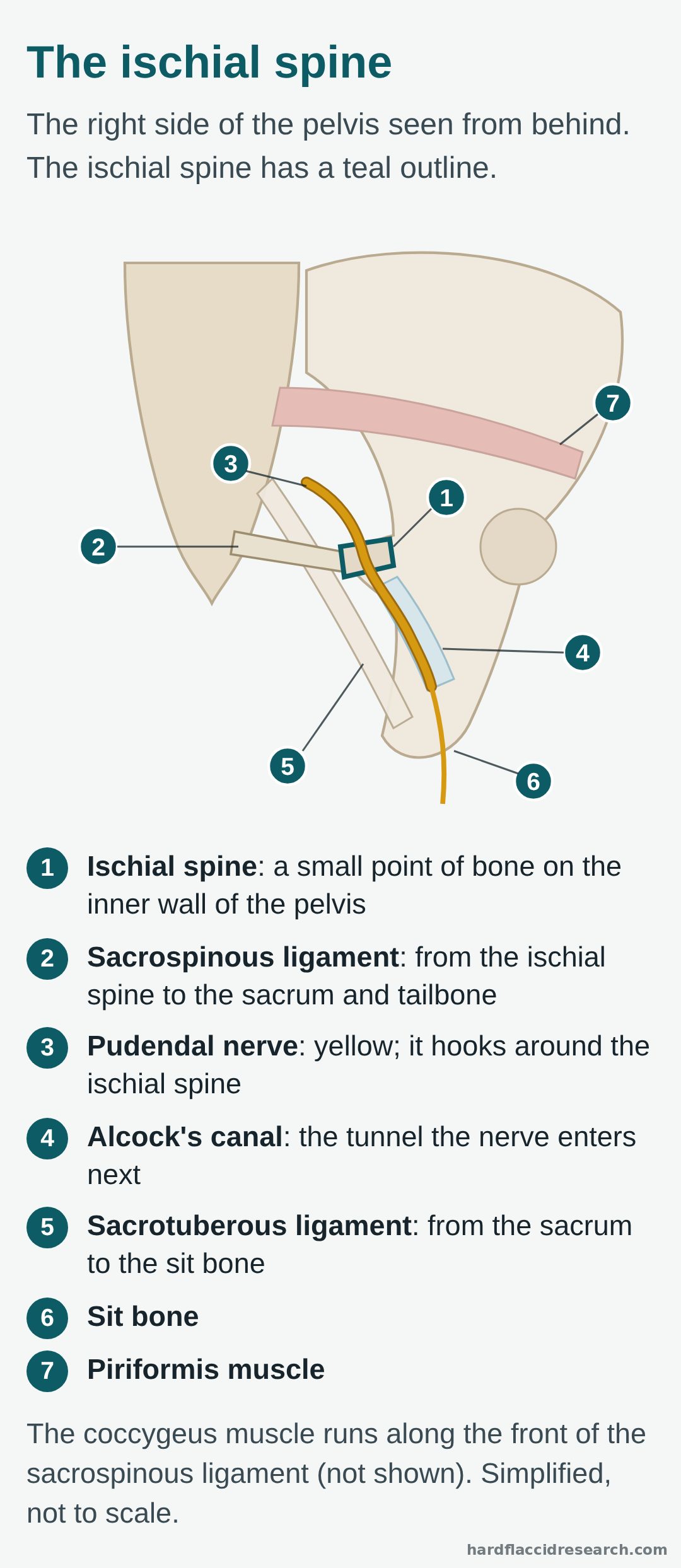
Related: Perineum Pain in Men: Causes, Relief and When to Worry »
What attaches to the ischial spine?
The sacrospinous ligament
A strong, fan-shaped band that runs from the ischial spine to the lower sacrum and tailbone. It helps hold the sacrum steady and forms the boundary between the greater and lesser sciatic openings.
The coccygeus muscle
A triangular pelvic floor muscle that runs from the ischial spine to the tailbone, along the front of the sacrospinous ligament.
The levator ani
The back part of the levator ani, the main pelvic floor muscle, hangs from a band of tissue that ends at the ischial spine.
Small hip muscles
One of the small muscles that turn the hip outward, the superior gemellus, starts near the ischial spine.
How does the pudendal nerve pass the ischial spine?
The pudendal nerve starts from the lower spinal nerves, inside the pelvis. It leaves the pelvis through the greater sciatic opening, below the piriformis muscle. It then hooks around the back of the ischial spine and the sacrospinous ligament, passes back into the pelvis through the lesser sciatic opening, and enters Alcock's canal, a tunnel on the inner side of the obturator internus muscle. From there, its branches run forward to the anus, the perineum and the penis.
In the area around the ischial spine, the nerve lies in a narrow space between two ligaments, the sacrospinous in front and the sacrotuberous behind. This is one of the places where it can be squeezed.
Related: Coccygeus Muscle: Where It Is, What It Does and Pain »
What problems involve the ischial spine?
Pudendal nerve entrapment
When the pudendal nerve is squeezed between the ligaments near the ischial spine, or in Alcock's canal, it can cause pudendal neuralgia. Typical features, which doctors use in a set of criteria called the Nantes criteria, include:
- Burning, shooting or aching pain in the area the nerve supplies, from the anus to the penis.
- Pain that's worse when sitting.
- No waking at night from the pain.
- No loss of feeling on clinical exam, in classic cases.
- Relief from a nerve block.
Tenderness and pelvic floor tension
The muscles that attach near the ischial spine, especially the coccygeus and the levator ani, can become tight and tender, causing deep pelvic or buttock pain.
Injury
Fractures of the pelvis can involve the ischium, though the ischial spine itself is rarely injured on its own.
How do doctors use the ischial spine?
- During an internal exam through the back passage, a doctor or pelvic floor physical therapist can feel the ischial spine and check whether the pudendal nerve area or nearby muscles are tender.
- Pudendal nerve block injections are often guided to the area near the ischial spine, using ultrasound, a CT scan or a finger as a guide.
- Surgeons who release a trapped pudendal nerve work in this area. A randomized trial of pudendal nerve decompression surgery found more men and women improved with surgery than without it, though it's only for carefully selected people.
Ischial spine and hard flaccid syndrome
Hard flaccid syndrome is a firm, shrunken penis at rest, often with numbness, weaker erections and pelvic pain. Many men with hard flaccid wonder whether the pudendal nerve is involved, because it carries feeling from the penis and controls the pelvic floor muscles. There's no evidence that pudendal nerve entrapment causes hard flaccid, but some symptoms overlap, and a tense pelvic floor may play a part in both. This isn't proven.
Of the 2,661 men who described their symptoms, 34% described numbness or reduced sensation (914 men) and 10% described pelvic, perineal or tailbone pain (267 men). In a separate count, 100 men asked whether it's a nerve problem (pudendal nerve).
Our members' guide, Pudendal Nerve or Hard Flaccid? Signs, Tests, Treatments, compares the two and explains the tests that help tell them apart.
When should I see a doctor?
See a primary care provider if you have burning or aching pain in the perineum, penis or anus that's worse when sitting, deep buttock pain, or numbness in the genitals or perineum that lasts more than a few weeks. You may be referred to a pain specialist, a neurologist or a pelvic floor physical therapist.
Get urgent care straight away (call 911 or go to the emergency room) if you have:
- New numbness around your back passage, genitals or inner thighs, or new weakness in your legs.
- New trouble controlling your bladder or bowel, or not being able to pee.
- Severe pelvic pain after a fall or injury.
- A fever or chills with back, buttock or pelvic pain.
- Sudden, severe pain in the penis, testicles or pelvis.
Frequently asked questions
Can I feel my ischial spine?
Not from the outside. It's deep inside the pelvis. It can be felt during an internal exam.
Is the ischial spine the same as the sit bone?
No. The sit bone is lower down, where you sit. The ischial spine is a smaller point higher up on the inner wall of the pelvis.
Why does sitting make pudendal pain worse?
Sitting presses on the area where the nerve runs, between the ligaments and in Alcock's canal, which can irritate an already sensitive nerve.
What is the sacrospinous ligament?
A strong band of tissue from the ischial spine to the sacrum and tailbone. The pudendal nerve passes just behind it.
Can pelvic floor physical therapy help pain near the ischial spine?
It can help if tight pelvic floor muscles are part of the problem, by releasing them and teaching relaxation.
Is pudendal nerve entrapment common?
It's uncommon. Many men with pelvic pain have tight pelvic floor muscles or chronic pelvic pain syndrome rather than true entrapment.
What tests check the pudendal nerve?
Doctors rely mostly on your symptoms and an exam. A nerve block near the ischial spine that eases the pain supports the diagnosis.
Is the ischial spine sharp?
It's a pointed bump of bone, but it's covered by ligaments and muscle, so it doesn't cause problems on its own.
Takeaway
The ischial spine is a small point of bone on the inner wall of the pelvis where the sacrospinous ligament and pelvic floor muscles attach and the pudendal nerve hooks past.
That makes it an important landmark in pudendal nerve pain and pelvic floor tension, for both diagnosis and treatment. Take our free self-check if you also notice changes in your penis at rest.
This article is for general information and isn't a substitute for advice from your own doctor. Hard Flaccid Research doesn't diagnose or treat. If you have new or worsening symptoms, see a qualified clinician. In an emergency, call 911.
Free tools that can help
- Self-check: do I have hard flaccid?Compare your symptoms with what 6,026 men report.
- Doctor visit kitA one-page summary to take to your appointment.
- Habit trackerCount your days without porn or masturbation, and get through urges.
- Diaphragm breathing toolBreathe with a moving picture of your diaphragm and pelvic floor.
- Add your experienceTell us what you tried and how it went. No name needed.
- Hard Flaccid Syndrome CensusWhat men answered in 818 polls.
- Symptom trackerLog your symptoms and see what helps you.
- Ask us a questionThe questions men ask most become new articles.
The numbers behind this article
Every number in this article comes from what men with hard flaccid syndrome shared between December 2020 and October 2026, counted once per person, or from their polls. These are self-selected reports, not a clinical study. See hard flaccid syndrome statistics, the Hard Flaccid Syndrome Census and how we count.
34% of men who described their symptoms described numbness or reduced sensation
Share of the 2,661 men who described their symptoms. Each man is counted once.These are self-selected reports, not a clinical study.
Source: Hard Flaccid Research, hardflaccidresearch.com
Every number in this article, with its source
| In this article | Source |
|---|---|
| 100 men asked whether it's a nerve problem (pudendal nerve) | 100 men asked whether it's a nerve problem (pudendal nerve), counted from what men wrote, once per person |
| 34% of the men who described their symptoms described numbness or reduced sensation (914 of 2,661) | 914 of 2,661 men, counted |
| 10% of the men who described their symptoms described pelvic, perineal or tailbone pain (267 of 2,661) | 267 of 2,661 men, counted |
| 6,026 men shared their experiences, and 2,661 of them described their symptoms | 2,661 of 6,026 men, counted |
Medical sources
What this article says about medical research, guidelines and urgent care comes from these sources.
- Anatomy, Abdomen and Pelvis, Pudendal Nerve. In: StatPearls. Treasure Island (FL): StatPearls Publishing. https://www.ncbi.nlm.nih.gov/books/NBK554736/
- Pudendal Nerve Entrapment Syndrome. In: StatPearls. Treasure Island (FL): StatPearls Publishing. https://www.ncbi.nlm.nih.gov/books/NBK544272/
- Anatomy, Abdomen and Pelvis: Pelvic Floor. In: StatPearls. Treasure Island (FL): StatPearls Publishing. https://www.ncbi.nlm.nih.gov/books/NBK482200/
- Anatomy, Abdomen and Pelvis: Levator Ani Muscle. In: StatPearls. Treasure Island (FL): StatPearls Publishing. https://www.ncbi.nlm.nih.gov/books/NBK556078/
- Labat JJ, Riant T, Robert R, Amarenco G, Lefaucheur JP, Rigaud J. Diagnostic criteria for pudendal neuralgia by pudendal nerve entrapment (Nantes criteria). Neurourol Urodyn. 2008;27:306-310. https://pubmed.ncbi.nlm.nih.gov/17828787/
- Robert R, Labat JJ, Bensignor M, et al. Decompression and transposition of the pudendal nerve in pudendal neuralgia: a randomized controlled trial and long-term evaluation. Eur Urol. 2005;47:403-408. https://doi.org/10.1016/j.eururo.2004.09.003
How we made this article
We started from the question many men asked. Every number was checked against our data. Our editorial team edited it and Dr. Julian Reyes reviewed it medically. Read our editorial policy.
Read next
See more of us on Google
Add Hard Flaccid Research as a preferred source, and Google shows you our pages more often when you search.
Add as a preferred sourceDon't see your question? Ask us. We answer the most-asked ones in new articles.
Cite and share this article
You're welcome to quote this article. Please name Hard Flaccid Research and link to this page, so others can find the full answer and the data behind it. To cite this page, use its link.
Citation
Hard Flaccid Research. (2026). Ischial Spine: Where It Is and Why It Matters for Pelvic Pain. Written by the Editorial Team, medically reviewed by Dr. Julian Reyes. https://hardflaccidresearch.com/articles/ischial-spine
Credit link for your article
Source: <a href="https://hardflaccidresearch.com/articles/ischial-spine">Hard Flaccid Research</a>
Wikipedia reference
<ref>{{cite web |url=https://hardflaccidresearch.com/articles/ischial-spine |title=Ischial Spine: Where It Is and Why It Matters for Pelvic Pain |website=Hard Flaccid Research |date=2026 |access-date=22 November 2026}}</ref>
How the data was collected: our methodology. Journalists and researchers: key numbers, data and contact.