Perineal Body: The Center of the Pelvic Floor Explained
In short
- The perineal body is a small, firm knot of muscle and connective tissue in the middle of the perineum, between the scrotum and the anus.
- Several pelvic floor muscles attach to it, including the bulbospongiosus, the transverse perineal muscles and the external anal sphincter.
- It anchors and steadies the pelvic floor.
- When the muscles around it are tight, men can feel pressure or pain in the perineum.
The perineal body is a small, firm knot of muscle and tough connective tissue in the middle of the perineum, the area between the scrotum and the anus. It's sometimes called the central tendon of the perineum, because several pelvic floor muscles meet and attach to it, like ropes tied to a central post.
You can't see it, but you can feel the area it sits in: press gently on the skin halfway between the back of the scrotum and the anus, and the firm spot underneath is roughly where it is. This page explains where the perineal body is, which muscles attach to it, what it does, and why the area can ache when the pelvic floor is tight.
By the numbers: of the 6,026 men who shared their experiences with hard flaccid syndrome, 2,661 described their symptoms, and 601 of them described pelvic floor tightness, spasm or twitching.
Key facts
- The perineal body lies in the middle of the perineum, between the bulb of the penis and the anus.
- It's made of muscle fibers and dense connective tissue, and in men it's shaped roughly like a small pyramid.
- Muscles from the front, the sides and the back attach to it, including the bulbospongiosus, the transverse perineal muscles, the external anal sphincter and parts of the levator ani.
- It acts as an anchor point that holds the pelvic floor together and helps support the organs above it.
- It gets its nerve supply mainly from the perineal nerve, a branch of the pudendal nerve.
- Tight pelvic floor muscles can make the perineum feel tense, sore or full of pressure.
Where is the perineal body?
The perineum is a diamond-shaped area at the bottom of the pelvis. An imaginary line between the two sit bones divides it into two triangles:
- The front triangle, called the urogenital triangle, holds the root of the penis and the urethra.
- The back triangle, called the anal triangle, holds the anus and its sphincter.
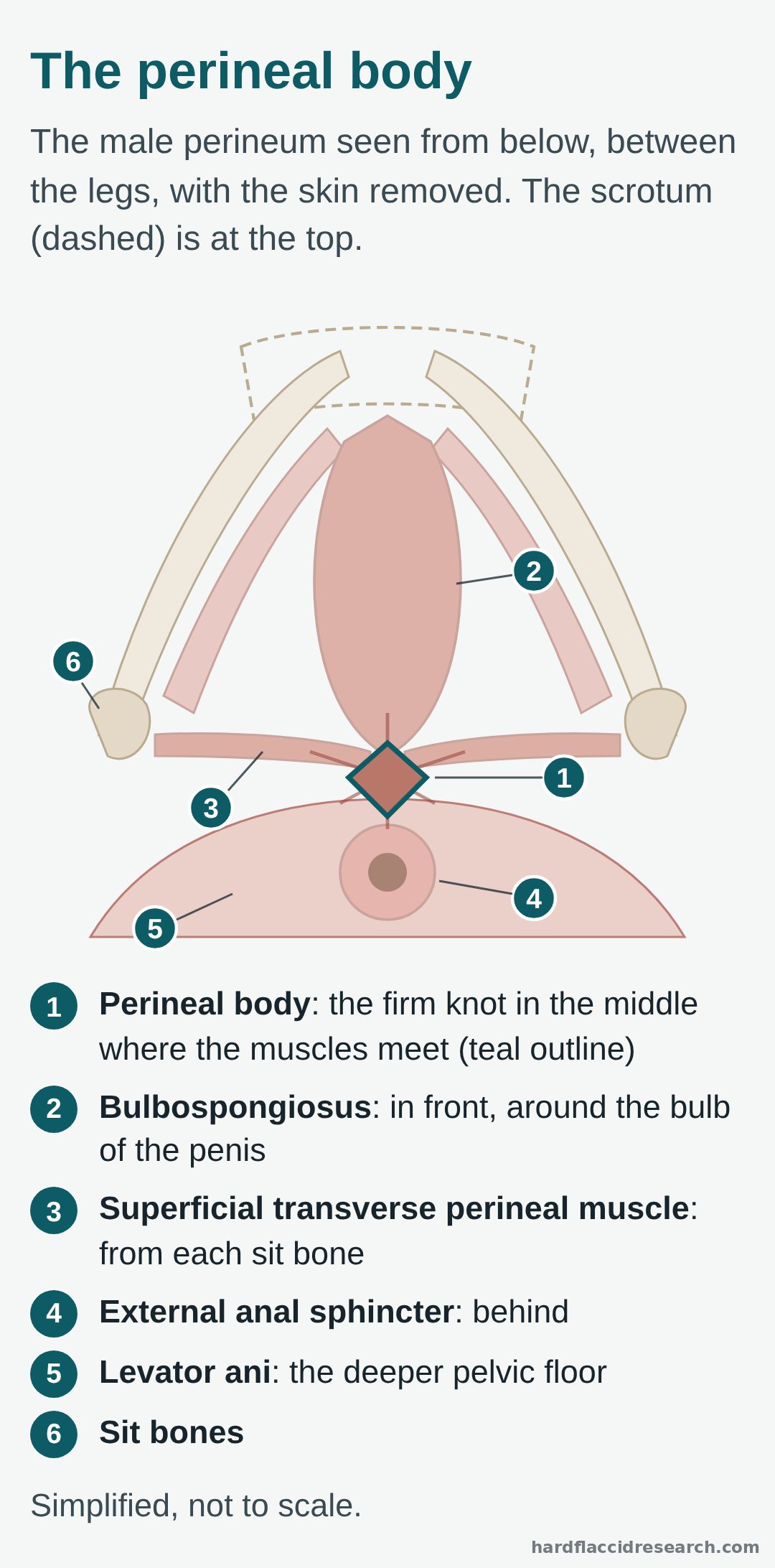
The perineal body sits right in the middle of that dividing line, where the two triangles meet. In front of it is the bulb of the penis, wrapped in the bulbospongiosus muscle. Behind it is the anus. Above it, deeper in the pelvis, are the prostate and the bottom of the rectum.
Related: Coccygeus Muscle: Where It Is, What It Does and Pain »
Which muscles attach to the perineal body?
From the front
The bulbospongiosus, the muscle that wraps the bulb of the penis and helps with erections, ejaculation and emptying the urethra, attaches to the front of the perineal body.
From the sides
The superficial and deep transverse perineal muscles run across from the sit bones on each side and meet at the perineal body, like the arms of a cross.
From the back
The external anal sphincter, the ring of muscle that keeps the anus closed, attaches to the back of the perineal body. Smooth muscle from the wall of the anal canal blends into it too.
From above
Fibers of the levator ani, the main muscle of the pelvic floor, attach to its sides. The external urethral sphincter, which controls the flow of urine, attaches to the front of it.
Membranes
The perineal membrane, a tough sheet that supports the root of the penis, and the fascia under the skin of the perineum both blend into it.
What does the perineal body do?
It anchors the pelvic floor
Because so many muscles attach to it, the perineal body acts as a central anchor. When these muscles contract, the perineal body gives them something stable to pull against.
It supports the organs above
With the rest of the pelvic floor, it helps hold up the bladder, prostate and rectum, especially when you cough, lift, strain or stand for long periods.
It helps the muscles work together
Erections, ejaculation, peeing and bowel movements all involve muscles that attach to the perineal body. It ties their pull together so they can work as a team.
Related: External Anal Sphincter: What It Does, Tightness and Pain »
Why can the perineum hurt?
The perineal body itself rarely causes problems in men, but the muscles that attach to it often do. Pain or pressure in the middle of the perineum can come from:
- Tight, tender pelvic floor muscles, which are common in men with chronic pelvic pain.
- Prostatitis or chronic pelvic pain syndrome.
- Irritation of the pudendal nerve or its branches, often worse when sitting.
- Pressure from long hours on a bicycle seat or a hard chair.
- An injury, such as a fall astride a bar or a blow between the legs.
- Rarely, an infection or an abscess near the anus, which causes a hot, swollen, very painful lump.
What helps a tense, sore perineum?
Relaxing the pelvic floor
- Breathe slowly into your belly. As you breathe in, let the perineum and back passage drop and soften, like letting go of a held breath.
- Practice this for a few minutes, several times a day, lying down at first.
- Avoid clenching the buttocks and pelvic floor through the day.
Pelvic floor physical therapy
A pelvic floor physical therapist can check whether the muscles around the perineal body are tight or tender and help them relax, using hands-on release, breathing and relaxation training. US urology guidelines say doctors may offer this to men with chronic pelvic pain who have tight, tender pelvic floor muscles, and a small trial found physical therapy aimed at these muscles helped more men than general massage.
Sitting and daily habits
- Use a cushion with a cut-out so the perineum doesn't take your weight.
- Take breaks from long periods of sitting or cycling.
- Treat constipation and don't strain on the toilet.
- Use warmth, such as a warm bath, to ease muscle tension.
Perineal body and hard flaccid syndrome
Hard flaccid syndrome is a firm, shrunken penis at rest, often with numbness, weaker erections and pelvic pain. Doctors think a tense pelvic floor may help keep it going. This isn't proven. Several of the muscles that attach to the perineal body, including the bulbospongiosus and the anal sphincter, are the ones that tighten in that tense pelvic floor, and many men with hard flaccid feel tension or pressure right in the middle of the perineum.
Of the 2,661 men who described their symptoms, 34% described numbness or reduced sensation (914 men), 23% described pelvic floor tightness, spasm or twitching (601 men) and 10% described pelvic, perineal or tailbone pain (267 men).
Our members' guide, Hard Flaccid Pelvic Floor Reset: Why Kegels May Backfire, explains how to relax these muscles before thinking about strengthening them.
How are perineal problems checked?
A primary care provider or a urologist (a doctor for urinary and sexual health) will ask about your symptoms and examine the perineum. They may suggest:
- A urine test and a check of the prostate, if prostatitis is possible.
- A pelvic floor assessment by a pelvic floor physical therapist.
- A referral to a pain specialist or neurologist, if a nerve problem is possible.
- An ultrasound or MRI scan, if there's a lump or swelling.
Our doctor visit kit helps you describe where the pain is and what makes it worse.
When should I see a doctor?
See a primary care provider or a urologist if you have pain, pressure or numbness in the perineum that lasts more than a few weeks, keeps coming back or makes sitting hard, or if it comes with urinary or sexual symptoms.
Get urgent care straight away (call 911 or go to the emergency room) if you have:
- A hot, swollen, very painful lump near the anus or in the perineum, especially with a fever.
- New numbness around your back passage, genitals or inner thighs, or new weakness in your legs.
- New trouble controlling your bladder or bowel, or not being able to pee.
- Severe pain, swelling or bruising after an injury between the legs, or blood in your urine.
- Sudden, severe pain in the penis, testicles or pelvis.
Frequently asked questions
Is the perineal body the same as the perineum?
No. The perineum is the whole area between the scrotum and the anus. The perineal body is a small knot of tissue in the middle of it.
Can I feel my perineal body?
You can feel the area. Pressing gently halfway between the scrotum and the anus, you'll feel firm tissue underneath, which is roughly where it sits.
Why does my perineum feel tight?
The muscles that meet at the perineal body can tighten with stress, long sitting, straining or pelvic pain. Slow belly breathing and relaxation often help.
Can sitting cause perineal pain?
Yes. Long hours on hard seats or bicycle saddles press on the perineum and the nerves and muscles there.
Should I do Kegels for perineal pain?
Usually not at first. If the pelvic floor is tight, relaxing it comes before strengthening it.
Is perineal pain serious?
Usually not, and most causes can be treated. A hot, swollen, very painful lump, or pain with fever, needs prompt care.
Takeaway
The perineal body is a small, firm anchor in the middle of the perineum where several pelvic floor muscles meet. It holds the pelvic floor together and supports the organs above.
When those muscles are tight, the perineum can ache or feel full of pressure, and relaxation, better sitting habits and pelvic floor physical therapy often help. Take our free self-check if you also notice changes in your penis at rest.
This article is for general information and isn't a substitute for advice from your own doctor. Hard Flaccid Research doesn't diagnose or treat. If you have new or worsening symptoms, see a qualified clinician. In an emergency, call 911.
Free tools that can help
- Self-check: do I have hard flaccid?Compare your symptoms with what 6,026 men report.
- Doctor visit kitA one-page summary to take to your appointment.
- Habit trackerCount your days without porn or masturbation, and get through urges.
- Diaphragm breathing toolBreathe with a moving picture of your diaphragm and pelvic floor.
- Add your experienceTell us what you tried and how it went. No name needed.
- Hard Flaccid Syndrome CensusWhat men answered in 818 polls.
- Symptom trackerLog your symptoms and see what helps you.
- Ask us a questionThe questions men ask most become new articles.
The numbers behind this article
Every number in this article comes from what men with hard flaccid syndrome shared between December 2020 and October 2026, counted once per person, or from their polls. These are self-selected reports, not a clinical study. See hard flaccid syndrome statistics, the Hard Flaccid Syndrome Census and how we count.
23% of men who described their symptoms described pelvic floor tightness
Share of the 2,661 men who described their symptoms. Each man is counted once.These are self-selected reports, not a clinical study.
Source: Hard Flaccid Research, hardflaccidresearch.com
Every number in this article, with its source
| In this article | Source |
|---|---|
| 23% of the men who described their symptoms described pelvic floor tightness, spasm or twitching (601 of 2,661) | 601 of 2,661 men, counted |
| 10% of the men who described their symptoms described pelvic, perineal or tailbone pain (267 of 2,661) | 267 of 2,661 men, counted |
| 34% of the men who described their symptoms described numbness or reduced sensation (914 of 2,661) | 914 of 2,661 men, counted |
| 6,026 men shared their experiences, and 2,661 of them described their symptoms | 2,661 of 6,026 men, counted |
Medical sources
What this article says about medical research, guidelines and urgent care comes from these sources.
- Anatomy, Abdomen and Pelvis, Perineal Body. In: StatPearls. Treasure Island (FL): StatPearls Publishing. https://www.ncbi.nlm.nih.gov/books/NBK537345/
- Anatomy, Abdomen and Pelvis: Deep Perineal Space. In: StatPearls. Treasure Island (FL): StatPearls Publishing. https://www.ncbi.nlm.nih.gov/books/NBK538272/
- Anatomy, Abdomen and Pelvis: Pelvic Floor. In: StatPearls. Treasure Island (FL): StatPearls Publishing. https://www.ncbi.nlm.nih.gov/books/NBK482200/
- Anatomy, Abdomen and Pelvis, Pudendal Nerve. In: StatPearls. Treasure Island (FL): StatPearls Publishing. https://www.ncbi.nlm.nih.gov/books/NBK554736/
- Lai HH, Pontari MA, Argoff CE, et al. Male chronic pelvic pain: AUA guideline. J Urol. 2025. https://www.auanet.org/guidelines-and-quality/guidelines/male-chronic-pelvic-pain
- FitzGerald MP, Anderson RU, Potts J, et al. Randomized multicenter feasibility trial of myofascial physical therapy for the treatment of urological chronic pelvic pain syndromes. J Urol. 2009;182:570-580. https://doi.org/10.1016/j.juro.2009.04.022
How we made this article
We started from the question many men asked. Every number was checked against our data. Our editorial team edited it and Dr. Julian Reyes reviewed it medically. Read our editorial policy.
Read next
See more of us on Google
Add Hard Flaccid Research as a preferred source, and Google shows you our pages more often when you search.
Add as a preferred sourceDon't see your question? Ask us. We answer the most-asked ones in new articles.
Cite and share this article
You're welcome to quote this article. Please name Hard Flaccid Research and link to this page, so others can find the full answer and the data behind it. To cite this page, use its link.
Citation
Hard Flaccid Research. (2026). Perineal Body: The Center of the Pelvic Floor Explained. Written by the Editorial Team, medically reviewed by Dr. Julian Reyes. https://hardflaccidresearch.com/articles/perineal-body
Credit link for your article
Source: <a href="https://hardflaccidresearch.com/articles/perineal-body">Hard Flaccid Research</a>
Wikipedia reference
<ref>{{cite web |url=https://hardflaccidresearch.com/articles/perineal-body |title=Perineal Body: The Center of the Pelvic Floor Explained |website=Hard Flaccid Research |date=2026 |access-date=22 November 2026}}</ref>
How the data was collected: our methodology. Journalists and researchers: key numbers, data and contact.